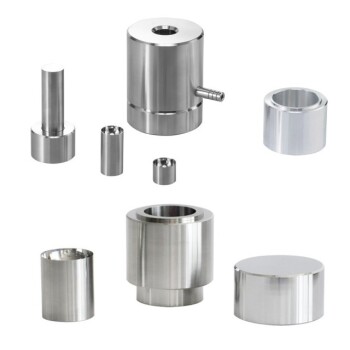
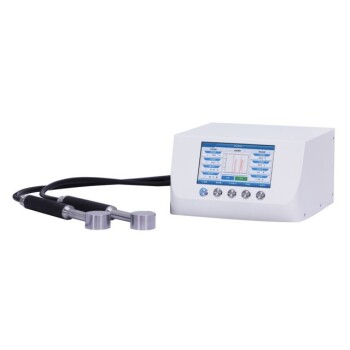
The combination of high-purity graphite consumables and precision molding equipment is critical for isolating the true physical effects of vacancy defects from external contamination. This approach ensures that any observed changes in electronic properties are attributable solely to the intentional structural defects, rather than accidental chemical doping or inconsistent sample density.
To study vacancy defects accurately, you must exclude impurity atoms like Nitrogen, Sulfur, or Oxygen which alter the Fermi level and Local Density of States (LDOS). Pairing high-purity materials with precision equipment allows for the controlled introduction of defects, enabling the verification of interlayer coupling and lattice symmetry without interference.
The Critical Role of Material Purity
Excluding Chemical Contaminants
The primary reason for using high-purity graphite is the rigorous exclusion of impurity atoms. Standard graphite often contains trace amounts of elements such as Nitrogen, Sulfur, or Oxygen.
These impurities are not merely inert fillers; they are active contaminants. If present, they can fundamentally alter the chemical composition of your sample before you even begin to introduce defects.
Preserving the Electronic Baseline
Impurity atoms act as unintentional dopants. They can significantly shift the Fermi level and modify the Local Density of States (LDOS) of the graphite.
If your baseline material is compromised by these shifts, it becomes impossible to determine if an observed electronic change is caused by a vacancy defect or a stray Nitrogen atom. High-purity consumables eliminate this variable, ensuring a neutral electronic starting point.
The Function of Precision Equipment
Controlled Defect Introduction
Synthesizing specific vacancy defects is not a random process; it requires exact mechanical conditions. Precision molding equipment, such as laboratory presses, allows researchers to apply accurate pressure and temperature profiles.
This level of control ensures that defects are introduced systematically. It moves the process from random damage generation to precise structural engineering.
Verifying Intrinsic Physics
Once a clean, controlled sample is created, you can accurately study complex physical phenomena. The primary reference highlights the ability to verify interlayer coupling and lattice symmetry breaking.
Furthermore, you can isolate electronic scattering behavior. Without precision molding, sample inconsistencies would create noise that masks these subtle scattering signals.
Common Pitfalls in Sample Synthesis
The "False Positive" of Doping
A major risk in using lower-grade consumables is misinterpreting data. You might attribute a change in conductivity or magnetic property to a vacancy defect, when it is actually the result of impurity-induced doping.
This leads to scientifically invalid conclusions. You are essentially measuring the dirt in the sample, not the structure of the graphite.
Inconsistent Defect density
Without precision molding equipment, the density and distribution of defects will vary between samples. This lack of reproducibility makes it impossible to establish a reliable correlation between the number of vacancies and the magnitude of the physical effect.
Ensuring Experimental Integrity
To achieve reliable results in graphite defect research, you must align your materials and methods with your specific analytical goals.
- If your primary focus is Electronic Structure: Prioritize high-purity consumables to prevent N, S, or O from altering the Fermi level and LDOS.
- If your primary focus is Structural Mechanics: Rely on precision molding equipment to control the introduction of vacancies and ensure consistent lattice symmetry breaking.
By rigorously controlling both material purity and mechanical processing, you transform graphite synthesis from a variable-heavy art into an exact science.
Summary Table:
| Feature | High-Purity Consumables | Precision Molding Equipment |
|---|---|---|
| Core Function | Eliminates N, S, and O impurity atoms | Controls pressure and temperature profiles |
| Electronic Impact | Maintains stable Fermi level and LDOS | Isolates electronic scattering behavior |
| Structural Goal | Provides a neutral chemical baseline | Enables systematic defect introduction |
| Research Benefit | Prevents "False Positive" doping data | Ensures reproducible lattice symmetry breaking |
Elevate Your Materials Research with KINTEK Precision
Don't let impurities or inconsistent molding compromise your scientific conclusions. KINTEK specializes in comprehensive laboratory pressing solutions designed for the most demanding research environments. Whether you are synthesizing graphite samples or developing next-generation battery technology, our range of manual, automatic, heated, and glovebox-compatible presses—along with our cold and warm isostatic models—provide the exact mechanical control needed to isolate intrinsic physics.
Ready to achieve reproducible results and superior sample purity? Contact our experts today to find the perfect pressing solution for your lab's specific needs!
References
- Mary T. Ajide, Niall J. English. Machine Learning Force Field Predictions of Structural and Dynamical Properties in HOPG Defects and the HOPG-Water Interface with Electronic Structure Analysis. DOI: 10.1021/acsomega.5c02543
This article is also based on technical information from Kintek Solution Knowledge Base .
Related Products
- Lab Ring Press Mold for Sample Preparation
- Lab Polygon Press Mold
- Square Lab Press Mold for Laboratory Use
- Lab Cylindrical Press Mold for Laboratory Use
- Carbide Lab Press Mold for Laboratory Sample Preparation
People Also Ask
- What is the purpose of incorporating cartridge heaters into a lab press mold for MLCC block compression? Optimize Results
- What is the role of a laboratory press in COF electrolyte prep? Achieving High-Performance Pellet Densification
- Why is precise cooling management of the lab press mold necessary? Protect Core Integrity in Thermoforming
- What is the function of a pressing tool in thermoplastic panels? Master Precision Shaping & Fusion Bonding
- What impact does a sample preparation press have on testing results when researching MXene as an electrolyte additive?