
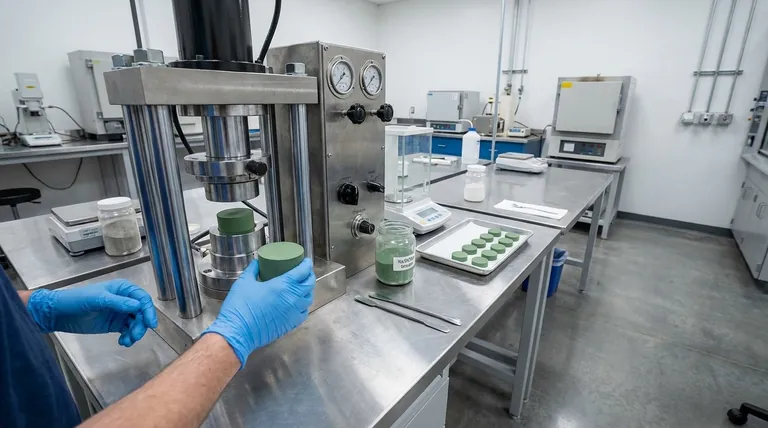
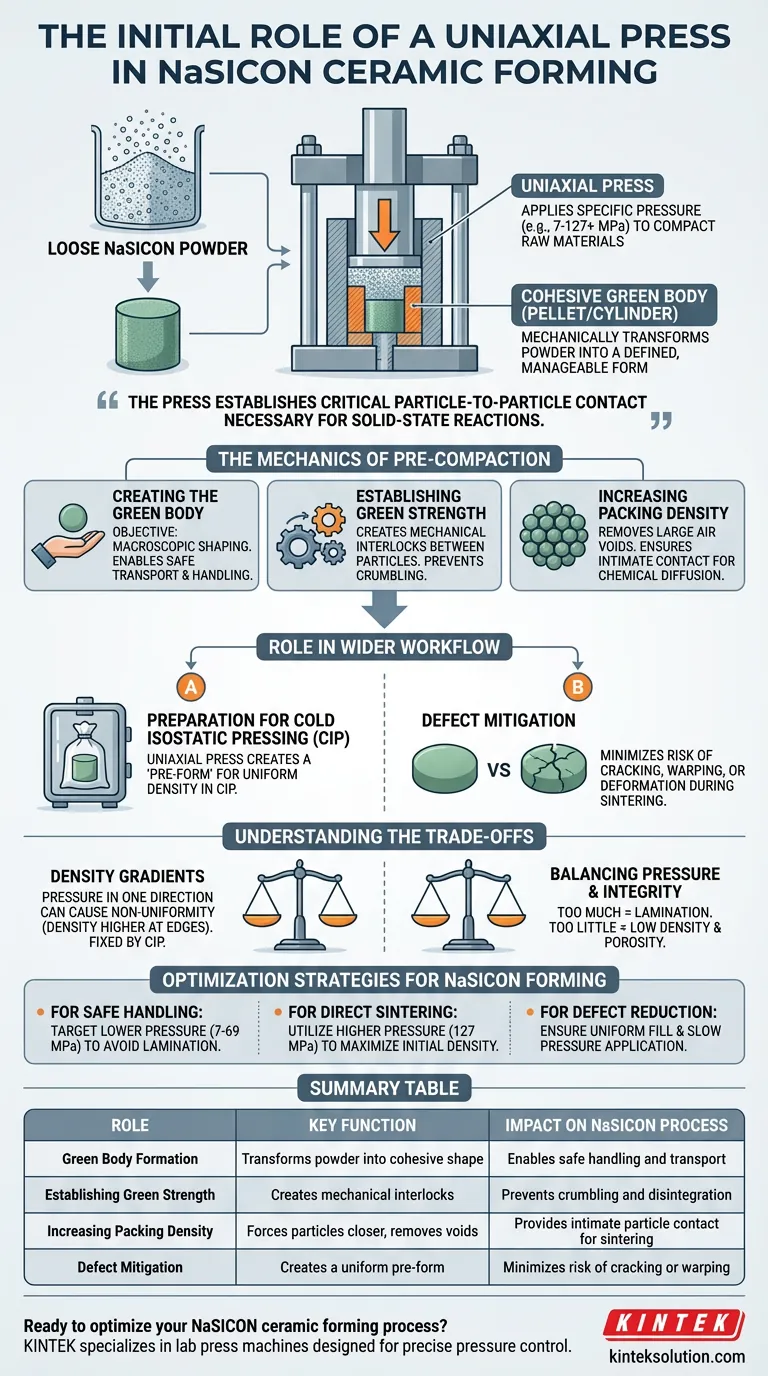
The initial role of a uniaxial press in the NaSICON ceramic workflow is to mechanically transform loose powder into a cohesive, semi-solid form known as a green body. By applying specific pressure—ranging widely from 7 MPa to over 127 MPa depending on the protocol—the press compacts the raw materials into a defined shape, such as a cylinder or pellet, imparting sufficient handling strength to prevent the structure from crumbling during subsequent processing stages.
The uniaxial press does more than shape the material; it establishes the critical particle-to-particle contact necessary for solid-state reactions. It serves as the foundational step that bridges the gap between loose raw ingredients and a high-density, sinter-ready ceramic electrolyte.
The Mechanics of Pre-Compaction
Creating the Green Body
The primary objective during this phase is macroscopic shaping. The press consolidates loose NaSICON powder into a geometric form that can be physically managed.
Without this step, the powder would be impossible to transport to a sintering furnace or a Cold Isostatic Press (CIP) without losing its composition or shape.
Establishing Green Strength
The pressure applied creates mechanical interlocks between powder particles. This results in green strength, which is the structural integrity required for the pellet to survive transfer and handling.
If the pressure is too low, the pellet will remain fragile and prone to disintegration; if optimized, it becomes a stable solid ready for further densification.
Increasing Packing Density
Beyond simple shaping, the uniaxial press significantly increases the packing density of the material. By forcing particles closer together, the process removes large air voids found in the loose powder.
This increased density ensures intimate contact between the reactants. This proximity is a fundamental prerequisite for the chemical diffusion and solid-state reactions that must occur during high-temperature sintering.
The Role in the Wider Workflow
Preparation for Cold Isostatic Pressing (CIP)
In many high-performance NaSICON workflows, uniaxial pressing is merely a preparatory step. It creates a "pre-form" that is subsequently subjected to Cold Isostatic Pressing.
The uniaxial press provides the initial shape, while the CIP stage applies uniform pressure from all directions to maximize density. The uniaxial step ensures the sample is solid enough to be bagged and pressurized in the CIP without deforming unpredictably.
Defect Mitigation
Achieving a green pellet with uniform density and no macroscopic defects is critical for the final quality of the ceramic.
A well-formed green body minimizes the risk of cracking, warping, or deformation during the sintering process. If the initial pressing is flawed, those defects will be magnified, not fixed, by high temperatures.
Understanding the Trade-offs
The Issue of Density Gradients
A major limitation of uniaxial pressing is that pressure is applied in only one direction. This can lead to density gradients within the pellet, where the edges or surfaces are denser than the center due to wall friction.
This lack of uniformity can lead to uneven shrinkage during sintering. This is why uniaxial pressing is often followed by CIP, which equalizes the density distribution.
Balancing Pressure and Integrity
There is a delicate balance regarding the applied pressure (e.g., 7 MPa vs. 127 MPa).
Applying too much pressure can cause lamination or capping, where the top of the pellet separates from the body. Applying too little pressure results in a low-density body that reacts poorly during sintering, leading to a porous, low-performance electrolyte.
Optimization Strategies for NaSICON Forming
To achieve the best results with your NaSICON ceramics, align your pressing parameters with your specific processing goals.
- If your primary focus is Safe Handling: Target a lower pressure range (e.g., 7–69 MPa) to establish just enough green strength to move the sample to a Cold Isostatic Press without inducing lamination.
- If your primary focus is Direct Sintering: Utilize higher pressures (e.g., 127 MPa) to maximize initial packing density and particle contact, reducing porosity before the sample ever hits the furnace.
- If your primary focus is Defect Reduction: Ensure the die is filled uniformly and pressure is applied slowly to minimize air entrapment and density gradients that lead to warping.
By controlling the initial compaction effectively, you set the structural baseline required to achieve a dense, highly conductive NaSICON electrolyte.
Summary Table:
| Role | Key Function | Impact on NaSICON Process |
|---|---|---|
| Green Body Formation | Transforms loose powder into a cohesive shape (pellet/cylinder) | Enables safe handling and transport to next process step (e.g., CIP, sintering furnace) |
| Establishing Green Strength | Creates mechanical interlocks between particles | Prevents crumbling and disintegration during handling |
| Increasing Packing Density | Forces particles closer, removing large air voids | Provides intimate particle contact essential for solid-state reactions during sintering |
| Defect Mitigation | Creates a uniform pre-form | Minimizes risk of cracking, warping, or deformation in the final sintered electrolyte |
Ready to optimize your NaSICON ceramic forming process? The initial compaction step is critical for achieving a high-density, high-performance final product. KINTEK specializes in lab press machines, including automatic and heated lab presses, designed to deliver the precise pressure control and uniformity required for advanced ceramics like NaSICON. Our expertise helps laboratories like yours achieve consistent green bodies with optimal handling strength and density, setting the foundation for successful sintering. Contact us today to discuss how our lab presses can enhance your ceramic workflow and results.
Visual Guide
References
- Amanda Peretti, Leo J. Small. Machinable, high‐conductivity NaSICON through mitigation of humidity effects during solid‐state synthesis. DOI: 10.1111/jace.70195
This article is also based on technical information from Kintek Solution Knowledge Base .
Related Products
- Lab Round Bidirectional Press Mold
- Lab Polygon Press Mold
- Lab Cylindrical Press Mold with Scale
- Split Automatic Heated Hydraulic Press Machine with Heated Plates
- Lab Cylindrical Press Mold for Laboratory Use
People Also Ask
- What is the purpose of incorporating cartridge heaters into a lab press mold for MLCC block compression? Optimize Results
- Why is precise cooling management of the lab press mold necessary? Protect Core Integrity in Thermoforming
- What is the function of a pressing tool in thermoplastic panels? Master Precision Shaping & Fusion Bonding
- Why is a high-performance laboratory molding press critical for in-situ electrolyte formation? Unlock Battery Success
- How do the design and geometric precision of pressing molds and mandrels affect the quality of PTFE composite samples?



















