
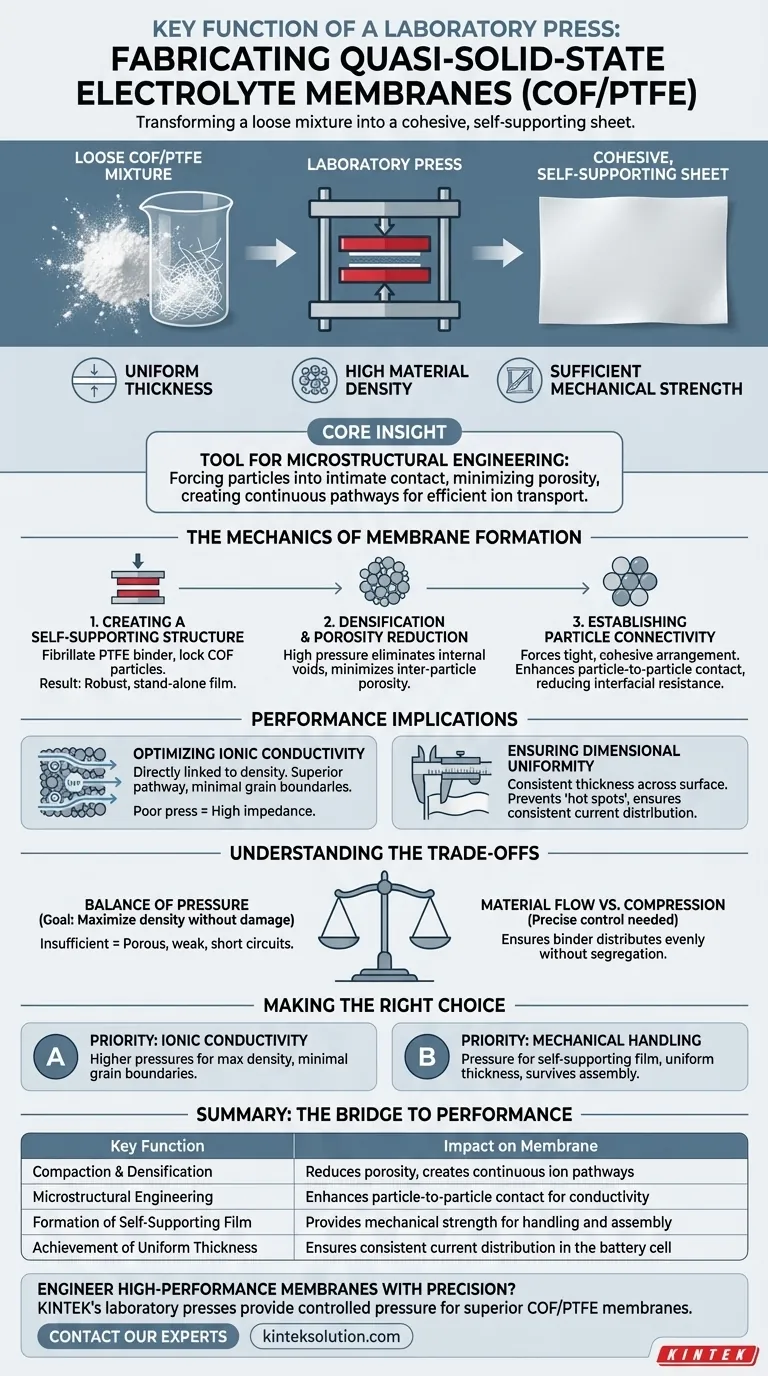
The primary function of a laboratory press in fabricating quasi-solid-state electrolyte membranes is to physically transform a loose, soft mixture of Covalent Organic Framework (COF) powder and Polytetrafluoroethylene (PTFE) binder into a cohesive, self-supporting sheet.
By applying controlled uniaxial pressure, the press compacts the material to achieve three critical physical characteristics: uniform thickness, high material density, and sufficient mechanical strength for practical handling and integration into battery cells.
Core Insight: The value of the laboratory press extends beyond simple shaping; it is a tool for microstructural engineering. By forcing particles into intimate contact, the press minimizes porosity and creates the continuous pathways necessary for efficient ion transport.

The Mechanics of Membrane Formation
Creating a Self-Supporting Structure
Initially, the COF/PTFE mixture acts as a soft material or loose powder blend. The press applies force to fibrillate the PTFE binder and lock the COF particles into a matrix.
This converts a fragile mixture into a robust, stand-alone film that can be handled without crumbling.
Densification and Porosity Reduction
High-pressure compaction is essential for eliminating internal voids. As indicated by general solid electrolyte processing principles, applying significant pressure minimizes inter-particle porosity.
This results in a "dense" membrane where the volume of non-conductive dead space is drastically reduced.
Establishing Particle Connectivity
For ions to move effectively, the active particles must touch. The press forces the COF particles and the binder into a tight, cohesive arrangement.
This enhances particle-to-particle contact, reducing the interfacial resistance that typically impedes performance at grain boundaries.
Performance Implications of Pressing
Optimizing Ionic Conductivity
Ionic conductivity is directly linked to the density achieved during pressing. By creating a dense sheet with minimal grain boundaries, the press establishes a superior pathway for ion conduction.
A poorly pressed, porous membrane will suffer from high impedance, severely limiting the battery's power output.
Ensuring Dimensional Uniformity
The laboratory press ensures the resulting membrane has a consistent thickness across its entire surface. References suggest compaction can significantly reduce membrane thickness (e.g., from 200µm to 100µm).
Uniformity is critical for ensuring consistent current distribution and preventing "hot spots" during battery operation.
Understanding the Trade-offs
The Balance of Pressure
While high density is desirable, the application of pressure must be calibrated. The goal is to maximize density without damaging the structural integrity of the components.
Insufficient pressure results in a porous, mechanically weak separator that may lead to short circuits or poor conductivity.
Material Flow vs. Compression
In systems using binders like PTFE or polymers like PEO, the press facilitates material flow to fill interstitial spaces.
However, precise control is required to ensure the binder distributes evenly without segregating from the active COF powder, which would create non-conductive regions.
Making the Right Choice for Your Goal
When configuring your laboratory press for COF/PTFE membranes, align your parameters with your specific performance targets:
- If your primary focus is Ionic Conductivity: Prioritize higher pressures to maximize density and minimize high-impedance grain boundaries between particles.
- If your primary focus is Mechanical Handling: Focus on achieving a pressure that yields a self-supporting film with uniform thickness, ensuring it survives the assembly process without tearing.
Ultimatley, the laboratory press acts as the bridge between raw chemical potential and a functional, high-performance battery component.
Summary Table:
| Key Function | Impact on Membrane |
|---|---|
| Compaction & Densification | Reduces porosity, creates continuous ion pathways |
| Microstructural Engineering | Enhances particle-to-particle contact for conductivity |
| Formation of Self-Supporting Film | Provides mechanical strength for handling and assembly |
| Achievement of Uniform Thickness | Ensures consistent current distribution in the battery cell |
Ready to engineer high-performance battery membranes with precision?
KINTEK's laboratory presses, including our automatic and heated models, provide the controlled pressure essential for transforming your COF/PTFE powder mixtures into dense, uniform electrolyte membranes. Achieve superior ionic conductivity and mechanical integrity for your battery research.
Contact our experts today to discuss how our lab press solutions can optimize your quasi-solid-state electrolyte fabrication process.
Visual Guide
Related Products
- Automatic Laboratory Hydraulic Press for XRF and KBR Pellet Pressing
- Square Lab Press Mold for Laboratory Use
- Assemble Square Lab Press Mold for Laboratory Use
- Lab Round Bidirectional Press Mold
- Lab Cylindrical Press Mold for Laboratory Use
People Also Ask
- Why is pressing powder into a pellet critical before sintering? Ensure Dense, Conductive Solid-State Electrolytes
- What is the role of a laboratory pressure machine and KBr in FTIR? Master Sample Preparation for Flame Retardants
- What are the advantages of using a laboratory automatic hydraulic press for HEA green compact forming?
- What are the advantages of using a lab automatic hydraulic press for HEA green body molding? Ensure Material Integrity
- How does an automatic laboratory hydraulic press improve KBr pellet preparation? Achieve Precision IR Spectroscopy



















