
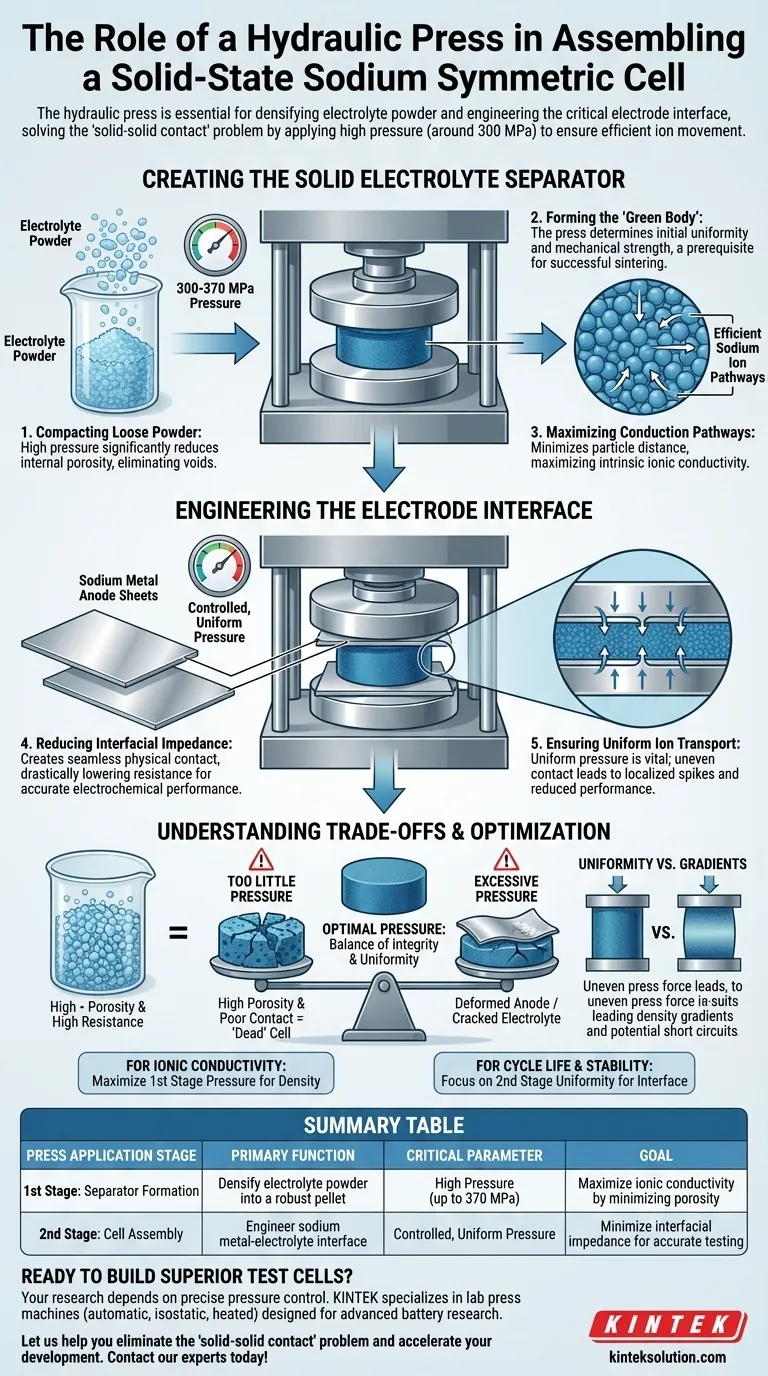
The primary role of a laboratory hydraulic press in assembling a solid-state sodium symmetric cell is two-fold: densifying the electrolyte powder into a robust separator and engineering the critical interface between the anode and that separator. Specifically, it applies high pressure (often around 300 MPa) to transform loose powder into a dense pellet, and subsequently presses sodium metal sheets against this pellet to ensure the low resistance required for accurate testing.
The press effectively solves the fundamental "solid-solid contact" problem; without sufficient mechanical pressure to eliminate voids and force intimate contact, ions cannot move efficiently between the sodium anode and the solid electrolyte.
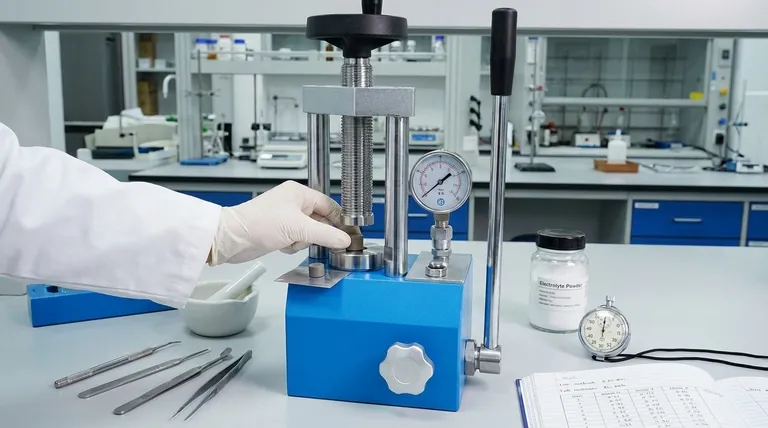
Creating the Solid Electrolyte Separator
To function correctly, a solid-state battery requires a separator that is mechanically sound and ionically conductive. The hydraulic press is the primary tool used to manufacture this component from raw materials.
Compacting Loose Powder
The first step involves subjecting synthesized electrolyte powder to immense pressure within a die.
This process compresses the particles, significantly reducing internal porosity and reducing the voids that impede ion flow.
References indicate pressures as high as 300 to 370 MPa are often required to achieve the necessary density for sodium-based systems.
Forming the "Green Body"
In ceramic processing, this compacted pellet is known as a "green body."
The press determines the initial uniformity and mechanical strength of this pellet.
A high-quality green body is a non-negotiable prerequisite; if the pellet is not dense and defect-free at this stage, subsequent sintering processes will likely result in cracks or poor performance.
Maximizing Conduction Pathways
Densification is not just about structural integrity; it is about performance.
By minimizing the distance between particles and increasing their contact area, the press creates efficient pathways for sodium ions to travel.
This direct physical compaction is the primary method for maximizing the intrinsic ionic conductivity of the material.
Engineering the Electrode Interface
Once the separator is formed, the hydraulic press serves a second, equally critical function: cell assembly. Unlike liquid electrolytes that naturally wet surfaces, solid electrolytes struggle to bond with solid electrodes.
Reducing Interfacial Impedance
The press is used to tightly press sodium metal anode sheets against the prepared electrolyte separator.
This creates an intimate, seamless physical contact that drastically lowers interfacial impedance.
Low impedance is fundamental for the battery to function; without it, the resistance at the interface would be too high to measure accurate electrochemical performance.
Ensuring Uniform Ion Transport
Uniform pressure distribution during this step is vital.
If the contact is uneven, sodium ions will flux unevenly, leading to localized current spikes or reduced critical current density (CCD).
A high-quality assembly ensures stable, long-term cycling by maintaining consistent ion transport across the entire active area of the cell.
Understanding the Trade-offs
While pressure is essential, it must be applied with precision. Misapplication of force is a common source of experimental failure.
The Balance of Pressure vs. Integrity
Applying too little pressure results in high porosity and poor contact, rendering the cell effectively "dead" due to high resistance.
Conversely, excessive pressure during the second stage can deform the soft sodium metal anode or crack the brittle ceramic electrolyte pellet.
Uniformity vs. Gradients
The press must deliver pressure uniformly across the entire surface of the pellet.
If the press applies force unevenly, it creates density gradients within the electrolyte.
These gradients can cause warping during sintering or create preferred paths for dendrites to grow, leading to short circuits during testing.
Making the Right Choice for Your Goal
The way you utilize the hydraulic press dictates the validity of your data.
- If your primary focus is Ionic Conductivity: Prioritize the first pressing stage (highest possible pressure without cracking) to maximize pellet density and minimize internal porosity.
- If your primary focus is Cycle Life and Stability: Focus on the second pressing stage to ensure the sodium-electrolyte interface is uniform and tight, preventing delamination during cycling.
The hydraulic press is not merely a manufacturing tool; it is the instrument that defines the structural and electrochemical quality of your test cell.
Summary Table:
| Press Application Stage | Primary Function | Critical Parameter | Goal |
|---|---|---|---|
| 1st Stage: Separator Formation | Densify electrolyte powder into a robust pellet | High Pressure (up to 370 MPa) | Maximize ionic conductivity by minimizing porosity |
| 2nd Stage: Cell Assembly | Engineer sodium metal-electrolyte interface | Controlled, Uniform Pressure | Minimize interfacial impedance for accurate testing |
Ready to Build Superior Solid-State Battery Test Cells?
Your research on solid-state sodium batteries depends on the quality of your cell assembly. The precise pressure control of a KINTEK laboratory hydraulic press is the key to achieving the dense electrolytes and low-impedance interfaces required for reliable, publishable data.
KINTEK specializes in lab press machines – including automatic, isostatic, and heated lab presses – designed to meet the exacting demands of advanced battery research.
Let us help you eliminate the 'solid-solid contact' problem and accelerate your development.
Contact our experts today to find the perfect press for your lab!
Visual Guide
Related Products
- Laboratory Hydraulic Press Lab Pellet Press Button Battery Press
- Laboratory Hydraulic Press 2T Lab Pellet Press for KBR FTIR
- Laboratory Hydraulic Press Lab Pellet Press Machine for Glove Box
- 24T 30T 60T Heated Hydraulic Lab Press Machine with Hot Plates for Laboratory
- Automatic Laboratory Hydraulic Press Lab Pellet Press Machine
People Also Ask
- How is a laboratory hydraulic press used for HAP composite gels? Master Mineral Substrate Standardization
- What role does a laboratory hydraulic press play in reaction pellets? Optimizing Lunar Soil and Metal Fuel Density
- What role does a laboratory hydraulic press play in the preparation of piezoelectric ceramic discs for DC-PG? | KINTEK
- Why is a laboratory hydraulic press required for PBAT and PLA sample preparation? Achieve Flawless Characterization
- What role does a laboratory hydraulic press play in the assembly of all-solid-state battery test cells? Expert Guide



















