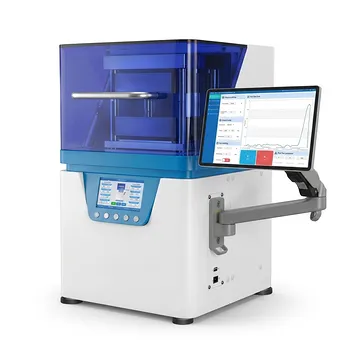
The operating principle of a lab hydraulic press is based on the use of a confined fluid to transfer and multiply force. The device employs a liquid—typically water, oil, or a synthetic fluid—to move a piston, converting hydraulic pressure into mechanical energy. This process allows the machine to exert compressive forces often reaching hundreds of tons to reshape, assemble, or crush materials.
Core Takeaway The system functions according to Pascal’s Law, which dictates that pressure changes in a closed fluid system are transmitted undiminished. Practically, this allows a small force applied to a smaller area to generate a massively amplified output force on a larger piston, providing significant mechanical advantage.
The Physics Behind the Power
Pascal’s Law Explained
The fundamental mechanism driving a hydraulic press is Pascal’s Law.
This principle states that when pressure is applied to a fluid confined in a closed system, that pressure is transmitted equally in all directions. The fluid does not compress; instead, it displaces force uniformly.
Force Multiplication
This physical property allows for distinct force multiplication.
In a hydraulic press, a small amount of force is applied to a small piston (often via a hand lever or pump). Because the pressure remains constant, when this fluid pushes against a much larger piston (the ram), the resulting output force is significantly higher.
The Hydraulic System Components
The Role of the Fluid
The fluid serves as the vehicle for force transmission.
According to standard laboratory configurations, this medium is usually oil, water, or a synthetic fluid. The choice of fluid depends on the specific viscosity requirements and the operating environment of the press.
The Piston and Ram
The fluid drives the movement of the piston.
As the fluid pressure increases, it forces the piston to extend. This component acts as a solid "ram," delivering the accumulated energy directly into the workpiece.
Applications and Capability
Material Alteration
The primary purpose of this force is to permanently alter a material's state.
Users employ these presses to compress, assemble, bend, or crush samples. This is essential for tasks ranging from sample preparation (such as creating KBr pellets for spectroscopy) to destructive testing of materials.
Tonnage and Output
Lab presses are designed to generate immense power in a compact footprint.
Despite their relatively small size compared to industrial machinery, these units can exert forces in the range of hundreds of tons. This high-pressure output is critical for condensing materials that resist deformation.
Understanding the Trade-offs
System Integrity Dependencies
The efficiency of the press relies entirely on a closed system.
Any leak in the hydraulic lines or seals immediately compromises Pascal’s principle. A loss of fluid pressure results in an immediate and drastic loss of output force, making seal maintenance critical.
Operation Method
The source of the initial pressure varies by design.
Manual presses utilize hand-operated levers, offering tactile feedback and lower cost but requiring physical effort. Electric motor-driven presses offer consistent, automated pressure application but add complexity and cost to the equipment.
Making the Right Choice for Your Goal
When selecting or operating a hydraulic press, align the mechanism with your specific laboratory requirements:
- If your primary focus is high-volume repeatability: Prioritize an electric motor-driven press to ensure consistent pressure application without operator fatigue.
- If your primary focus is cost-efficiency and tactile control: A manual lever-operated press is ideal for low-volume tasks where "feeling" the material compression is beneficial.
- If your primary focus is extreme force generation: Ensure the press is rated for the specific tonnage required, as the fluid type and piston size dictate the maximum limit.
By leveraging the mechanical advantage of fluid dynamics, the lab hydraulic press transforms minimal input into the massive force required for material science and engineering.
Summary Table:
| Feature | Description |
|---|---|
| Core Principle | Pascal's Law (uniform pressure transmission in a closed fluid system) |
| Force Transmission | Uses non-compressible fluids like oil, water, or synthetic liquids |
| Mechanical Advantage | Multiplies small input force into high tonnage via piston size ratios |
| Primary Function | Compressing, bending, crushing, or assembling materials |
| Operation Types | Manual (hand lever) or Automatic (electric motor-driven) |
| Common Applications | KBr pellet preparation, battery research, and destructive testing |
Elevate Your Research with KINTEK Precision
Ready to harness the power of advanced hydraulic technology? KINTEK specializes in comprehensive laboratory pressing solutions tailored to your specific research needs. Whether you require manual, automatic, heated, multifunctional, or glovebox-compatible models, our equipment delivers the precision and reliability your lab demands. We also offer specialized cold and warm isostatic presses widely applied in cutting-edge battery research.
Don't settle for inconsistent results. Let our experts help you select the perfect system to amplify your lab's efficiency and output. Contact us today to find your ideal pressing solution!
Related Products
- 24T 30T 60T Heated Hydraulic Lab Press Machine with Hot Plates for Laboratory
- Automatic Heated Hydraulic Lab Press with Programmable Touch Screen Controls and Precision Temperature Regulation
- Automatic Heated Hydraulic Lab Press 120x120mm Plate Fully Automated Material Research Press
- Automatic Heated Hydraulic Lab Press Machine 200x200 Plate Size for Battery Research and Materials Science
- Laboratory Hydraulic Press Lab Pellet Press Machine for Glove Box
People Also Ask
- Function of a Laboratory Hydraulic Press with Heated Platens in SSE? Enhance Battery Density & Conductivity
- Why is a laboratory hydraulic press with heating plates required for PLA/TEC films? Achieve Precise Sample Integrity
- What role does a laboratory heated hydraulic press play in LTCC? Essential for High-Density Ceramic Lamination
- What is the primary function of a laboratory heated hydraulic press? Mastering Thermoplastic Carbon Fiber Composites
- What is the critical role of a laboratory heated hydraulic press? Mastering PVC Sample Prep for Testing