
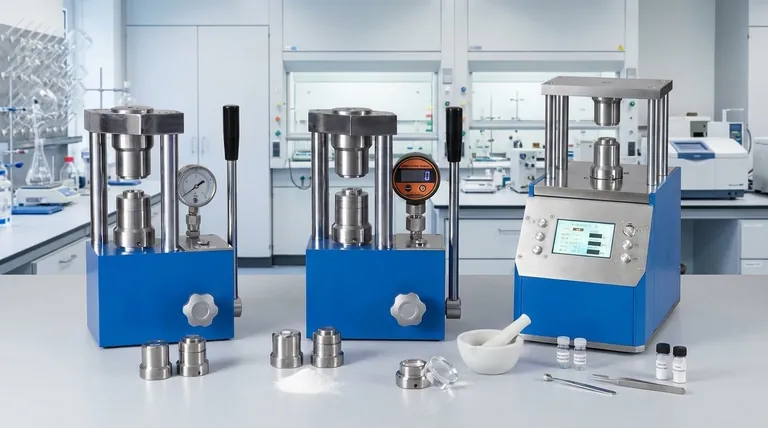
The primary function of a KBr Pellet Press is to compress solid chemical samples mixed with potassium bromide (KBr) into thin, transparent discs suitable for Fourier Transform Infrared (FTIR) analysis. This mechanical compression is a prerequisite for spectroscopy, as it transforms loose powder into a solid medium that infrared light can pass through without scattering. Without this preparation, accurate molecular analysis of solid materials would be impossible.
The KBr Pellet Press serves as the bridge between raw solid samples and accurate spectral data by creating an optically transparent medium that eliminates matrix interference.
The Role of Sample Preparation in FTIR
To understand the press, you must understand the challenge of analyzing solids. Infrared spectroscopy relies on passing light through a material to measure how it interacts with molecular bonds.
Overcoming Light Scattering
Loose powders scatter infrared light, creating noise that obscures valuable data. You cannot simply place a raw solid powder into an FTIR spectrometer and expect clear results.
The "Transparent Window" Principle
Potassium bromide (KBr) is used because it is transparent to infrared radiation. When a sample is mixed with KBr and compressed, the KBr becomes a clear matrix.
This allows the spectrometer to read the sample's molecular signature without interference from the medium holding it.
Key Operational Advantages
The KBr Pellet Press is not just a crushing tool; it is a precision instrument designed for consistency in industries like pharmaceuticals, biology, and nutrition.
High-Fidelity Spectral Analysis
The primary advantage of using a press is transparency. By creating a clear pellet, the instrument ensures that the infrared light interacts purely with the sample.
This leads to sharp, interpretable peaks in the resulting data, which are essential for identifying chemical compounds.
Versatility Across Sample Types
These presses are adaptable tools. They allow laboratories to process a wide variety of solid materials.
Whether analyzing a new pharmaceutical compound or a nutritional supplement, the mechanism remains the same, making the press a central tool in analytical chemistry.
Understanding the Operational Factors
While the concept is simple, the execution requires precision. There are specific operational factors that determine the success of the pellet preparation.
The Importance of Pressure Monitoring
Applying force blindly leads to poor results. If the pressure is too low, the pellet will remain opaque; if it is too high, the pellet may fracture.
References highlight that an integrated pressure gauge is a critical feature. It provides real-time feedback, allowing the user to maintain optimal pressure levels.
Reproducibility Challenges
In quality control, result A must be comparable to result B. The press facilitates reproducibility by allowing technicians to apply the exact same mechanical conditions to every sample.
Without this mechanical consistency, variances in the pellet thickness or density could define the analytical results, rather than the actual sample composition.
Making the Right Choice for Your Goal
The KBr Pellet Press is a foundational tool, but its value depends on your specific analytical objectives.
- If your primary focus is Pharmaceutical Quality Control: Rely on the pressure gauge features to ensure high reproducibility, guaranteeing that batch-to-batch comparisons are valid.
- If your primary focus is General Chemical Research: Leverage the press's versatility to analyze diverse solid sample types without needing different preparation equipment.
Proper sample preparation is the invisible step that guarantees the visibility of your data.
Summary Table:
| Function | Key Benefit | Critical for |
|---|---|---|
| Compress samples with KBr | Creates optically transparent pellets | Eliminating light scattering in FTIR |
| Ensure uniform pressure | Guarantees high-fidelity, reproducible results | Quality control and batch comparison |
| Handle diverse solid materials | Versatile sample preparation for various industries | Pharmaceutical, chemical, and biological research |
Achieve precise and reproducible FTIR results with a KINTEK lab press.
Our automatic and manual KBr Pellet Presses are engineered with precision pressure monitoring to ensure every pellet is perfectly transparent, providing the clarity and consistency your spectroscopy demands. Whether you're in pharmaceutical quality control or general chemical research, KINTEK's robust equipment is designed to handle your specific laboratory needs.
Ready to enhance your sample preparation? Contact our experts today to find the perfect press for your lab!
Visual Guide

Related Products
- Laboratory Hydraulic Press 2T Lab Pellet Press for KBR FTIR
- XRF KBR Plastic Ring Lab Powder Pellet Pressing Mold for FTIR
- XRF KBR Steel Ring Lab Powder Pellet Pressing Mold for FTIR
- Laboratory Hydraulic Pellet Press for XRF KBR FTIR Lab Press
- Automatic Laboratory Hydraulic Press for XRF and KBR Pellet Pressing
People Also Ask
- What is the role of a laboratory pressure machine and KBr in FTIR? Master Sample Preparation for Flame Retardants
- What is the role of a laboratory hydraulic press in high-loading NCM811 cathode prep for solid-state batteries?
- What role does a laboratory hydraulic press play in reaction pellets? Optimizing Lunar Soil and Metal Fuel Density
- Why is a laboratory hydraulic press necessary for sample preparation? Precise Pelleting for Spiro Heterocyclic Analysis
- What is the role of a laboratory hydraulic press in the preparation of Covalent Organic Framework (COF) precursors?



















