
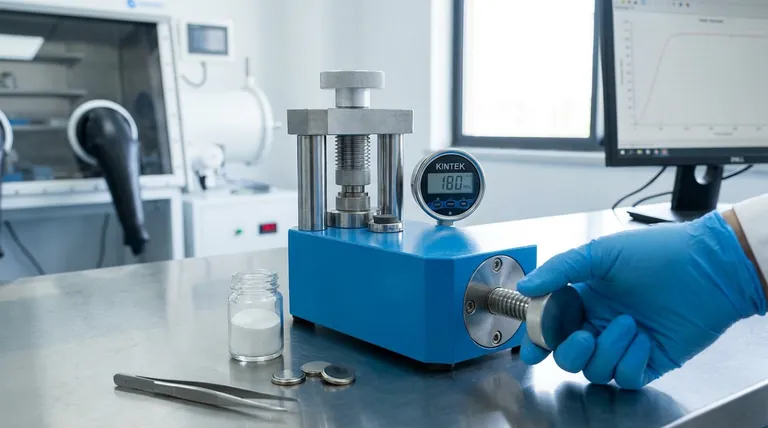
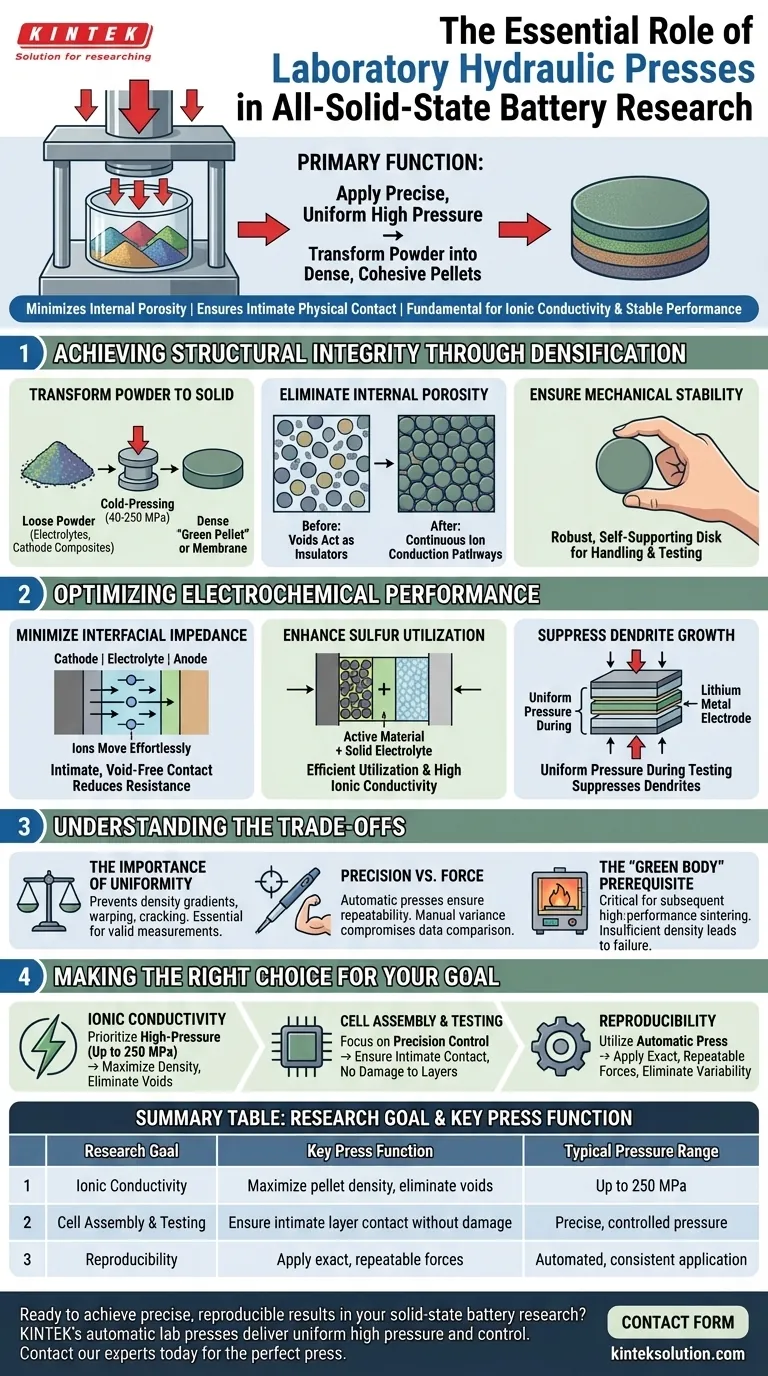
The primary function of a laboratory hydraulic press in the context of all-solid-state battery research is to apply precise, uniform high pressure to powdered materials, transforming them into dense, cohesive pellets. This mechanical compaction minimizes internal porosity and ensures intimate physical contact between particles, which is the fundamental prerequisite for ionic conductivity and stable electrochemical performance.
The hydraulic press is more than a shaping tool; it is an interface engineering device. By eliminating voids and maximizing the density of electrolyte and electrode layers, it lowers interfacial impedance and creates the mechanical stability required for reproducible scientific data.
Achieving Structural Integrity Through Densification
Transforming Powder to Solid
The initial role of the press is the cold-pressing of powdered materials—such as solid-state electrolytes (like LGPS or LATP) and cathode composites—into a unified structure. By applying pressures typically ranging from 40 to 250 MPa, the loose powder is compacted into a dense "green pellet" or a finished membrane.
Eliminating Internal Porosity
High-pressure compaction is critical for reducing the void space between individual powder particles. In a solid-state system, air voids act as insulators that block ion movement. The press forces particles together, creating a continuous path for ion conduction pathways.
Ensuring Mechanical Stability
The fabrication process must result in a pellet with sufficient mechanical strength to withstand handling and testing. Whether intended for immediate use or as a precursor for high-temperature sintering, the press creates a robust, self-supporting disk from loose starting materials.
Optimizing Electrochemical Performance
Minimizing Interfacial Impedance
For a solid-state battery to function, ions must move effortlessly between the cathode, electrolyte, and anode. The hydraulic press ensures intimate, void-free physical contact between these distinct layers. This tight contact drastically reduces interfacial resistance, which is often the bottleneck in solid-state battery performance.
Enhancing Sulfur Utilization
In composite cathodes, particularly those containing sulfur active materials, the press forces the active material and the solid electrolyte into close proximity. This solid-solid contact ensures efficient utilization of the active material and high ionic conductivity throughout the electrode structure.
Suppressing Dendrite Growth
Beyond fabrication, the press plays a role in applying external stack pressure during testing. Maintaining uniform pressure helps ensure contact with lithium metal electrodes, which aids in the systematic investigation and suppression of lithium dendrite growth during cycling.
Understanding the Trade-offs
The Importance of Uniformity
While pressure is necessary, it must be applied uniformly across the entire surface of the pellet. Uneven pressure distribution can lead to density gradients, warping, or cracking, which compromises the validity of electrochemical measurements.
Precision vs. Force
Ideally, researchers utilize automatic presses to ensure repeatability. Manual variance in pressure application can lead to inconsistent pellet densities, making it difficult to compare results between different experimental batches.
The "Green Body" Prerequisite
For ceramic electrolytes requiring sintering, the press creates the "green pellet." If the initial pressing density is insufficient, the subsequent sintering process will fail to produce a high-performance ceramic sheet, rendering the material useless for conductivity testing.
Making the Right Choice for Your Goal
To maximize the utility of your laboratory hydraulic press, align your operation with your specific research objectives:
- If your primary focus is Ionic Conductivity: Prioritize high-pressure capabilities (up to 250 MPa) to maximize pellet density and eliminate internal voids that impede ion flow.
- If your primary focus is Cell Assembly & Testing: Focus on precision control to ensure intimate contact between the electrolyte and lithium metal without damaging fragile layers.
- If your primary focus is Reproducibility: Utilize an automatic press to apply exact, repeatable compressive forces, eliminating operator variability from your dataset.
Success in all-solid-state battery research relies not just on the chemistry of your materials, but on the mechanical precision used to integrate them.
Summary Table:
| Research Goal | Key Press Function | Typical Pressure Range |
|---|---|---|
| Ionic Conductivity | Maximize pellet density, eliminate voids | Up to 250 MPa |
| Cell Assembly & Testing | Ensure intimate layer contact without damage | Precise, controlled pressure |
| Reproducibility | Apply exact, repeatable forces | Automated, consistent application |
Ready to achieve precise, reproducible results in your solid-state battery research? KINTEK's automatic lab presses deliver the uniform high pressure and control you need to fabricate dense, high-performance pellets. Our equipment is designed to meet the specific demands of laboratory research, ensuring the mechanical integrity and intimate contact required for valid electrochemical data. Contact our experts today to find the perfect press for your application and accelerate your development cycle.
Visual Guide
Related Products
- Laboratory Hydraulic Press Lab Pellet Press Machine for Glove Box
- Laboratory Hydraulic Press 2T Lab Pellet Press for KBR FTIR
- 24T 30T 60T Heated Hydraulic Lab Press Machine with Hot Plates for Laboratory
- Laboratory Hydraulic Press Lab Pellet Press Button Battery Press
- Laboratory Hydraulic Pellet Press for XRF KBR FTIR Lab Press
People Also Ask
- How does a laboratory hydraulic press contribute to the preparation of Li3-3xScxSb samples? Optimize Ionic Conductivity
- What is the function of a laboratory hydraulic press in FT-IR of curcumin-coated MWCNTs? Achieve Optical Clarity.
- Why is a laboratory hydraulic press required for compression molding boron-siloxane? Solve High-Loading Density Challenges
- What role does a laboratory hydraulic press play in reaction pellets? Optimizing Lunar Soil and Metal Fuel Density
- What role does a laboratory hydraulic press play in the preparation of piezoelectric ceramic discs for DC-PG? | KINTEK



















