
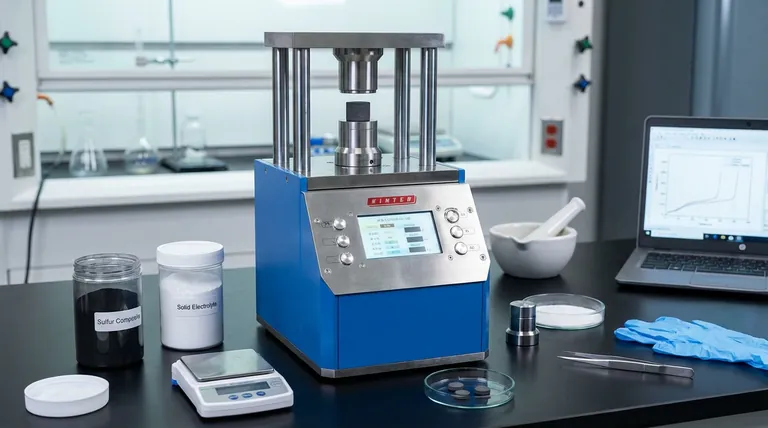
The primary function of a laboratory hydraulic press in this context is to apply high, controllable pressure to compact powdered materials into dense pellets and ensure intimate physical contact between battery layers. By forcing solid particles together, the press overcomes the lack of liquid "wetting," effectively minimizing porosity and interfacial impedance to create a functional electrochemical cell.
The Core Challenge: In traditional batteries, liquid electrolytes naturally wet the electrodes to facilitate ion movement. In all-solid-state batteries (ASSBs), this contact must be mechanically forced. The hydraulic press acts as the external driver to create the "solid-solid" continuity required for ions to flow.
Transforming Powders into Functional Components
Densification of Electrolytes and Cathodes
The fabrication process begins with loose powders, such as sulfur active materials or ceramic electrolytes like La0.95Ba0.05F2.95 (LBF). The hydraulic press is used to subject these powders to pressures typically ranging from 40 to 250 MPa.
Minimizing Porosity
This high-pressure compaction significantly reduces internal porosity within the material. By eliminating air voids, you maximize the contact area between particles. This creates continuous pathways for ion conduction, which is a prerequisite for high conductivity.
Forming the 'Green Body'
For ceramic electrolytes, the press is used to cold-press powder into a "green body" prior to sintering. The magnitude and duration of this pressure determine the initial density and uniformity of the pellet. A defect-free green body is essential for obtaining a dense ceramic pellet after high-temperature processing.
Mastering the Solid-Solid Interface
Establishing Intimate Contact
Beyond creating individual pellets, the press is critical during the assembly of the cell stack. It applies precise pressure (e.g., 60 MPa) to the combined electrode and electrolyte layers. This ensures the interface is void-free and seamless.
Reducing Interfacial Impedance
High resistance at the interface between layers is a major bottleneck in ASSB performance. By mechanically forcing the layers together, the press lowers this interfacial impedance. This allows for efficient lithium-ion transport between the cathode, solid electrolyte, and anode.
Suppressing Lithium Dendrite Growth
The application of uniform external stack pressure is also used to stabilize lithium metal anodes. Maintaining this pressure helps suppress the growth of lithium dendrites. This mechanical suppression is vital for preventing short circuits and ensuring the structural integrity of the cell during cycling.
Understanding the Trade-offs
The Necessity of Uniformity
While high pressure is required, it must be applied via a mechanism (often utilizing Pascal's law) that ensures total uniformity. Uneven pressure distribution can lead to warping, localized stress points, or heterogeneous ion flux.
Delamination Risks during Multilayering
When fabricating bilayer structures (such as a composite cathode on an electrolyte), the process often involves a pre-compaction step. This creates a flat substrate for the second layer. Failing to achieve this flat interface can cause intermixing or delamination during subsequent sintering, rendering the cell useless.
Making the Right Choice for Your Goal
Ideally, your use of the hydraulic press should adapt to the specific stage of fabrication you are in.
- If your primary focus is Material Synthesis: Prioritize the magnitude of pressure (40-250 MPa) to maximize the density of your green body and reduce internal porosity before sintering.
- If your primary focus is Cell Assembly & Testing: Focus on the precision and uniformity of the applied stack pressure (e.g., 60 MPa) to minimize interfacial impedance without crushing brittle components.
Success in all-solid-state battery fabrication is ultimately defined by your ability to use mechanical pressure to bridge the microscopic gaps between solid particles.
Summary Table:
| Function | Key Pressure Range | Primary Benefit |
|---|---|---|
| Densify Powders (Electrolytes/Cathodes) | 40 - 250 MPa | Maximizes particle contact, reduces porosity for ion conduction |
| Assemble Cell Stack | ~60 MPa | Creates void-free interfaces, lowers interfacial impedance |
| Form 'Green Body' for Sintering | Varies by material | Ensures uniform, defect-free pre-sintered pellet |
| Suppress Lithium Dendrite Growth | Application-specific | Stabilizes lithium metal anode, prevents short circuits |
Ready to Fabricate Superior All-Solid-State Batteries?
Achieving the precise, uniform pressure required for dense pellets and seamless interfaces is critical for your ASSB research and development. KINTEK specializes in laboratory hydraulic presses (including automatic, isostatic, and heated models) designed specifically for the demanding needs of battery fabrication.
Our presses provide the high, controllable force you need to:
- Eliminate Porosity: Create dense, functional components from powdered materials.
- Master Interfaces: Ensure intimate contact between layers to minimize impedance.
- Accelerate R&D: Achieve reliable, repeatable results in material synthesis and cell assembly.
Let KINTEK's expertise in lab press machines empower your battery innovation. Contact our team today to discuss your specific application requirements and find the perfect press for your laboratory.
Visual Guide

Related Products
- Laboratory Hydraulic Press Lab Pellet Press Machine for Glove Box
- Laboratory Hydraulic Press 2T Lab Pellet Press for KBR FTIR
- 24T 30T 60T Heated Hydraulic Lab Press Machine with Hot Plates for Laboratory
- Laboratory Hydraulic Press Lab Pellet Press Button Battery Press
- Laboratory Hydraulic Pellet Press for XRF KBR FTIR Lab Press
People Also Ask
- How does a laboratory hydraulic press contribute to the preparation of Li3-3xScxSb samples? Optimize Ionic Conductivity
- What is the function of a laboratory hydraulic press in FT-IR of curcumin-coated MWCNTs? Achieve Optical Clarity.
- Why is a laboratory hydraulic press required for compression molding boron-siloxane? Solve High-Loading Density Challenges
- What role does a laboratory hydraulic press play in reaction pellets? Optimizing Lunar Soil and Metal Fuel Density
- What role does a laboratory hydraulic press play in the preparation of piezoelectric ceramic discs for DC-PG? | KINTEK



















