
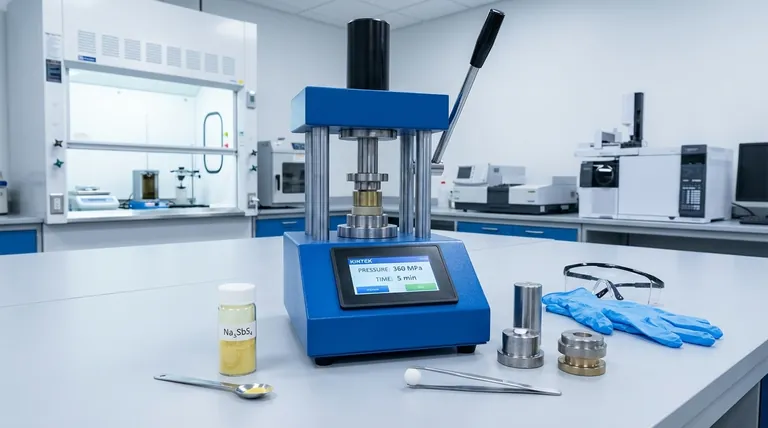
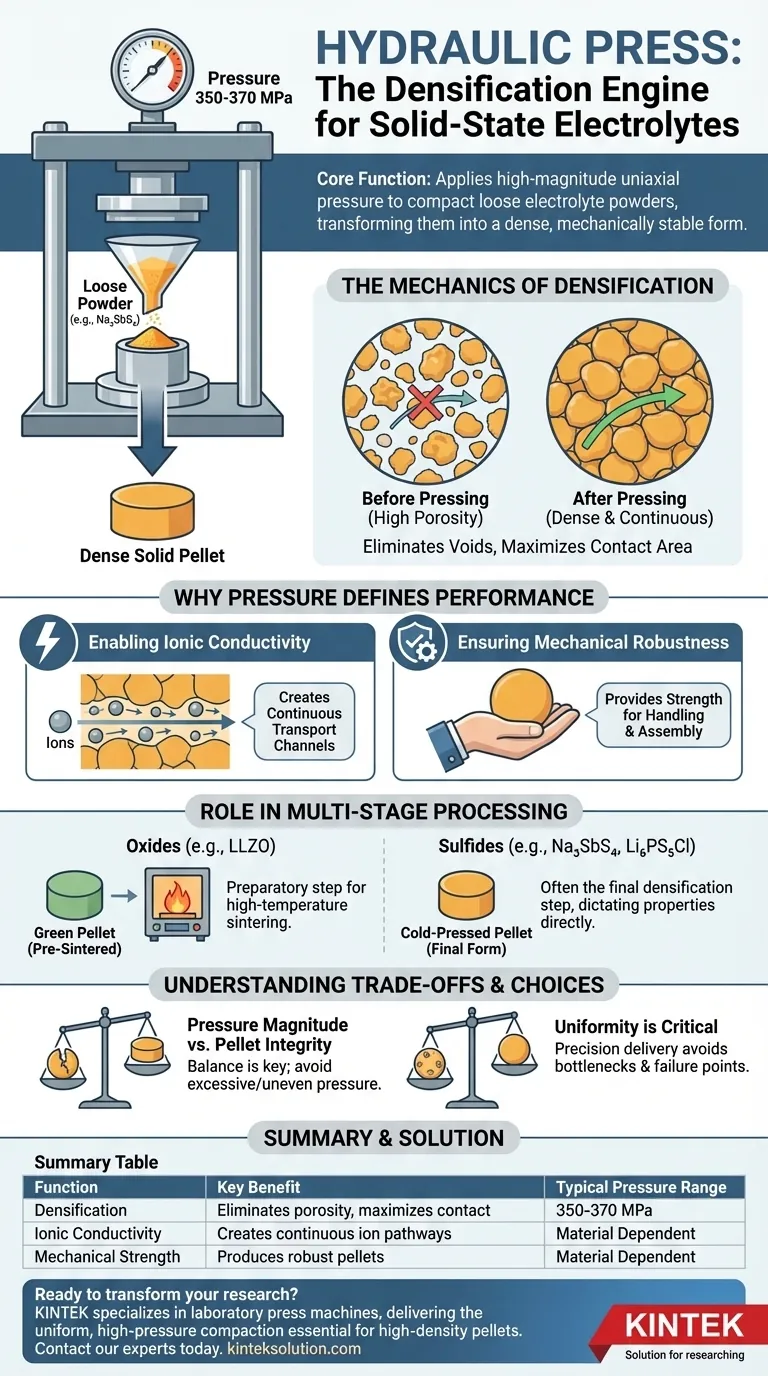
The primary function of a laboratory hydraulic press in this context is to apply precise, high-magnitude uniaxial pressure—often reaching 350 to 370 MPa—to compact loose electrolyte powders into dense, solid pellets. This cold-pressing process is the critical step that transforms raw chemical powders, such as Na₃SbS₄, from a loose aggregate into a mechanically stable form with a defined geometry and thickness.
Core Takeaway: The press is not merely a shaping tool; it is a densification engine. Its purpose is to eliminate microscopic voids and maximize particle-to-particle contact, creating the continuous pathways necessary for efficient ion transport and structural integrity.
The Mechanics of Densification
Eliminating Porosity
The immediate physical goal of the hydraulic press is the reduction of internal voids. Loose powders contain significant empty space (air) between particles, which acts as a barrier to performance.
By applying high pressure, the press forces particles to rearrange and deform. This minimizes porosity, resulting in a dense, solid pellet that is significantly more compact than the original powder volume.
Maximizing Contact Area
Densification is useless without connection. The pressure applied must be sufficient to increase the contact area between individual powder particles.
This physical contact is the bridge that allows ions to move from one particle to the next. Without the intense compression provided by the press, the particles would remain isolated, rendering the material non-conductive.
Why Pressure Defines Performance
Enabling Ionic Conductivity
For a solid-state electrolyte to function, lithium or sodium ions must travel through the material. This requires continuous transport channels.
The hydraulic press creates these channels by crushing the particles together. High-pressure compaction reduces interfacial resistance, directly enabling the high ionic conductivity required for superior battery performance.
Ensuring Mechanical Robustness
Beyond electrical performance, the pellet must physically survive the assembly process. The press ensures the pellet has enough mechanical strength to be handled without crumbling.
Furthermore, a dense, flat pellet ensures excellent physical contact with the battery electrodes. This interface is critical for the overall stability and efficiency of the battery assembly.
The Role in Multi-Stage Processing
Creating the "Green Pellet"
For certain materials like LLZO (oxide-based electrolytes), the press serves a preparatory function. It forms a "green pellet"—a pre-sintered compact that holds its shape.
This green body possesses just enough initial strength to be transferred to a furnace. It acts as the fundamental prerequisite for subsequent high-temperature sintering, which will eventually yield a crack-free, high-density ceramic.
Cold-Pressing Sulfides
For sulfide-based materials (like the Na₃SbS₄ mentioned or Li₆PS₆Cl), the pressing stage is often the final densification step.
Here, the hydraulic press does not just shape the material; it dictates the final properties. The pressure must be high enough to achieve near-theoretical density without the need for further heat treatment.
Understanding the Trade-offs
Pressure Magnitude vs. Pellet Integrity
While high pressure is essential for density, excessive or rapidly applied pressure can be detrimental. The trade-off lies in balancing densification against structural stress.
If pressure is applied unevenly, it can create density gradients within the pellet. This internal stress often leads to cracking or delamination effectively ruining the sample before it can be tested.
Uniformity is Critical
The press must deliver uniform uniaxial pressure. If the force is not distributed evenly across the die, the resulting pellet will have weak spots.
These weak spots become bottlenecks for ion transport and initiation points for mechanical failure. Precision in the pressing mechanism is just as valuable as the raw force it can generate.
Making the Right Choice for Your Goal
To maximize the utility of your hydraulic press, tailor your approach to the specific material chemistry you are working with:
- If your primary focus is Sulfides (e.g., Na₃SbS₄, LGPS): Prioritize the magnitude of pressure (up to 350-370 MPa) to maximize ionic conductivity directly through cold pressing.
- If your primary focus is Oxides (e.g., LLZO): Focus on forming a uniform green pellet with sufficient handling strength to survive the transfer to a sintering furnace.
- If your primary focus is Battery Assembly: Ensure the press creates perfectly flat surfaces to minimize interfacial resistance between the electrolyte and the electrodes.
The hydraulic press is the bridge between raw chemistry and functional device physics; its proper use is the difference between a pile of powder and a high-performance electrolyte.
Summary Table:
| Function | Key Benefit | Typical Pressure Range |
|---|---|---|
| Densification | Eliminates porosity, maximizes particle contact | 350 - 370 MPa |
| Enabling Ionic Conductivity | Creates continuous ion transport pathways | Material Dependent |
| Ensuring Mechanical Strength | Produces robust pellets for handling & assembly | Material Dependent |
Ready to transform your solid-state battery research with precision pressing?
KINTEK specializes in laboratory press machines, including automatic, isostatic, and heated lab presses, designed to meet the exacting demands of electrolyte pellet fabrication. Our equipment delivers the uniform, high-pressure compaction essential for achieving high-density pellets with superior ionic conductivity from materials like Na₃SbS₄ and LLZO.
Let us help you bridge the gap between raw powder and high-performance device. Contact our experts today to discuss your specific application and find the perfect press for your laboratory's needs.
Visual Guide
Related Products
- Laboratory Hydraulic Press Lab Pellet Press Machine for Glove Box
- Laboratory Hydraulic Press 2T Lab Pellet Press for KBR FTIR
- Laboratory Hydraulic Press Lab Pellet Press Button Battery Press
- 24T 30T 60T Heated Hydraulic Lab Press Machine with Hot Plates for Laboratory
- Automatic Laboratory Hydraulic Press Lab Pellet Press Machine
People Also Ask
- How does a laboratory hydraulic press contribute to the preparation of Li3-3xScxSb samples? Optimize Ionic Conductivity
- What is the function of a laboratory hydraulic press in FT-IR of curcumin-coated MWCNTs? Achieve Optical Clarity.
- Why is a laboratory hydraulic press required for compression molding boron-siloxane? Solve High-Loading Density Challenges
- What role does a laboratory hydraulic press play in the preparation of piezoelectric ceramic discs for DC-PG? | KINTEK
- What role does a laboratory hydraulic press play in reaction pellets? Optimizing Lunar Soil and Metal Fuel Density



















