
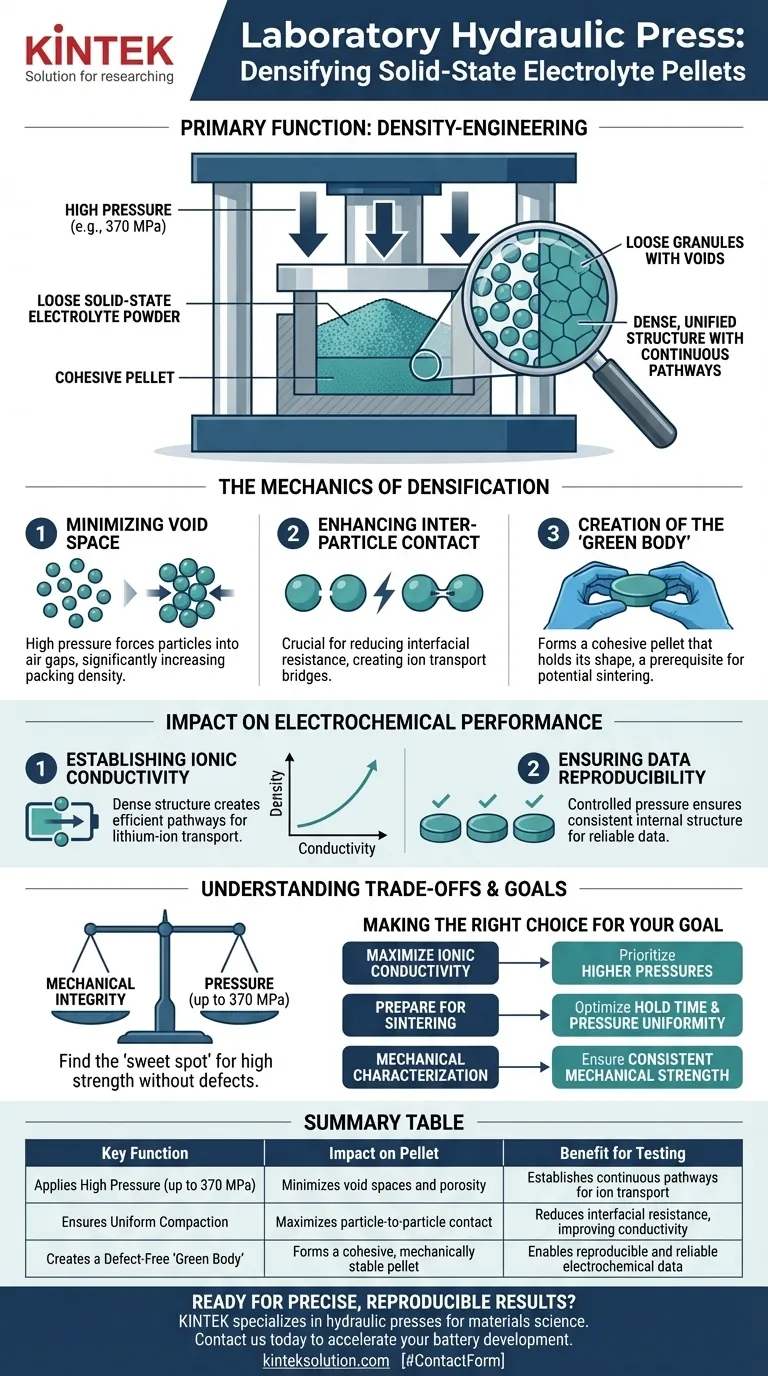
The primary function of a laboratory hydraulic press in this context is to apply precise, uniform, and high-magnitude pressure to consolidate loose solid-state electrolyte powder into a dense, cohesive pellet.
This process, often referred to as cold-pressing, is the critical mechanical step that minimizes void spaces and maximizes particle-to-particle contact. By applying pressures often reaching 370 MPa, the press transforms independent powder granules into a unified structure capable of supporting ion transport.
Core Takeaway The hydraulic press is not merely a shaping tool; it is a density-engineering instrument. Its purpose is to mechanically eliminate porosity to create continuous pathways for lithium-ion transport, which is the absolute prerequisite for high ionic conductivity and reliable electrochemical data.

The Mechanics of Densification
Minimizing Void Space
The immediate physical goal of the hydraulic press is the reduction of voids.
Loose electrolyte powders naturally contain significant air gaps, which act as insulators against ionic movement. By applying high pressure (e.g., 350–370 MPa), the press forces particles into these gaps, significantly increasing the packing density of the material.
Enhancing Inter-Particle Contact
Beyond simple density, the press drives the physical connection between individual powder grains.
High-pressure compaction increases the contact area between particles. This is essential for reducing interfacial resistance, effectively creating a "bridge" for ions to travel from one particle to the next without interruption.
Creation of the "Green Body"
In ceramic processing terms, the press forms the "green body"—a compacted pellet that holds its shape before any potential sintering steps.
The magnitude of pressure and the duration of the hold time determine the initial density and uniformity of this body. A defect-free green body is often a critical requirement for obtaining a successful result in subsequent high-temperature sintering processes.
Impact on Electrochemical Performance
Establishing Ionic Conductivity
The density achieved by the press is directly proportional to the material's performance.
A dense structure creates efficient, continuous pathways for lithium-ion transport. Without the sufficient densification provided by the press, the electrolyte would exhibit poor conductivity regardless of the material's intrinsic chemical properties.
Ensuring Data Reproducibility
Reliable science requires consistent sample preparation.
By applying controlled, precise pressure, the hydraulic press ensures that every pellet has a similar internal structure. This consistency is vital for obtaining reproducible electrochemical performance data, allowing researchers to trust that variations in results are due to material chemistry, not inconsistent pellet fabrication.
Understanding the Trade-offs
Mechanical Integrity vs. Pressure
While high pressure is necessary, it must be carefully calibrated.
The goal is to achieve a pellet with high mechanical strength, but the pressure must be uniform to avoid defects. The press allows researchers to find the specific "sweet spot" where the pellet is dense enough to be conductive but mechanically stable enough to handle without crumbling.
The Limits of Cold-Pressing
It is important to recognize that the press prepares the material, but does not always finalize it.
For some materials, the "green body" formed by the press is sufficient for testing. However, for traditional ceramics, the density achieved here is only the prerequisite for sintering; the press sets the stage, but heat completes the bonding.
Making the Right Choice for Your Goal
To maximize the utility of a laboratory hydraulic press for solid-state electrolytes, align your settings with your specific research objectives:
- If your primary focus is maximizing ionic conductivity: Prioritize higher pressures (up to the material's limit) to minimize internal porosity and interfacial resistance completely.
- If your primary focus is preparing for sintering: Focus on optimizing the "hold time" and pressure uniformity to create a defect-free green body that will not crack during heating.
- If your primary focus is mechanical characterization: Use the press to ensure the pellet achieves a specific, consistent mechanical strength to withstand handling and tension testing.
The laboratory hydraulic press is the bridge between a theoretical material chemistry and a functional, conductive physical reality.
Summary Table:
| Key Function | Impact on Pellet | Benefit for Testing |
|---|---|---|
| Applies High Pressure (up to 370 MPa) | Minimizes void spaces and porosity | Establishes continuous pathways for ion transport |
| Ensures Uniform Compaction | Maximizes particle-to-particle contact | Reduces interfacial resistance, improving conductivity |
| Creates a Defect-Free 'Green Body' | Forms a cohesive, mechanically stable pellet | Enables reproducible and reliable electrochemical data |
Ready to achieve precise, reproducible results in your solid-state electrolyte research?
KINTEK specializes in laboratory hydraulic presses, including automatic and heated models, designed to meet the exacting demands of materials science. Our presses deliver the uniform, high-pressure compaction essential for creating dense pellets with superior ionic conductivity.
Contact us today using the form below to discuss how our solutions can enhance your lab's capabilities and accelerate your development of next-generation batteries.
Visual Guide
Related Products
- Laboratory Hydraulic Press Lab Pellet Press Machine for Glove Box
- Laboratory Hydraulic Press 2T Lab Pellet Press for KBR FTIR
- 24T 30T 60T Heated Hydraulic Lab Press Machine with Hot Plates for Laboratory
- Laboratory Hydraulic Press Lab Pellet Press Button Battery Press
- Laboratory Hydraulic Pellet Press for XRF KBR FTIR Lab Press
People Also Ask
- How does a laboratory hydraulic press contribute to the preparation of Li3-3xScxSb samples? Optimize Ionic Conductivity
- What is the function of a laboratory hydraulic press in FT-IR of curcumin-coated MWCNTs? Achieve Optical Clarity.
- Why is a laboratory hydraulic press required for compression molding boron-siloxane? Solve High-Loading Density Challenges
- What role does a laboratory hydraulic press play in reaction pellets? Optimizing Lunar Soil and Metal Fuel Density
- What role does a laboratory hydraulic press play in the preparation of piezoelectric ceramic discs for DC-PG? | KINTEK



















