
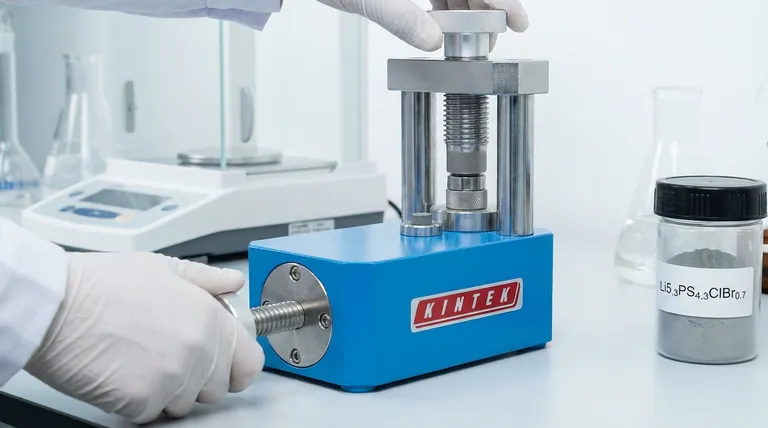
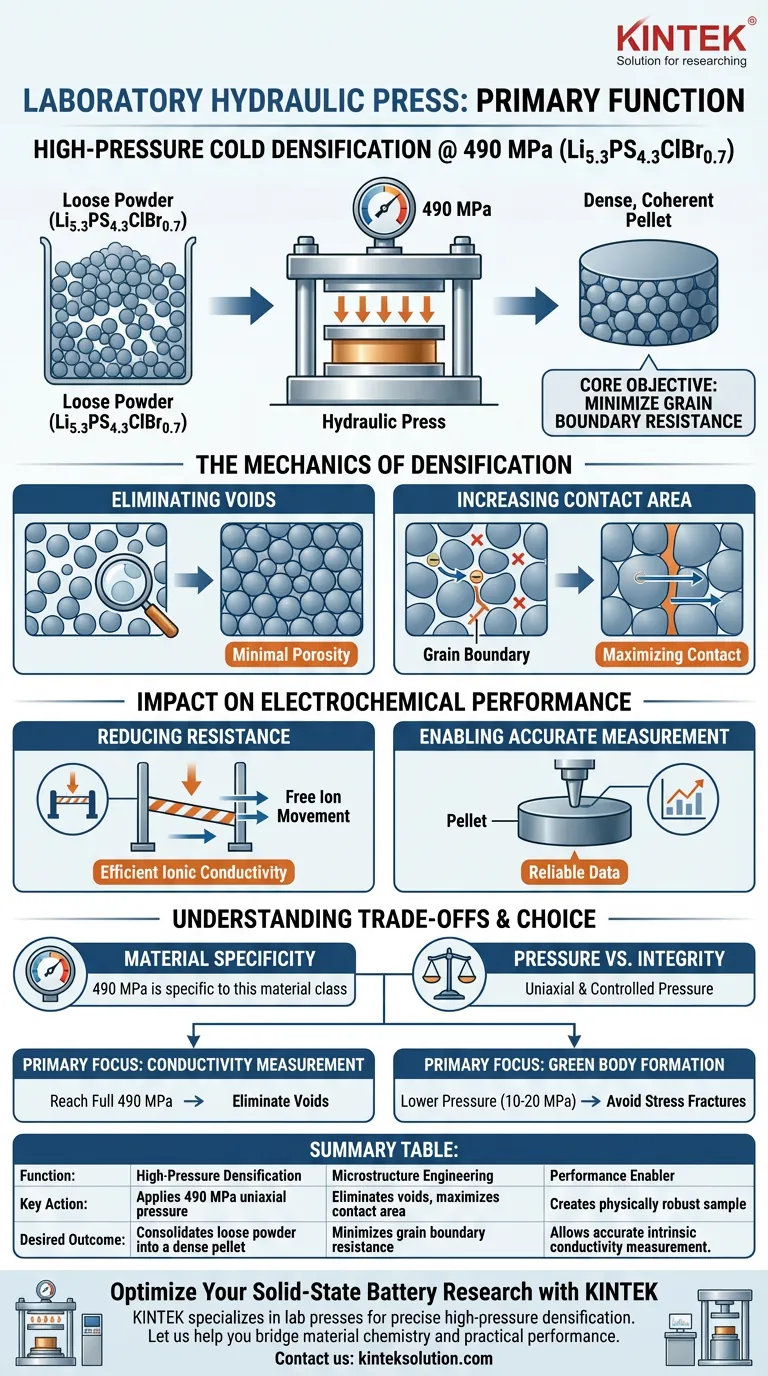
The primary function of the laboratory hydraulic press in this context is high-pressure cold densification. Specifically, the press applies 490 MPa to consolidate loose Li5.3PS4.3ClBr0.7 powder into a coherent, high-density pellet. This mechanical compaction is the critical prerequisite for transforming raw powder into a functional solid electrolyte capable of conducting ions efficiently.
The core objective of applying this specific pressure is not merely shaping the material, but minimizing grain boundary resistance. By forcing particles into intimate contact, you create the continuous physical pathways necessary for the electrolyte to exhibit its intrinsic ionic conductivity.
The Mechanics of Densification
Eliminating Inter-Particle Voids
When the electrolyte exists as a loose powder, air gaps and voids separate the individual grains. These voids act as insulators, preventing the flow of lithium ions.
The application of 490 MPa is significantly higher than standard molding pressures. This magnitude is necessary to plastically deform the powder particles, forcing them to fill these voids and creating a near-solid mass with minimal porosity.
Increasing Contact Area
For ions to traverse the electrolyte, they must "hop" from one particle to the next.
High-pressure consolidation maximizes the physical contact area between these grains. This ensures that the interface between particles—the grain boundary—is tight and continuous, rather than loose and disjointed.
Impact on Electrochemical Performance
Reducing Grain Boundary Resistance
The resistance encountered by ions at the interface between particles is known as grain boundary resistance. In solid-state batteries, this is often the bottleneck for performance.
By applying 490 MPa, the hydraulic press effectively lowers this resistance barrier. The resulting dense pellet allows ions to move freely through the bulk of the material, ensuring the measured conductivity reflects the material's true potential.
Enabling Accurate Measurement
To accurately measure the intrinsic ionic conductivity of Li5.3PS4.3ClBr0.7, the sample must be physically robust.
A pellet pressed at lower pressures would yield artificially low conductivity data due to structural defects. The high-density pellet created at 490 MPa provides the structural integrity required for reliable electrochemical testing and the construction of viable all-solid-state batteries.
Understanding the Trade-offs
Pressure vs. Integrity
While high pressure is essential for density, it must be applied with precision. The hydraulic press ensures the pressure is uniaxial and controlled.
If pressure is applied unevenly, the pellet may suffer from density gradients. Conversely, while 490 MPa is specified for this material to achieve final density, other materials (like ceramics requiring sintering) might only require lower pressures (e.g., 10–20 MPa) to form a "green pellet."
Material Specificity
It is vital to recognize that 490 MPa is a process parameter specific to cold-pressing this class of sulfide/halide electrolytes.
Applying this same pressure to a different material without understanding its mechanical properties could lead to crushing brittle particles or laminating the pellet. The pressure must always be matched to the material's compressibility and the desired final state (e.g., green body vs. final part).
Making the Right Choice for Your Goal
When configuring your hydraulic press for solid electrolyte synthesis, consider your end goal:
- If your primary focus is Conductivity Measurement: Ensure you reach the full 490 MPa to eliminate voids; insufficient pressure will result in data dominated by grain boundary resistance rather than intrinsic material properties.
- If your primary focus is Green Body Formation: For ceramics requiring subsequent sintering, you may need significantly lower pressure (approx. 10-20 MPa) to avoid locking in stress fractures before heat treatment.
Ultimately, the hydraulic press serves as the bridge between theoretical material chemistry and practical battery performance by defining the physical microstructure of the electrolyte.
Summary Table:
| Function | Key Action | Desired Outcome |
|---|---|---|
| High-Pressure Densification | Applies 490 MPa uniaxial pressure | Consolidates loose powder into a dense, coherent pellet |
| Microstructure Engineering | Eliminates inter-particle voids and maximizes contact area | Minimizes grain boundary resistance for efficient ion transport |
| Performance Enabler | Creates a physically robust sample | Allows for accurate measurement of intrinsic ionic conductivity |
Ready to optimize your solid-state battery research with precise high-pressure densification?
KINTEK specializes in laboratory press machines, including automatic lab presses and heated lab presses, designed to meet the exacting demands of solid electrolyte development. Our equipment delivers the controlled, high-pressure compaction (like the 490 MPa used for Li5.3PS4.3ClBr0.7) essential for creating high-density pellets and achieving reliable electrochemical data.
Let us help you bridge the gap between material chemistry and practical performance.
Contact our experts today to discuss how a KINTEK lab press can enhance your R&D process.
Visual Guide
Related Products
- Laboratory Hydraulic Press 2T Lab Pellet Press for KBR FTIR
- Laboratory Hydraulic Press Lab Pellet Press Button Battery Press
- Manual Laboratory Hydraulic Press Lab Pellet Press
- Automatic Laboratory Hydraulic Press Lab Pellet Press Machine
- Laboratory Hydraulic Press Lab Pellet Press Machine for Glove Box
People Also Ask
- What is the role of a laboratory pressure machine and KBr in FTIR? Master Sample Preparation for Flame Retardants
- What is the role of a laboratory hydraulic press in high-loading NCM811 cathode prep for solid-state batteries?
- What role does a laboratory hydraulic press play in reaction pellets? Optimizing Lunar Soil and Metal Fuel Density
- Why is a laboratory hydraulic press necessary for sample preparation? Precise Pelleting for Spiro Heterocyclic Analysis
- How does a laboratory hydraulic press ensure repair performance? Master Self-Healing CFRP Molding with Precision



















