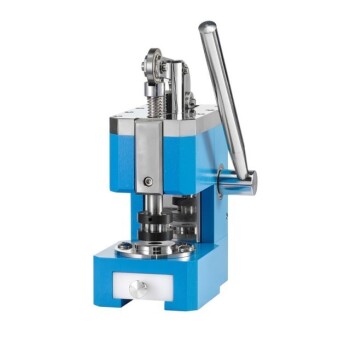
The primary function of grinding equipment in the Solid-State Reactive Sintering (SSRS) process is to mechanically reduce raw material powders into microscopic particles. By significantly refining the particle size, the equipment maximizes the physical surface area available for inter-particle contact. This physical alteration is the necessary catalyst for efficient solid-state reactions, enabling the material to sinter effectively.
Grinding is not just about size reduction; it is the critical step that increases particle surface area to drive chemical reactivity. This enhanced contact area allows phase formation, densification, and grain growth to occur simultaneously at lower processing temperatures.
The Mechanics of Particle Refinement
Reduction of Raw Powders
The SSRS process begins with raw precursor materials that typically exist as coarse powders. Grinding equipment subjects these materials to mechanical force, breaking them down into uniform, tiny particles.
Increasing Surface Contact
As particle size decreases, the specific surface area of the powder increases significantly. This creates a much higher density of contact points where individual particles physically touch their neighbors.
Driving Chemical Efficiency
Facilitating Solid-Surface Reactions
Solid-state reactions rely heavily on physical contact points to facilitate atomic diffusion between materials. By maximizing the surface contact area, the grinding process directly improves the efficiency of these solid-surface contact reactions.
Enabling Integrated Processing
The refined powder structure allows multiple distinct manufacturing stages to happen simultaneously. Specifically, it enables phase formation, densification, and grain growth to occur in a single, integrated processing step.
Thermal Benefits and Efficiency
Lowering Process Temperatures
Finer particles possess higher surface energy, making them more reactive and easier to sinter than coarse particles. Consequently, the improved reactivity achieved through grinding allows the entire SSRS process to occur at lower temperatures.
Understanding the Trade-offs
The Necessity of Uniformity
While reducing particle size is the primary goal, the consistency of that reduction is equally vital. If the grinding equipment produces irregular sizes, the reaction rates may vary across the material, potentially undermining the benefits of the integrated process.
Optimizing Your SSRS Strategy
To maximize the benefits of the SSRS process, consider how grinding impacts your specific manufacturing goals.
- If your primary focus is energy efficiency: Prioritize grinding parameters that achieve the finest viable particle size to minimize the thermal energy required for successful sintering.
- If your primary focus is structural homogeneity: Focus on the uniformity of the particle distribution to ensure consistent phase formation and densification throughout the fuel cell.
Ultimately, precise control over particle size is the fundamental lever that allows you to achieve high-performance proton conducting solid oxide fuel cells with reduced thermal overhead.
Summary Table:
| Feature | Impact on SSRS Process | Benefit |
|---|---|---|
| Particle Size Reduction | Breaks coarse powders into microscopic particles | Increased specific surface area |
| Surface Area Contact | Maximizes inter-particle contact points | Faster solid-state chemical reactions |
| Integrated Processing | Enables simultaneous phase formation & densification | Streamlined manufacturing workflow |
| Thermal Efficiency | Increases surface energy of raw powders | Lower sintering temperatures required |
Elevate Your Fuel Cell Research with KINTEK Precision
Unlock the full potential of Solid-State Reactive Sintering (SSRS) for your Proton Conducting Solid Oxide Fuel Cells (PCFC). At KINTEK, we specialize in comprehensive laboratory pressing and grinding solutions designed to achieve the precise particle refinement your research demands.
Whether you require manual, automatic, or heated models, or advanced cold and warm isostatic presses, our equipment ensures the structural homogeneity and density critical for battery and fuel cell innovation.
Ready to optimize your sintering efficiency and lower processing temperatures?
Contact KINTEK Experts Today to find the perfect solution for your lab!
References
- Mengyang Yu, Shenglong Mu. Recent Novel Fabrication Techniques for Proton-Conducting Solid Oxide Fuel Cells. DOI: 10.3390/cryst14030225
This article is also based on technical information from Kintek Solution Knowledge Base .
Related Products
- Automatic High Temperature Heated Hydraulic Press Machine with Heated Plates for Lab
- Lab Manual Microtome Slicer for Tissue Sectioning
- Lab Ball Press Mold
- Split Automatic Heated Hydraulic Press Machine with Heated Plates
- Automatic Heated Hydraulic Press Machine with Hot Plates for Laboratory
People Also Ask
- Function of a Laboratory Hydraulic Press with Heated Platens in SSE? Enhance Battery Density & Conductivity
- What are the requirements for electrode pressing with high-viscosity ionic liquids like EMIM TFSI? Optimize Performance
- How does a laboratory heated hydraulic press facilitate PBN sample prep for WAXS? Achieve Precise X-Ray Scattering
- What are the industrial applications of heated hydraulic presses? Master Heat & Force for Precision Manufacturing
- Why is a laboratory hydraulic press with heating plates required for PLA/TEC films? Achieve Precise Sample Integrity