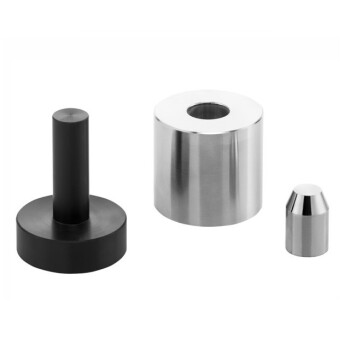
The primary function of high-precision laboratory presses and compaction fixtures in sulfide all-solid-state battery development is to apply specific, uniform mechanical pressure to establish and maintain physical contact between solid interfaces. While liquid batteries rely on wetting, solid-state batteries require this external force—typically between 5 to 30 MPa during operation—to ensure ion transport and prevent structural failure caused by electrode volume changes.
Core Takeaway Unlike traditional batteries where liquid electrolytes naturally fill voids, solid-state systems rely entirely on mechanical pressure to move ions. These tools are critical for two distinct phases: applying high pressure to eliminate porosity during manufacturing, and maintaining moderate, constant pressure to counteract material expansion during charge-discharge cycles.
The Critical Role of Pressure in Solid-State Chemistry
Overcoming the "Solid-Solid" Contact Problem
In a sulfide all-solid-state battery, ions must move through solid particles rather than a liquid solution.
If these particles do not touch, the battery has infinite internal resistance. Laboratory presses force these solid powders together to create continuous ion transport channels.
Managing Chemo-Mechanical Volume Changes
During charging and discharging, electrode materials (especially silicon anodes) undergo significant expansion and contraction.
Without external constraint, this "breathing" causes the material to pull away from the electrolyte. Compaction fixtures apply a continuous stack pressure to ensure the layers remain in contact despite these physical shifts.
The Function of Laboratory Presses (Fabrication)
Achieving Maximum Density
Before a battery is ever tested, it must be formed into a dense ceramic pellet.
High-pressure hydraulic presses are used to apply massive force—often up to 410 MPa—to sulfide electrolyte powders. This "cold-pressing" eliminates internal pores, maximizing the material's ionic conductivity.
Lamination of the Battery Stack
Once the electrolyte is densified, the press is used to laminate the composite cathode, anode, and electrolyte layers together.
This process, sometimes involving specific pressures like 240 MPa for micron-silicon anodes, creates a cohesive unit. It establishes the initial tight physical contact required for the electronic conductive network to function.
The Function of Compaction Fixtures (Testing & Operation)
Preventing Interface Delamination
The primary reference highlights that during operation, the required pressure typically ranges from 5 to 30 MPa.
Specialized fixtures maintain this specific pressure range on the finished cell. This prevents contact loss at the interfaces, which is the leading cause of performance degradation in these batteries.
Inhibiting Dendrite Growth
Gaps or low-pressure areas in the electrolyte interface can allow lithium dendrites to form and penetrate the cell.
By maintaining constant external pressure, compaction fixtures help suppress these formations. This ensures the acquisition of reliable cycle life data and improves safety.
Understanding the Trade-offs
Fabrication vs. Operation Pressure
A common pitfall is confusing the pressure needed to make the battery with the pressure needed to run the battery.
Fabrication requires extremely high pressure (hundreds of MPa) to densify the powder. However, operating the battery at these extreme pressures is often impractical and unnecessary. The goal is to find the minimum viable stack pressure (e.g., 5-30 MPa) that maintains contact without requiring massive external machinery in a commercial application.
Static vs. Dynamic constraints
Rigid fixtures may increase pressure dangerously as the battery expands.
Advanced testing often requires fixtures with dynamic pressure sensors or torque control. These allow the fixture to adapt to volume expansion, maintaining a constant pressure rather than a fixed gap, which ensures the data reflects true electrochemical performance rather than mechanical crushing.
Making the Right Choice for Your Goal
To ensure your development process yields valid results, align your equipment use with your specific objective:
- If your primary focus is Material Synthesis (Fabrication): Prioritize high-tonnage hydraulic presses capable of reaching 410 MPa to ensure maximum density and pore elimination in ceramic pellets.
- If your primary focus is Cycle Life Testing (Operation): Prioritize compaction fixtures with dynamic control that can maintain a stable 5-30 MPa stack pressure to compensate for volume expansion without delamination.
Success in sulfide solid-state batteries is not just about the chemistry; it is about maintaining the mechanical integrity of the stack through precise pressure management.
Summary Table:
| Stage | Function | Typical Pressure Range | Key Objective |
|---|---|---|---|
| Fabrication | Powder Compaction & Lamination | 240 - 410 MPa | Eliminate porosity and create ion transport channels |
| Operation | Stack Pressure Maintenance | 5 - 30 MPa | Prevent delamination and manage volume expansion |
| Testing | Interface Stability | Variable | Inhibit lithium dendrite growth and ensure cycle life |
Maximize Your Battery Research Precision with KINTEK
Don't let interface resistance or mechanical failure compromise your results. KINTEK specializes in comprehensive laboratory pressing solutions tailored for the next generation of energy storage. Whether you need manual, automatic, heated, or glovebox-compatible hydraulic presses, or advanced cold and warm isostatic presses, our equipment is engineered to deliver the precise mechanical pressure required for high-performance sulfide solid-state batteries.
Ready to optimize your battery stack integrity? Contact us today to find the perfect pressing solution for your lab!
References
- Finks, Christopher. Investment Risk Assessment: Solid-State Batteries for Automotive Applications - Technical Analysis. DOI: 10.5281/zenodo.17596884
This article is also based on technical information from Kintek Solution Knowledge Base .
Related Products
- Warm Isostatic Press for Solid State Battery Research Warm Isostatic Press
- Lab Polygon Press Mold
- Laboratory Hydraulic Press Lab Pellet Press Button Battery Press
- Lab Infrared Press Mold for Laboratory Applications
- Lab Round Bidirectional Press Mold
People Also Ask
- Why must composite cathodes be sealed in vacuum lamination bags for WIP? Ensure Battery Stability and Density
- How do sacrificial volume materials (SVM) maintain microchannels in isostatic pressing? Ensure Structural Integrity
- What is the function of elastic molds in warm isostatic pressing? Achieve Uniform Density in Composite Particles
- What is the mechanism of a Warm Isostatic Press (WIP) on cheese? Master Cold Pasteurization for Superior Safety
- What is the significance of temperature control in Warm Isostatic Pressing? Unlock Uniform Densification and Process Stability