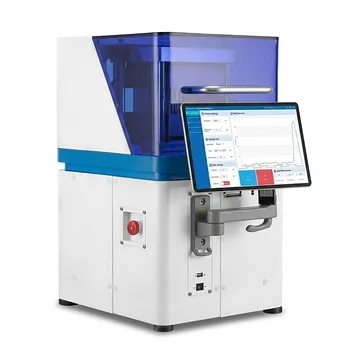
The primary function of a laboratory press is to transform powdered materials into solid, uniform samples. By applying strictly controlled pressure, these devices compress loose powders into pellets or specific shapes, a process that is fundamental for ensuring accuracy in spectroscopic analysis, material testing, and pharmaceutical development.
Laboratory presses provide the mechanical force necessary to reduce porosity and increase density in experimental materials. They are the bridge between raw, loose ingredients and the consistent, solid forms required for rigorous scientific data collection.
The Science of Sample Preparation
Achieving Uniformity for Analysis
The core purpose of a laboratory press is to create a homogeneous solid sample. In fields like spectroscopy or bomb calorimetry, loose powder cannot be analyzed accurately; it must be compressed into a stable pellet to ensure precise, repeatable results.
Densification and Compacting
Presses are used to drastically reduce material porosity. By increasing the density of powders and granular materials, researchers can simulate production environments for metallurgy, ceramics, and pharmaceuticals on a manageable scale.
Expanding Capabilities: Hot Presses
Lamination and Composites
While standard presses focus on compaction, hot presses add thermal regulation to the equation. They are essential for lamination, bonding different materials together to create multilayer structures or composites.
Molding and Curing
Hot presses allow for the precise shaping of plastics and ceramics. They facilitate curing, a process that uses heat and pressure to harden adhesives and coatings, significantly enhancing the material's final physical properties.
Operational Mechanics and Performance
Core Components
A typical system consists of three main elements: a frame, a baseplate, and a ram. The ram is the component responsible for delivering force, driven by either a hydraulic or pneumatic system.
Force and Temperature Ranges
Modern laboratory presses are capable of immense power and precision. Standard models can exert forces up to 1,000 kN and feature platens capable of heating or cooling samples to extremes, such as 450 °C.
Understanding the Trade-offs
Manual vs. Automatic Operation
Hand presses (manual hydraulic presses) are cost-effective, portable, and simple to operate, making them ideal for low-volume tasks or limited counter space. However, they rely on operator consistency.
Precision vs. Cost
While manual options are economical, high-end units with programmable controls and data acquisition offer superior repeatability. These features are critical for strictly regulated environments like aerospace or medical R&D but come with a larger footprint and financial investment.
Making the Right Choice for Your Goal
Selecting the correct laboratory press depends entirely on the specific requirements of your material and the volume of your testing.
- If your primary focus is basic sample preparation: A manual hydraulic press offers a cost-effective, portable solution for creating simple pellets with minimal training.
- If your primary focus is composite development: A hot press is required to provide the thermal control necessary for lamination, molding, and curing adhesives.
- If your primary focus is high-volume Quality Control: A programmable press with data acquisition ensures the repeatability and high-force application needed for rigorous industrial standards.
The right press transforms variable raw materials into the reliable constants needed for scientific discovery.
Summary Table:
| Feature | Manual Hydraulic Press | Hot Press | Programmable/Automatic Press |
|---|---|---|---|
| Primary Use | Basic sample preparation | Lamination, molding & curing | High-volume QC & R&D |
| Key Benefit | Cost-effective & portable | Precise thermal regulation | Superior repeatability |
| Force Output | Up to 25 tons (typical) | High force + heat | Up to 1,000 kN |
| Application | Simple pellets | Composites & ceramics | Aerospace & Medical |
| Control | Operator dependent | Manual or digital | Fully automated data logging |
Elevate Your Research with Precision Pressing Solutions
Don't let inconsistent sample preparation compromise your data accuracy. KINTEK specializes in comprehensive laboratory pressing solutions designed to meet the rigorous demands of modern science. Whether you are conducting fundamental battery research or complex material testing, our expert-engineered equipment ensures perfect results every time.
Our Versatile Range Includes:
- Manual & Automatic Models: From portable hand presses to high-force automated systems.
- Heated & Multifunctional Presses: Perfect for curing, lamination, and composite development.
- Specialized Isostatic Presses: Cold and warm isostatic options for uniform densification.
- Glovebox-Compatible Designs: Ensuring safety and integrity for sensitive material handling.
Ready to transform your laboratory workflow? Contact KINTEK today to find the ideal press for your application and experience the value of precision engineering.
Related Products
- Laboratory Hydraulic Press Lab Pellet Press Button Battery Press
- Laboratory Hydraulic Press Lab Pellet Press Machine for Glove Box
- Laboratory Split Manual Heated Hydraulic Press Machine with Hot Plates
- Laboratory Hydraulic Split Electric Lab Pellet Press
- Laboratory Hydraulic Pellet Press for XRF KBR FTIR Lab Press
People Also Ask
- How is a laboratory hydraulic press used for HAP composite gels? Master Mineral Substrate Standardization
- What role does a laboratory hydraulic press play in the preparation of piezoelectric ceramic discs for DC-PG? | KINTEK
- What role does a laboratory hydraulic press play in reaction pellets? Optimizing Lunar Soil and Metal Fuel Density
- Why is a laboratory hydraulic press required for PBAT and PLA sample preparation? Achieve Flawless Characterization
- What role does a laboratory hydraulic press play in the assembly of all-solid-state battery test cells? Expert Guide