
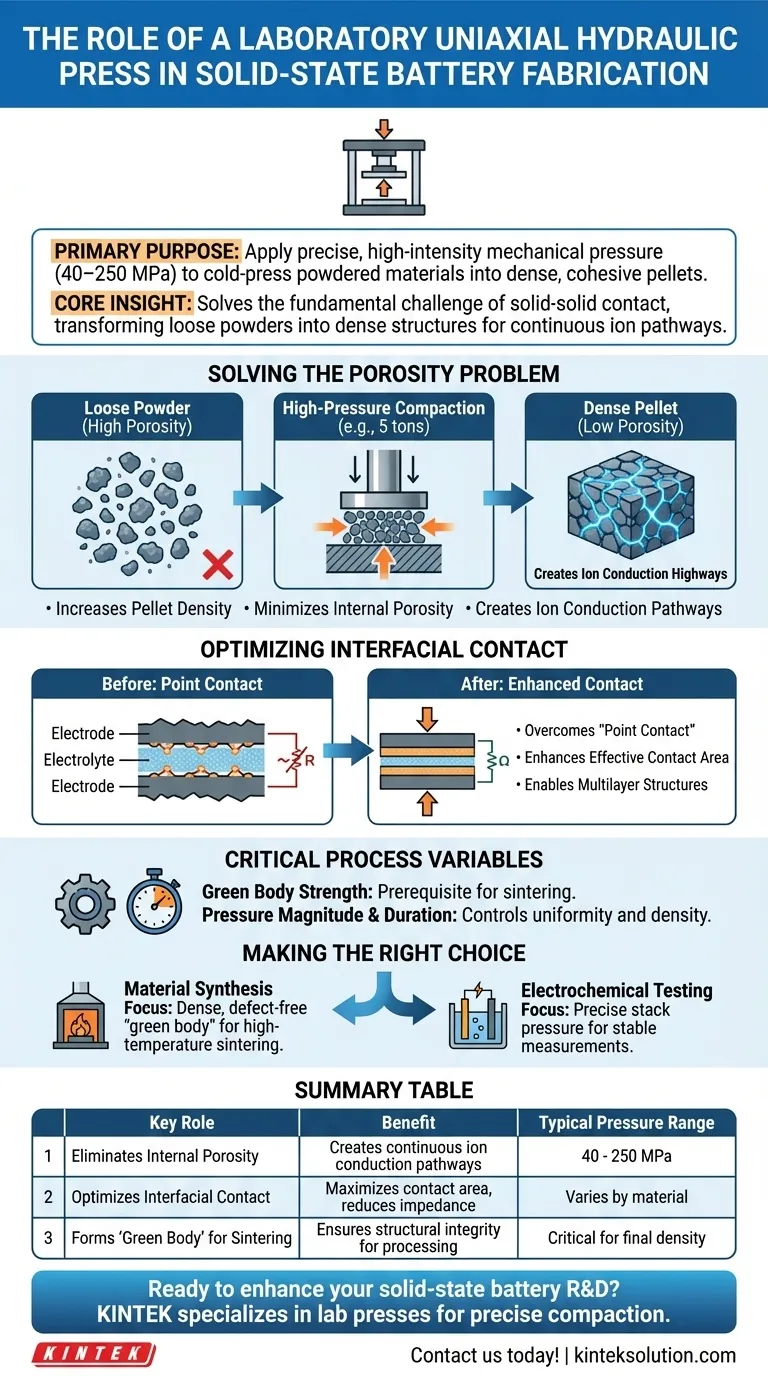
The primary purpose of a laboratory uniaxial hydraulic press in solid-state battery fabrication is to apply precise, high-intensity mechanical pressure to cold-press powdered materials into dense, cohesive pellets. By subjecting solid-state electrolytes and cathode composites to pressures typically ranging from 40 to 250 MPa, the press eliminates internal voids and forces individual particles into intimate physical contact.
The Core Insight In solid-state batteries, ions cannot flow through air gaps; they require continuous physical pathways. The hydraulic press solves the fundamental challenge of solid-solid contact, transforming loose powders into dense structures that maximize ionic conductivity and minimize interfacial impedance.
Solving the Porosity Problem
The fundamental hurdle in fabricating solid-state batteries is that, unlike liquid electrolytes which naturally wet surfaces, solid powders naturally contain gaps and voids.
Increasing Pellet Density
The press compacts materials like Li10GeP2S12 (LGPS) or La0.95Ba0.05F2.95 (LBF) powder into a solidified form. This high-pressure compaction significantly increases the material's overall density.
Minimizing Internal Porosity
By applying uniform pressure (e.g., 5 tons), the machine mechanically forces particles closer together. This reduction in internal porosity is critical, as any remaining void acts as a barrier to ion movement.
Creating Ion Conduction Pathways
The densification process ensures intimate contact between individual powder particles. This connectivity creates the necessary "highways" for ions to travel through the material, directly lowering the internal resistance of the battery.
Optimizing Interfacial Contact
Beyond simple densification, the hydraulic press is essential for managing the interfaces between different layers of the battery, such as the electrode and the electrolyte.
Overcoming "Point Contact"
Rigid electrolytes, such as garnets, struggle to form good contact with electrodes, leading to weak "point contacts" and high resistance. The press applies enough force to cause plastic deformation in softer materials like lithium metal.
Enhancing Effective Contact Area
This deformation forces the lithium metal to fill microscopic depressions on the electrolyte surface. This maximizes the effective contact area, ensuring uniform ion flux and reducing interfacial impedance.
Enabling Multilayer Structures
For composite cathodes or bilayer structures, the press is used to pre-compact the first layer. This creates a flat, mechanically stable substrate that prevents delamination or intermixing when a second layer is added before sintering.
Critical Process Variables
While the machine's function is mechanical, its impact is electrochemical. The success of the pressing stage relies on specific variables.
The Importance of Green Body Strength
In ceramic processing, the press forms a "green body" with specific mechanical strength. The density achieved here is a prerequisite for the subsequent high-temperature sintering step; a poorly pressed green body will result in a defective final ceramic.
Pressure Magnitude and Duration
The quality of the pellet is directly determined by the magnitude of pressure applied and the hold time. These factors control the initial uniformity and density, which ultimately dictate the battery's final efficiency and sulfur utilization.
Making the Right Choice for Your Goal
The specific application of the hydraulic press depends on which stage of the fabrication or testing process you are prioritizing.
- If your primary focus is Material Synthesis: Focus on achieving a dense, defect-free "green body" to ensure the pellet survives high-temperature sintering without cracking.
- If your primary focus is Electrochemical Testing: Focus on applying precise stack pressure to induce plastic deformation in the lithium metal, ensuring stable measurements and suppressing dendrite growth.
Summary: The laboratory uniaxial hydraulic press is not merely a shaping tool, but a critical enabler of ionic conductivity that bridges the gap between loose powder and a functioning high-performance energy storage device.
Summary Table:
| Key Role | Benefit | Typical Pressure Range |
|---|---|---|
| Eliminates Internal Porosity | Creates continuous ion conduction pathways | 40 - 250 MPa |
| Optimizes Interfacial Contact | Maximizes contact area, reduces impedance | Varies by material |
| Forms 'Green Body' for Sintering | Ensures structural integrity for high-temperature processing | Critical for final density |
Ready to enhance your solid-state battery R&D with precise compaction? KINTEK specializes in automatic lab presses, isostatic presses, and heated lab presses designed to meet the exacting demands of laboratory material fabrication. Our machines help researchers like you achieve the dense, uniform pellets essential for high-performance energy storage. Contact us today to find the perfect press for your specific application and material goals!
Visual Guide
Related Products
- Laboratory Hydraulic Press 2T Lab Pellet Press for KBR FTIR
- 24T 30T 60T Heated Hydraulic Lab Press Machine with Hot Plates for Laboratory
- Automatic Laboratory Hydraulic Press Lab Pellet Press Machine
- Automatic Laboratory Hydraulic Press for XRF and KBR Pellet Pressing
- Laboratory Hydraulic Press Lab Pellet Press Machine for Glove Box
People Also Ask
- What is the role of a laboratory pressure machine and KBr in FTIR? Master Sample Preparation for Flame Retardants
- What is the role of a laboratory hydraulic press in high-loading NCM811 cathode prep for solid-state batteries?
- Why is a laboratory hydraulic press necessary for sample preparation? Precise Pelleting for Spiro Heterocyclic Analysis
- What role does a laboratory hydraulic press play in reaction pellets? Optimizing Lunar Soil and Metal Fuel Density
- Why is a laboratory hydraulic press necessary for the assembly of trilayer bipolar stacking pouch cells?



















