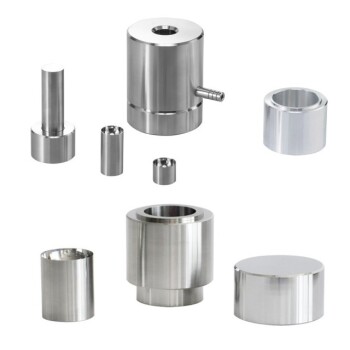
The primary function of silicon spray in the Mg-SiC pressing process is to serve as a critical interface lubricant between the composite powder and the internal walls of the metallic mold. By significantly reducing friction, the spray ensures that the pressure applied during compaction is distributed effectively, preventing the powder from binding to the steel die.
Silicon spray is not merely a release agent; it is a process control tool that ensures uniform material density while protecting both the fragile green compact and the expensive tooling from abrasive wear.
Optimizing Composite Density
Improving Pressure Transmission
Friction is the enemy of consistency in powder metallurgy. When friction is high at the mold walls, it "steals" the applied force, preventing it from traveling deep into the powder bed.
Applying silicon spray reduces this wall friction. This allows the pressing force to transmit uniformly throughout the Mg-SiC powder, rather than being concentrated only at the contact surfaces.
Minimizing Density Gradients
When pressure is uneven, the resulting part has "density gradients"—areas that are tightly packed and areas that are porous.
By facilitating smooth particle movement, the lubricant helps eliminate these inconsistencies. This ensures the final green compact has a homogeneous structure, which is vital for the mechanical integrity of the final product.
Protecting the Workpiece and Tooling
Ensuring Safe Ejection
The "green" compact (the pressed part before sintering) is mechanically weak and prone to damage.
If the compact sticks to the mold walls, the ejection force can cause surface tearing or cracking. Silicon spray provides a slip layer that allows the compact to slide out of the die without sustaining surface damage.
Extending Operational Lifespan
The interaction between metal matrix composites and steel molds can be abrasive.
Repeated pressing without lubrication leads to rapid tool wear. The silicon spray acts as a protective barrier for the metallic mold surfaces, significantly extending the operational lifespan of the steel molds and reducing replacement costs.
Understanding the Risks of Omission
The Friction Penalty
It is important to understand that skipping this lubrication step is not a valid time-saving measure.
Without the spray, the friction coefficient between the Mg-SiC particles and the mold rises sharply. This inevitably leads to a higher rejection rate due to cracked compacts and necessitates more frequent, expensive maintenance of the mold surfaces.
Making the Right Choice for Your Goal
To maximize the effectiveness of the pressing process, consider your specific objectives:
- If your primary focus is Part Quality: Ensure consistent spray coverage to minimize density gradients and prevent internal structural weaknesses.
- If your primary focus is Asset Management: Prioritize lubrication to protect mold surfaces from scoring and extend the lifecycle of your steel tooling.
Effective lubrication is the bridge between raw powder and a viable, high-quality component.
Summary Table:
| Function | Key Benefit | Impact on Process |
|---|---|---|
| Wall Lubrication | Reduces friction | Enhances pressure transmission for uniform density |
| Release Agent | Prevents sticking | Ensures safe ejection without surface tearing or cracks |
| Tool Protection | Acts as a barrier | Minimizes abrasive wear and extends mold lifespan |
| Process Control | Eliminates gradients | Improves mechanical integrity of the final green compact |
Elevate Your Material Research with KINTEK
Precise lubrication is only one part of the equation—superior pressing equipment is the other. KINTEK specializes in comprehensive laboratory pressing solutions tailored for advanced battery research and materials science.
Whether you need manual, automatic, heated, or multifunctional models, or are looking for high-performance cold and warm isostatic presses, our equipment is designed to minimize density gradients and maximize your research output.
Ready to optimize your Mg-SiC compacting process? Contact KINTEK today to discover how our glovebox-compatible and specialized presses can enhance your laboratory's efficiency and part quality.
References
- Fatemeh Rahimi Mehr, Mohammad Salavati. Optimal Performance of Mg-SiC Nanocomposite: Unraveling the Influence of Reinforcement Particle Size on Compaction and Densification in Materials Processed via Mechanical Milling and Cold Iso-Static Pressing. DOI: 10.3390/app13158909
This article is also based on technical information from Kintek Solution Knowledge Base .
Related Products
- Lab Round Bidirectional Press Mold
- Lab Anti-Cracking Press Mold
- Lab Polygon Press Mold
- Special Shape Lab Press Mold for Laboratory Applications
- Lab Infrared Press Mold for Laboratory Applications
People Also Ask
- What is the purpose of incorporating cartridge heaters into a lab press mold for MLCC block compression? Optimize Results
- What is the function of a pressing tool in thermoplastic panels? Master Precision Shaping & Fusion Bonding
- Why is precise cooling management of the lab press mold necessary? Protect Core Integrity in Thermoforming
- Why is a high-performance laboratory molding press critical for in-situ electrolyte formation? Unlock Battery Success
- How do the design and geometric precision of pressing molds and mandrels affect the quality of PTFE composite samples?