Knowledge What is the primary purpose of applying uniaxial pressure during SPS? Achieve Dense, Nanostructured Ceramics
Author avatar

Tech Team · Kintek Press

Updated 3 days ago

What is the primary purpose of applying uniaxial pressure during SPS? Achieve Dense, Nanostructured Ceramics


The primary purpose of applying uniaxial pressure during Spark Plasma Sintering (SPS) is to act as a mechanical driving force that dramatically accelerates powder densification. By physically compressing the material while current is applied, you promote immediate particle rearrangement and plastic flow, enabling the creation of high-density doped ceria ceramics at significantly lower temperatures and in shorter timeframes than conventional methods.

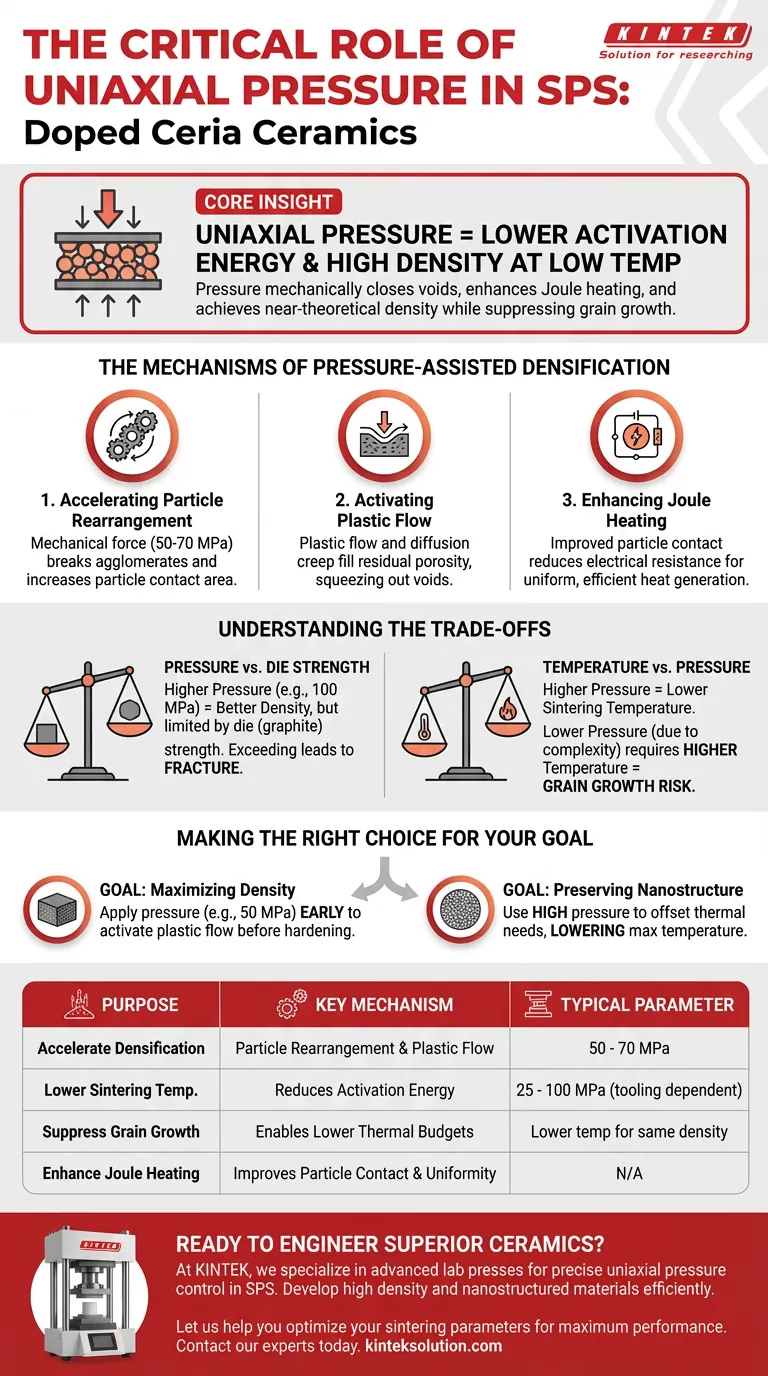
Core Insight: Uniaxial pressure in SPS is not merely about compaction; it effectively lowers the activation energy required for sintering. By mechanically closing inter-particle voids and enhancing the efficiency of Joule heating, pressure allows you to achieve near-theoretical density while suppressing the grain growth that typically degrades ceramic performance.
What is the primary purpose of applying uniaxial pressure during SPS? Achieve Dense, Nanostructured Ceramics

The Mechanisms of Pressure-Assisted Densification

Accelerating Particle Rearrangement

In the initial stages of sintering, loose powder particles contain significant void space. Uniaxial pressure, typically ranging from 50 to 70 MPa in these applications, mechanically forces particles into a tighter packing configuration.

This external force breaks down agglomerates and causes particles to slide past one another.

The result is an immediate increase in the contact area between particles, which is necessary for the subsequent bonding phases.

Activating Plastic Flow and Mass Transport

Once the particles are in contact, the applied pressure activates critical mass transport mechanisms, specifically plastic flow and diffusion creep.

Under high pressure, the material at the contact points yields and deforms.

This deformation physically fills the residual porosity between particles, effectively squeezing out voids that would otherwise remain in a pressureless sintering environment.

Enhancing Joule Heating Efficiency

The application of pressure does more than move mass; it improves the electrical and thermal dynamics of the process.

By forcing particles into intimate contact, pressure reduces electrical resistance at the interfaces.

This enhances the Joule heating effects generated by the pulsed direct current. It ensures that the heat is generated efficiently and uniformly throughout the sample, rather than being lost to contact resistance or voids.

Understanding the Trade-offs

Balancing Pressure and Die Strength

While higher pressure generally leads to better density, you are limited by the mechanical strength of the tooling.

SPS typically uses graphite dies, which have a mechanical limit (often around 100-150 MPa, though practical applications cited usually sit between 25-70 MPa). Exceeding this can cause die fracture.

Temperature vs. Pressure Relationship

There is an inverse relationship between the pressure applied and the temperature required for densification.

Relying heavily on pressure allows you to sinter at lower temperatures.

However, if you cannot apply sufficient pressure (due to complex shapes or tool limitations), you must compensate with higher temperatures, which introduces the risk of unwanted grain growth.

Making the Right Choice for Your Goal

When establishing your SPS parameters for doped ceria, consider your primary material objective:

  • If your primary focus is maximizing density: Prioritize applying pressure (e.g., 50 MPa) early in the heating ramp to activate plastic flow and eliminate voids before the ceramic hardens.
  • If your primary focus is preserving nanostructure: Use the high pressure to offset thermal requirements, allowing you to lower the maximum sintering temperature and minimize grain coarsening.

By leveraging uniaxial pressure as an active sintering parameter rather than just a shaping tool, you unlock the ability to engineer ceramics that are both fully dense and structurally refined.

Summary Table:

Purpose of Uniaxial Pressure Key Mechanism Typical Parameter Range
Accelerate Densification Particle Rearrangement & Plastic Flow 50 - 70 MPa
Lower Sintering Temperature Reduces Activation Energy 25 - 100 MPa (tooling dependent)
Suppress Grain Growth Enables lower thermal budgets Lower temperature for same density
Enhance Joule Heating Improves particle contact & thermal uniformity N/A

Ready to Engineer Superior Ceramics with Precision Sintering?

At KINTEK, we specialize in advanced lab press machines, including automated and heated presses that deliver the precise uniaxial pressure control critical for Spark Plasma Sintering (SPS) processes. Whether you're developing doped ceria electrolytes or other advanced ceramics, our equipment helps you achieve high density and nanostructured materials efficiently.

Let us help you optimize your sintering parameters for maximum performance.

Contact our experts today to discuss your laboratory needs and discover how our solutions can accelerate your research and development.

Visual Guide
What is the primary purpose of applying uniaxial pressure during SPS? Achieve Dense, Nanostructured Ceramics Visual Guide

Related Products

People Also Ask

Related Products

Automatic High Temperature Heated Hydraulic Press Machine with Heated Plates for Lab

Automatic High Temperature Heated Hydraulic Press Machine with Heated Plates for Lab

KINTEK High Temperature Hot Press: Precision sintering & material processing for labs. Achieve extreme temperatures & consistent results. Custom solutions available.

Automatic Heated Hydraulic Press Machine with Hot Plates for Laboratory

Automatic Heated Hydraulic Press Machine with Hot Plates for Laboratory

KINTEK Automatic Lab Heat Press: Precision heating, programmable control, and rapid cooling for efficient sample preparation. Enhance lab productivity today!

Heated Hydraulic Press Machine with Heated Plates for Vacuum Box Laboratory Hot Press

Heated Hydraulic Press Machine with Heated Plates for Vacuum Box Laboratory Hot Press

KINTEK Heated Hydraulic Lab Press with Vacuum Box ensures precise sample preparation. Compact, durable, and featuring digital pressure control for superior results.

24T 30T 60T Heated Hydraulic Lab Press Machine with Hot Plates for Laboratory

24T 30T 60T Heated Hydraulic Lab Press Machine with Hot Plates for Laboratory

High-quality hydraulic lab presses for precise sample preparation. Choose automatic or heated models for material research, pharmacy, and more. Get a quote now!

Automatic Heated Hydraulic Press Machine with Heated Plates for Laboratory

Automatic Heated Hydraulic Press Machine with Heated Plates for Laboratory

KINTEK Automatic Heated Hydraulic Lab Press: Precision heating, uniform pressure, and automated control for superior sample processing. Ideal for labs and research. Contact us today!

Laboratory Split Manual Heated Hydraulic Press Machine with Hot Plates

Laboratory Split Manual Heated Hydraulic Press Machine with Hot Plates

Boost lab efficiency with KINTEK's heated lab presses—precise temperature control, durable design, and rapid cooling for consistent results. Explore now!

Heated Hydraulic Press Machine With Heated Plates For Vacuum Box Laboratory Hot Press

Heated Hydraulic Press Machine With Heated Plates For Vacuum Box Laboratory Hot Press

Enhance lab precision with KINTEK's Heated Vacuum Lab Press for uniform, oxidation-free samples. Ideal for sensitive materials. Get expert advice now!

Manual Heated Hydraulic Lab Press with Integrated Hot Plates Hydraulic Press Machine

Manual Heated Hydraulic Lab Press with Integrated Hot Plates Hydraulic Press Machine

KINTEK's precision lab presses offer efficient, high-temperature sample prep for material research, pharmacy, and ceramics. Explore models now!

Split Automatic Heated Hydraulic Press Machine with Heated Plates

Split Automatic Heated Hydraulic Press Machine with Heated Plates

KINTEK Split Automatic Heated Lab Press: Precision hydraulic press with 300°C heating for efficient sample preparation. Ideal for research labs.

Lab Heat Press Special Mold

Lab Heat Press Special Mold

Precision KINTEK lab press molds for reliable sample prep. Durable, customizable, and ideal for diverse research needs. Enhance your lab's efficiency today!

Laboratory Manual Heated Hydraulic Press Machine with Hot Plates

Laboratory Manual Heated Hydraulic Press Machine with Hot Plates

KINTEK's Manual Hot Press delivers precise material processing with controlled heat and pressure. Ideal for labs needing reliable bonds and high-quality samples. Contact us today!

Laboratory Hydraulic Press Lab Pellet Press Button Battery Press

Laboratory Hydraulic Press Lab Pellet Press Button Battery Press

KINTEK Lab Press Machines: Precision hydraulic presses for material research, pharmacy, and electronics. Compact, durable, and low maintenance. Get expert advice today!

Laboratory Hydraulic Split Electric Lab Pellet Press

Laboratory Hydraulic Split Electric Lab Pellet Press

KINTEK Split Electric Lab Press: Precision sample preparation for research. Compact, versatile, with advanced pressure control. Ideal for material studies.

Manual Laboratory Hydraulic Pellet Press Lab Hydraulic Press

Manual Laboratory Hydraulic Pellet Press Lab Hydraulic Press

Boost lab efficiency with KINTEK's precision hydraulic presses—compact, leak-proof, and ideal for spectroscopy. Custom solutions available.

Manual Laboratory Hydraulic Press Lab Pellet Press

Manual Laboratory Hydraulic Press Lab Pellet Press

KINTEK's Protective Manual Lab Hydraulic Press ensures safe, precise sample preparation with durable construction, versatile applications, and advanced safety features. Ideal for labs.

Laboratory Hydraulic Press 2T Lab Pellet Press for KBR FTIR

Laboratory Hydraulic Press 2T Lab Pellet Press for KBR FTIR

KINTEK 2T Lab Hydraulic Press for precise FTIR sample prep, durable KBr pellet creation, and versatile material testing. Ideal for research labs.

Laboratory Hydraulic Press Lab Pellet Press Machine for Glove Box

Laboratory Hydraulic Press Lab Pellet Press Machine for Glove Box

Precision lab press for glove boxes: Compact, leak-proof design with digital pressure control. Ideal for inert atmosphere material processing. Explore now!

Electric Lab Cold Isostatic Press CIP Machine

Electric Lab Cold Isostatic Press CIP Machine

KINTEK's Lab Electric Isostatic Cold Press delivers precision, efficiency, and superior sample quality for advanced research. Explore customizable models today!

Automatic Laboratory Hydraulic Press for XRF and KBR Pellet Pressing

Automatic Laboratory Hydraulic Press for XRF and KBR Pellet Pressing

KinTek XRF Pellet Press: Automated sample prep for precise XRF/IR analysis. High-quality pellets, programmable pressure, durable design. Boost lab efficiency today!

Automatic Lab Cold Isostatic Pressing CIP Machine

Automatic Lab Cold Isostatic Pressing CIP Machine

High-efficiency Automatic Cold Isostatic Press (CIP) for precise lab sample preparation. Uniform compaction, customizable models. Contact KINTEK experts today!


Leave Your Message
