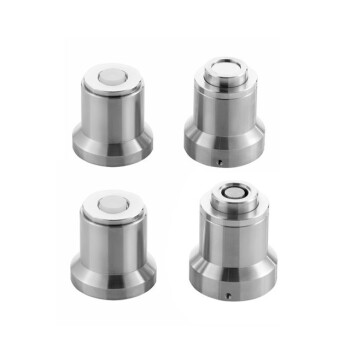
The primary purpose of using high-hardness molds with a hydraulic press is to achieve rigorous standardization. This combination allows you to fabricate solid electrolyte and electrode samples with high dimensional accuracy and exceptionally flat surfaces. These physical characteristics are the absolute prerequisite for gathering valid, noise-free electrochemical data.
The reliability of solid-state battery research hinges on the quality of the solid-solid interface. High-hardness molds eliminate physical irregularities, ensuring that your test data reflects the intrinsic properties of the material rather than artifacts of the sample preparation process.
The Critical Role of Surface Precision
Ensuring Repeatable EIS Data
The most immediate benefit of high-finish alloy molds is the production of perfectly flat sample surfaces. Surface irregularities cause inconsistent contact resistance, which introduces significant noise into Electrochemical Impedance Spectroscopy (EIS) data. By standardizing the surface finish, you ensure that impedance readings are reproducible across different samples and test cycles.
Analyzing Charge Storage Kinetics
Accurate analysis of kinetics requires precise knowledge of the sample's geometry. High-hardness molds prevent deformation during the pressing process, ensuring the final sample maintains exact dimensions. This dimensional certainty allows you to calculate active surface area and volume with confidence, leading to precise kinetic modeling.
The Physics of Interface Formation
Reducing Interfacial Impedance
In solid-state batteries, ions must physically jump from one solid particle to another. The hydraulic press provides the force necessary to compact the material and eliminate voids, but the mold ensures this force results in a high-density, uniform pellet. This intimate particle-to-particle contact is essential for creating low-impedance ion transport pathways.
Evaluating Material Systems
To compare two different electrolyte materials, the geometric variables must be identical. High-hardness molds act as a control variable, ensuring that performance differences observed in the lab are due to chemical variations in the material systems, not inconsistencies in the sample thickness or density.
Common Pitfalls to Avoid
The Risk of Soft Molds
Using molds made of softer metals can lead to microscopic deformations in the mold wall over time. This results in samples with inconsistent diameters or slightly tapered edges. Even minor geometric deviations can skew volumetric density calculations and alter the pressure distribution during testing.
Overlooking Surface Finish
A mold may be hard but lack a high-finish polish. Rough mold surfaces transfer texture to the sample, reducing the effective contact area between the electrode and the current collector. This artificially inflates the internal resistance of the test cell, potentially leading you to discard a viable material candidate.
Making the Right Choice for Your Goal
When selecting your preparation equipment, align your choice with your specific analytical needs:
- If your primary focus is fundamental kinetics: Prioritize molds with the highest possible surface finish to minimize contact resistance errors in your calculations.
- If your primary focus is material screening: Prioritize high-hardness durability to ensure identical sample geometry across hundreds of comparative tests.
High-precision sample preparation is not just a procedural step; it is the invisible foundation of reproducible solid-state battery research.
Summary Table:
| Feature | Benefit for Solid-State Battery Research |
|---|---|
| High Dimensional Accuracy | Ensures repeatable volumetric density and kinetic modeling calculations |
| Exceptional Surface Flatness | Minimizes contact resistance for noise-free EIS data |
| High Hardness Durability | Prevents mold deformation to maintain identical geometry across multiple tests |
| Optimized Force Distribution | Eliminates internal voids for superior ion transport and low-impedance pathways |
Elevate Your Battery Research with KINTEK Precision
Reliable electrochemical data starts with perfect sample preparation. KINTEK specializes in comprehensive laboratory pressing solutions tailored for the next generation of energy storage. Whether you require manual, automatic, heated, or glovebox-compatible models, our equipment ensures the rigorous standardization needed for valid EIS and kinetic analysis. From cold and warm isostatic presses to high-durability alloy molds, we provide the tools to eliminate preparation artifacts and focus on your material's intrinsic properties.
Ready to standardize your solid-state workflows? Contact KINTEK today for a customized pressing solution.
References
- Shashi Prakash Dwivedi, Jasgurpreet Singh Chohan. Fundamentals of Charge Storage in Next-Generation Solid-State Batteries. DOI: 10.1088/1742-6596/3154/1/012007
This article is also based on technical information from Kintek Solution Knowledge Base .
Related Products
- Carbide Lab Press Mold for Laboratory Sample Preparation
- Lab Cylindrical Press Mold for Laboratory Use
- Lab Ring Press Mold for Sample Preparation
- Lab Infrared Press Mold for Laboratory Applications
- Warm Isostatic Press for Solid State Battery Research Warm Isostatic Press
People Also Ask
- What is the purpose of incorporating cartridge heaters into a lab press mold for MLCC block compression? Optimize Results
- What is the function of a pressing tool in thermoplastic panels? Master Precision Shaping & Fusion Bonding
- Why is precise cooling management of the lab press mold necessary? Protect Core Integrity in Thermoforming
- How does the geometry of laboratory molds influence mycelium-based composites? Optimize Density and Strength
- What is the significance of standardized molds in lab presses? Ensure Precise Seal Material Evaluation