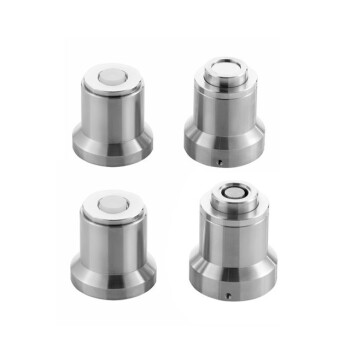
The primary purpose of standardized compression-style cell molds is to apply stable, controllable mechanical pressure to solid-state battery components while maintaining a sealed environment. By compressing the anode, gel polymer electrolyte (GPE), LAGP pellet, and air cathode, these fixtures ensure intimate physical contact between layers. This is essential for minimizing interfacial impedance and facilitating reliable testing under a pure oxygen atmosphere.
In solid-state lithium-oxygen research, the mold acts as both a mechanical stabilizer and an environmental chamber. It overcomes the inherent high resistance of solid-solid interfaces by forcing component contact, ensuring that performance data reflects the material's chemistry rather than poor connectivity.
The Role of Mechanical Pressure
Overcoming Solid-Solid Interface Challenges
Unlike liquid systems where the electrolyte wets the electrode surface, solid-state batteries rely on physical contact for ion transport.
Without external force, microscopic gaps exist between the anode, GPE separator, LAGP electrolyte, and air cathode.
The compression mold applies the necessary force to close these gaps, creating a continuous path for ionic movement.
Reducing Interfacial Impedance
High resistance at component boundaries, known as interfacial impedance, significantly degrades battery performance.
The mold's ability to apply stable and controllable pressure directly combats this issue.
By optimizing contact, the setup lowers the resistance barrier, allowing researchers to evaluate the intrinsic electrochemical performance of the materials.
Environmental Integrity
Enabling Pure Oxygen Testing
Lithium-oxygen batteries require a specific gaseous environment to function correctly.
The airtight design of these standardized molds isolates the internal components from the ambient atmosphere.
This isolation allows for testing under a pure oxygen atmosphere, preventing contamination from moisture or other atmospheric gases that could skew results.
Understanding the Trade-offs
Test Fixtures vs. Commercial Reality
While these molds are excellent for isolating variables in a lab setting, they are specialized test fixtures, not commercial prototypes.
The massive structural reinforcement required to maintain high pressure makes the mold heavy and bulky relative to the active battery material.
Consequently, performance metrics related to gravimetric energy density (energy per unit weight) derived from these cells must be calculated based on active materials, not the total cell weight.
Making the Right Choice for Your Goal
To maximize the utility of compression-style molds in your research, align the setup with your specific evaluation targets:
- If your primary focus is lowering internal resistance: Prioritize the mold's torque or pressure controls to optimize the physical contact at the solid-solid interfaces.
- If your primary focus is reaction chemistry analysis: Prioritize the integrity of the mold's seals to ensure the pure oxygen atmosphere remains uncompromised throughout the cycle.
Standardized compression is the baseline requirement for distinguishing true material behavior from experimental artifacts in solid-state systems.
Summary Table:
| Key Function | Benefit for Research |
|---|---|
| Mechanical Pressure | Eliminates microscopic gaps and minimizes interfacial impedance. |
| Airtight Sealing | Maintains a pure oxygen atmosphere and prevents atmospheric contamination. |
| Stable Contact | Ensures reliable ion transport between anode, electrolyte, and cathode layers. |
| Environmental Control | Isolates material chemistry from experimental artifacts for accurate data. |
Elevate Your Battery Research with KINTEK Precision
To achieve accurate electrochemical evaluations, stable and controllable mechanical pressure is non-negotiable. KINTEK specializes in comprehensive laboratory pressing solutions, offering manual, automatic, heated, multifunctional, and glovebox-compatible models. Whether you are developing next-generation solid-state lithium-oxygen batteries or exploring advanced material chemistry, our cold and warm isostatic presses provide the uniform pressure needed to eliminate interfacial impedance.
Ready to optimize your solid-state cell performance? Contact KINTEK today to find the perfect pressing solution for your lab!
Related Products
- Lab Button Battery Tablet Press Sealing Mold
- Carbide Lab Press Mold for Laboratory Sample Preparation
- Lab Cylindrical Press Mold for Laboratory Use
- Lab Button Battery Disassembly and Sealing Mold
- Lab Polygon Press Mold
People Also Ask
- How does a sealed battery mold facilitate the assembly and testing of asymmetric supercapacitors using VO2?
- Why use standardized CR2032 components & high-precision presses? Ensure reliability in lithium metal battery research.
- Why is a laboratory battery sealing press essential for desolvation energy testing? Ensure Reliable Kinetic Data
- What is the function of specialized battery molds and sealing consumables? Optimize Your In-situ XRD Testing Today
- What role does a laboratory sealing press play in thermal analysis of solid dispersion films? Ensure Data Integrity