
The primary risk associated with using high pressure on solid-state batteries is the mechanical fracture of the ceramic electrolyte. Because ceramic electrolytes are inherently brittle, applying excessive stack pressure to ensure contact with the anode can cause the material to crack, leading to compromised structural integrity, internal short circuits, and complete device failure.
The central engineering challenge in solid-state battery assembly is a balancing act: you must apply enough pressure to close microscopic voids and lower resistance, but not so much that you shatter the fragile ceramic separator.
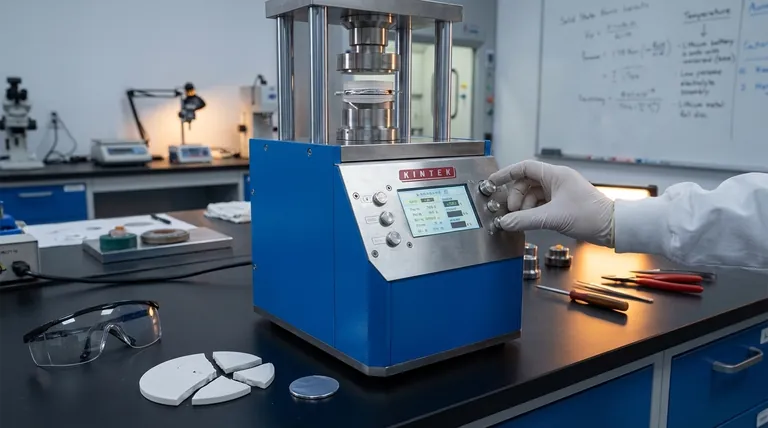
The Mechanics of Failure
The Brittleness of Ceramics
Unlike liquid electrolytes or polymer separators, ceramic solid electrolytes possess low ductility. They are hard but fragile.
When high pressure is applied via a hydraulic press, the material cannot deform plastically to absorb the stress. Instead, once the yield strength is exceeded, the ceramic undergoes catastrophic brittle fracture.
Consequences of Cracking
A fractured electrolyte is a failed electrolyte. Even microscopic cracks destroy the battery's function.
These fissures create direct pathways for internal short circuits. Furthermore, once the structural integrity is compromised, the device can no longer maintain the necessary separation between the anode and cathode, rendering the battery unsafe or inoperable.
Why Pressure Remains Essential
Despite the risks, you cannot eliminate high pressure from the assembly process. It serves three critical functions that are fundamental to battery performance.
Reducing Interfacial Impedance
Solid-to-solid contact is naturally poor compared to liquid-to-solid interfaces.
References indicate that applying pressure (e.g., 25 MPa) can reduce interfacial impedance drastically—in some cases dropping from over 500 Ω to approximately 32 Ω. Without this pressure, ion transport is choked off at the interface.
Leveraging Lithium Plasticity
Pressure is required to physically deform the lithium metal anode.
Because lithium is plastic (malleable), pressure causes it to creep and fill microscopic pores on the ceramic surface. This creates the intimate, void-free contact necessary for efficient ion transfer and stable electrochemical measurements.
Densification of Green Pellets
During the fabrication phase (before sintering), pressure is used to cold-press electrolyte powder.
Uniform high pressure minimizes internal porosity, packing particles tightly. This establishes the physical foundation required to sinter a dense, high-conductivity ceramic sheet.
Understanding the Trade-offs
The Contact vs. Integrity Conflict
The assembly process is governed by a strict trade-off.
If the pressure is too low, you retain high interfacial resistance and voids, leading to poor rate performance and potential dendrite growth.
If the pressure is too high, you achieve excellent contact momentarily, but fracture the electrolyte, destroying the cell.
Process-Specific Risks
The risk profile changes depending on the assembly stage.
During green pellet formation, the risk is primarily non-uniform density. However, during final stack assembly (contacting the anode), the risk of fracture is highest because the ceramic is already sintered and rigid.
Making the Right Choice for Your Goal
To navigate this trade-off effectively, align your pressure protocols with your specific objective.
- If your primary focus is Assembly Yield: Prioritize step-wise pressure application to identify the precise threshold where contact is maximized before fracture occurs.
- If your primary focus is Electrochemical Performance: Utilize the maximum safe pressure to drive impedance down, leveraging the creep of the lithium metal to eliminate voids at the interface.
- If your primary focus is Material Fabrication: Ensure the hydraulic press applies pressure uniformly to minimize porosity in the green pellet, which prevents defects during the sintering phase.
Success in solid-state assembly relies not on eliminating pressure, but on precisely controlling it to facilitate ion transport without exceeding the fracture toughness of the ceramic.
Summary Table:
| Risk Factor | Consequence | Key Consideration |
|---|---|---|
| Brittle Fracture | Catastrophic material failure, internal short circuits | Pressure must stay below the ceramic's fracture toughness |
| High Interfacial Impedance | Poor ion transport, reduced performance | Pressure is needed to reduce impedance (e.g., from 500Ω to 32Ω) |
| Void Formation | Unstable electrochemistry, dendrite growth | Pressure ensures intimate anode/electrolyte contact via lithium creep |
| Non-Uniform Density | Defects in the final sintered ceramic | Uniform pressure is critical during green pellet formation |
Master the delicate balance of pressure in your solid-state battery assembly.
Applying the correct pressure is critical to avoiding ceramic electrolyte fracture while ensuring optimal electrochemical performance. KINTEK specializes in precision lab press machines, including automatic and heated lab presses, designed to deliver the uniform, controlled pressure essential for your laboratory's solid-state battery R&D.
Our equipment helps you achieve high assembly yield and superior material fabrication by providing the precise control needed to navigate the contact vs. integrity trade-off. Let us help you enhance your research efficiency and battery performance.
Contact KINTEK today to find the perfect lab press solution for your specific solid-state battery development goals.
Visual Guide

Related Products
- Automatic High Temperature Heated Hydraulic Press Machine with Heated Plates for Lab
- Manual Heated Hydraulic Lab Press with Integrated Hot Plates Hydraulic Press Machine
- Heated Hydraulic Press Machine with Heated Plates for Vacuum Box Laboratory Hot Press
- Laboratory Hydraulic Press 2T Lab Pellet Press for KBR FTIR
- Laboratory Hydraulic Press Lab Pellet Press Machine for Glove Box
People Also Ask
- Function of a Laboratory Hydraulic Press with Heated Platens in SSE? Enhance Battery Density & Conductivity
- What are the requirements for electrode pressing with high-viscosity ionic liquids like EMIM TFSI? Optimize Performance
- How does a laboratory heated hydraulic press facilitate PBN sample prep for WAXS? Achieve Precise X-Ray Scattering
- What are the industrial applications of heated hydraulic presses? Master Heat & Force for Precision Manufacturing
- Why is a laboratory hydraulic press with heating plates required for PLA/TEC films? Achieve Precise Sample Integrity



















