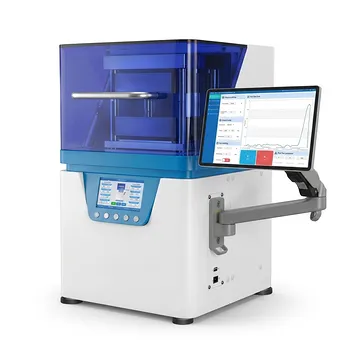
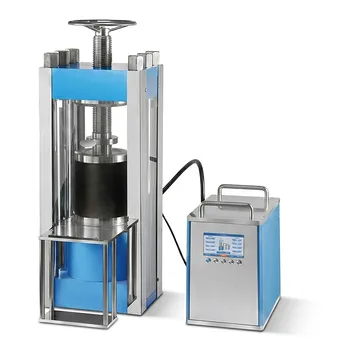
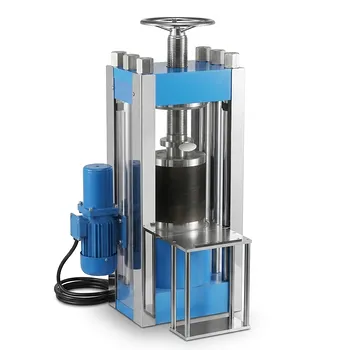
The primary role of a laboratory hot press in wood surface densification is to provide synchronized high temperature and high pressure to plasticize and collapse the wood's surface cell walls. By simultaneously softening the wood’s internal components and applying mechanical force, the press significantly increases surface density and hardness, transforming the material's structural properties.
The laboratory hot press acts as the critical catalyst for densification by using heat to reduce the wood's viscoelastic resistance, allowing precise mechanical pressure to permanently compress the internal pore structure. This synergy reduces porosity and increases the proportion of cell wall substance per unit volume, creating a high-strength, high-density material.
The Mechanics of Structural Transformation
Thermal Plasticization of Cell Wall Components
The heating function of the laboratory press raises the internal temperature of the wood to its softening point, typically between 120°C and 200°C. This thermal energy targets the lignin and hemicellulose, the natural polymers that provide wood with its rigidity. Once these components reach a softened, "rubbery" state, the wood's resistance to deformation is drastically lowered.
Pore Reduction and Lumen Collapse
While the wood is in this softened state, the hydraulic system applies uniaxial compressive force to the surface. This pressure causes the internal lumens (hollow cell centers) to fold and collapse, effectively squeezing out internal air space. By reducing internal porosity, the press rearranges the wood fibers into a tightly bonded, high-density configuration.
Significant Density Increases
The laboratory press provides the physical foundation for dramatic material changes, such as raising density from approximately 497 kg/m³ to 919 kg/m³. In specific workflows, this results in a compression rate of up to 50 percent of the original thickness. This increase in density is what enhances the shear performance and mechanical load-bearing capacity of the wood.
Precision Control for Material Quality
Temperature Uniformity and Densification Depth
The uniformity of the heating plates directly determines the consistency of the densified layer across the wood surface. If heat distribution is uneven, the depth of the densification will vary, leading to unpredictable surface hardness. Precise temperature control ensures that the thermal energy penetrates to the exact depth required for the specific application.
Pressure Synchronization and Stability
Maintaining a specific duration of pressure while the wood is at its softening point is essential for achieving a stable, high-density state. The laboratory hot press allows researchers to explore process parameters that prevent the wood from "springing back" to its original thickness. This stability is critical for the development of new materials like densified Cross-Laminated Timber (CLT).
Small-Scale R&D Versatility
In a research environment, the laboratory hot press is indispensable for preparing small-scale samples for testing and analysis. It allows for the precise adjustment of variables—such as pressure, temperature, and time—to determine the optimal settings for large-scale production. This controlled environment is the primary tool for exploring how different wood species react to thermomechanical strengthening.
Understanding the Trade-offs and Pitfalls
Risk of Micro-Fractures
While high pressure is necessary for densification, applying excessive force too rapidly can cause micro-fractures in the cell walls. If the pressure exceeds the structural integrity of the softened fibers, the resulting material may have high density but lower-than-expected tensile strength. Finding the balance between compression and fiber preservation is a key technical challenge.
Thermal Degradation Concerns
Maintaining high temperatures for extended periods can lead to the thermal degradation of wood hemicelluloses, which may darken the wood or reduce its natural elasticity. A laboratory press must offer precise timing controls to ensure that the wood is heated long enough to plasticize, but not so long that it begins to lose its chemical integrity.
Dimensional Recovery (Spring-Back)
A common pitfall in the densification process is "set recovery," where the wood attempts to return to its original shape when exposed to moisture. If the hot press parameters are not optimized to "set" the deformation permanently, the densification effect may be temporary. This requires a sophisticated understanding of the relationship between cooling cycles and pressure release.
Applying Densification to Your Project Goals
Optimizing the Process for Success
To achieve the best results with a laboratory hot press, your technical approach should align with the specific mechanical requirements of your end product.
- If your primary focus is maximum surface hardness: Prioritize high platen temperature (up to 200°C) to ensure deep plasticization of the surface fibers before peak pressure is applied.
- If your primary focus is structural shear performance: Focus on achieving a consistent 50% compression rate by maintaining synchronized pressure and heat for longer durations to ensure stable cell wall rearrangement.
- If your primary focus is exploring new wood species: Utilize the press to run small-scale incremental tests, varying the temperature between 120°C and 160°C to find the specific softening point of that species' lignin.
By mastering the synergy of heat and pressure, the laboratory hot press enables the creation of high-performance wood materials that rival the strength of much heavier synthetic alternatives.
Summary Table:
| Key Feature | Role in Densification | Impact on Wood Property |
|---|---|---|
| Synchronized Heating | Softens lignin and hemicellulose (120°C-200°C) | Transitions wood to a plasticized state |
| Mechanical Pressure | Collapses internal cell lumens and pores | Increases density (e.g., from 497 to 919 kg/m³) |
| Precision Control | Maintains stable pressure during cooling | Prevents "spring-back" and dimensional recovery |
| Uniform Heat Plates | Ensures consistent thermal penetration | Guarantees uniform surface hardness and depth |
Optimize Your Research with KINTEK Pressing Solutions
Achieve unmatched precision in wood surface densification and material science with KINTEK. As specialists in comprehensive laboratory pressing solutions, we provide the tools necessary to transform raw materials into high-performance assets.
Our extensive range includes:
- Manual & Automatic Hot Presses: For precise control over temperature and pressure cycles.
- Heated & Multifunctional Models: Designed for versatile R&D applications.
- Glovebox-Compatible Systems: Ensuring safety for sensitive material processing.
- Cold and Warm Isostatic Presses: Widely applied in advanced battery research and metallurgy.
Don't let process instability hinder your results. Benefit from our expertise in thermal plasticization and structural transformation.
Contact KINTEK today to find the perfect press for your laboratory!
References
- Benedikt Neyses, Dick Sandberg. Pre-treatment with sodium silicate, sodium hydroxide, ionic liquids or methacrylate resin to reduce the set-recovery and increase the hardness of surface-densified Scots pine. DOI: 10.3832/ifor2385-010
This article is also based on technical information from Kintek Solution Knowledge Base .
Related Products
- 24T 30T 60T Heated Hydraulic Lab Press Machine with Hot Plates for Laboratory
- Laboratory Split Manual Heated Hydraulic Press Machine with Hot Plates
- Heated Hydraulic Press Machine with Heated Plates for Vacuum Box Laboratory Hot Press
- Automatic Heated Hydraulic Press Machine with Hot Plates for Laboratory
- Automatic Large Format Laboratory Heated Hydraulic Press 400x400mm Plate Capacity
People Also Ask
- What is the primary function of a laboratory heated hydraulic press? Mastering Thermoplastic Carbon Fiber Composites
- Function of a Laboratory Hydraulic Press with Heated Platens in SSE? Enhance Battery Density & Conductivity
- Why Use a Laboratory Heated Hydraulic Press for SSAB CCM? Optimize Solid-State Battery Interfacial Bonding
- Why is a laboratory heated hydraulic press essential for PHB films? Achieve Flawless Material Characterization
- What role does a laboratory heated hydraulic press play in LTCC? Essential for High-Density Ceramic Lamination