
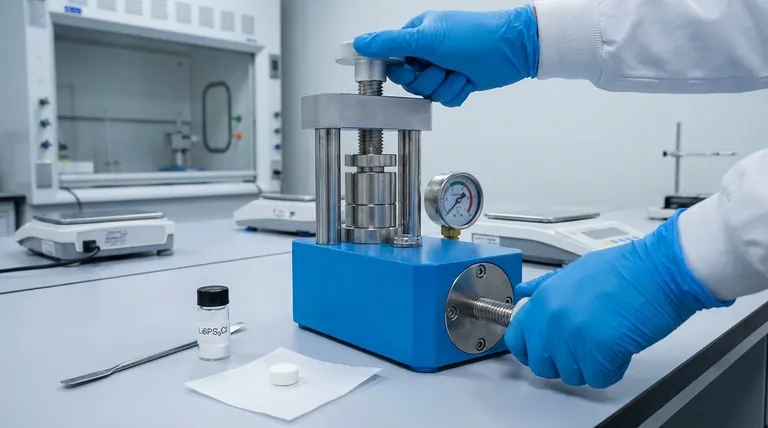
The primary role of a laboratory hydraulic press is to apply precise, high-magnitude pressure to compact loose Li6PS5Cl powder into a dense, solid pellet. This process is not merely about shaping the material; it is the critical step for minimizing porosity and forcing individual powder particles into intimate contact. Without this high-pressure consolidation, the material cannot achieve the structural integrity or electrochemical properties required for operation.
The press acts as the bridge between raw material and functional component. Its defining purpose is to create continuous lithium-ion transport channels by mechanically reducing voids and interfacial resistance, which is the direct prerequisite for high ionic conductivity.
The Mechanics of Densification
Eliminating Microscopic Voids
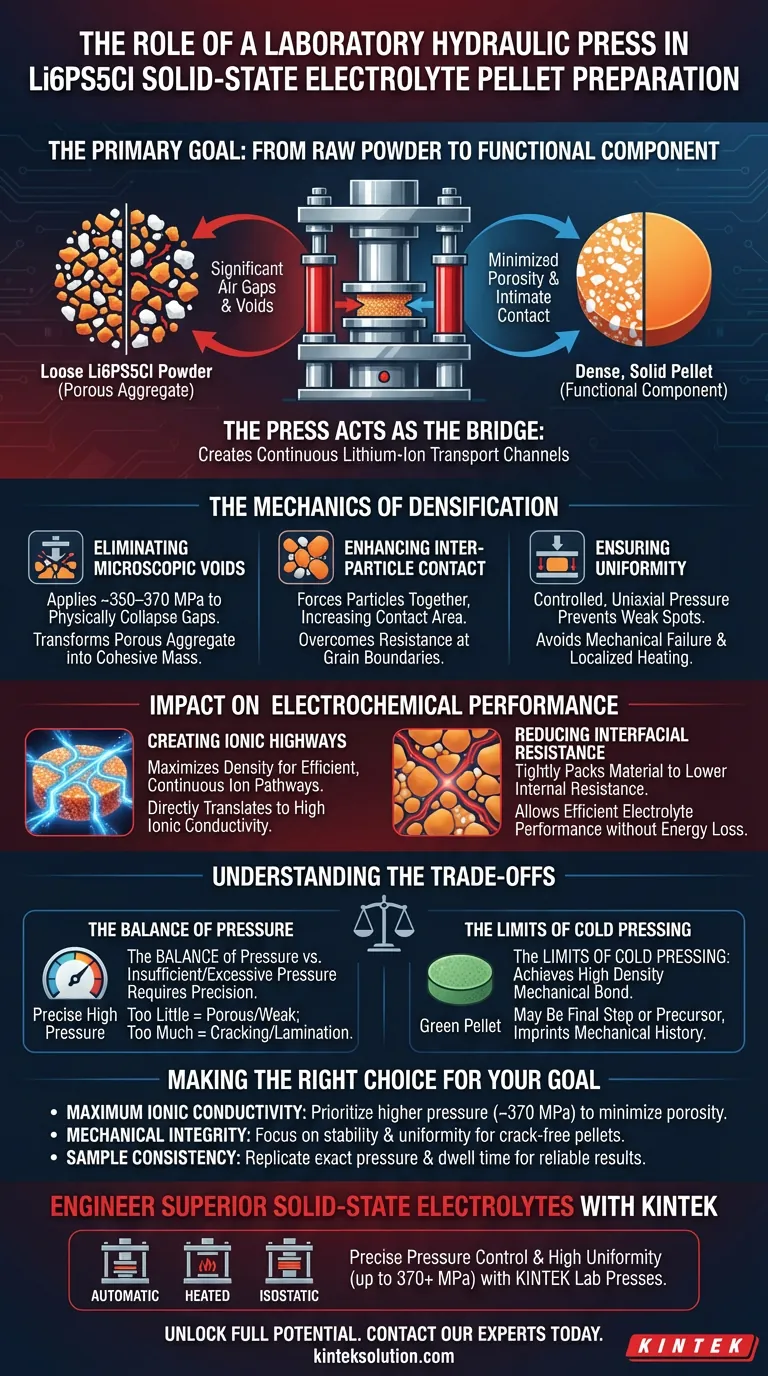
Loose Li6PS5Cl powder naturally contains significant air gaps and voids between particles. A laboratory press applies sufficient force (often upwards of 350–370 MPa) to physically collapse these voids. This transforms a porous aggregate into a cohesive solid mass.
Enhancing Inter-Particle Contact
For ions to move, particles must be physically connected. The hydraulic press forces particles together, increasing the contact area between them. This deformation is essential for overcoming the natural resistance found at grain boundaries.
Ensuring Uniformity
The press provides controlled, uniaxial pressure. This ensures that the densification occurs evenly across the entire surface of the pellet. Uniformity is vital to prevent weak spots that could lead to mechanical failure or localized heating during battery operation.
Impact on Electrochemical Performance
Creating Ionic Highways
The ultimate goal of the pressing stage is to facilitate ion movement. By maximizing density, the press creates efficient, continuous pathways for lithium ions. This directly translates to the high ionic conductivity required for solid-state batteries.
Reducing Interfacial Resistance
Gaps between particles act as barriers to energy flow. By tightly packing the material, the press significantly lowers internal resistance. This allows the electrolyte to perform efficiently without significant energy loss at the micro-level.
Understanding the Trade-offs
The Balance of Pressure
While high pressure is necessary, it must be precise. Insufficient pressure results in a porous, mechanically weak pellet with poor conductivity. Conversely, uncontrolled or excessive pressure can introduce stress gradients that lead to cracking or lamination.
The Limits of Cold Pressing
The hydraulic press creates what is often called a "green pellet" or a cold-pressed compact. While this achieves high density, it is a mechanical bond. Depending on the specific protocol, this may be the final step for sulfides, or a precursor to further treatment, but the mechanical history imprinted by the press remains a defining factor in performance.
Making the Right Choice for Your Goal
To maximize the utility of your hydraulic press for Li6PS5Cl pellets, consider your specific experimental targets:
- If your primary focus is Maximum Ionic Conductivity: Prioritize higher pressure ranges (e.g., nearing 370 MPa) to absolutely minimize porosity and grain boundary resistance.
- If your primary focus is Mechanical Integrity: Focus on the stability and uniformity of the pressure application to ensure the pellet does not crack during ejection or handling.
- If your primary focus is Consistency: Ensure your press can replicate the exact pressure dwell time and force for every sample to eliminate process variables.
The hydraulic press is not just a forming tool; it is a microstructure engineering instrument that dictates the upper limit of your electrolyte’s efficiency.
Summary Table:
| Goal | Key Pressing Parameter | Expected Outcome |
|---|---|---|
| Maximum Ionic Conductivity | High Pressure (~370 MPa) | Minimized porosity, continuous ion pathways |
| Mechanical Integrity | Stable, Uniform Pressure Application | Crack-free, robust pellets |
| Sample Consistency | Precise Replication of Force & Dwell Time | Reliable, repeatable experimental results |
Ready to Engineer Superior Solid-State Electrolytes?
The precise pressure control of a KINTEK lab press is the key to unlocking the full potential of your Li6PS5Cl materials. Our automatic lab presses, heated lab presses, and isostatic presses are engineered to deliver the uniformity and high-pressure performance (up to 370+ MPa) your research demands.
Let us help you achieve the dense, highly conductive pellets essential for breakthrough battery development. Contact our experts today to find the perfect press for your laboratory's needs.
Visual Guide
Related Products
- Automatic Laboratory Hydraulic Press Lab Pellet Press Machine
- Manual Laboratory Hydraulic Press Lab Pellet Press
- Manual Laboratory Hydraulic Pellet Press Lab Hydraulic Press
- Laboratory Hydraulic Press 2T Lab Pellet Press for KBR FTIR
- Laboratory Hydraulic Press Lab Pellet Press Button Battery Press
People Also Ask
- What is the primary purpose of a manual lab hydraulic pellet press? Ensure Accurate Sample Prep for XRF and FTIR
- What is the primary purpose of manual lab hydraulic pellet presses? Achieve High-Precision Sample Preparation for Spectroscopy
- Why are high-precision automatic hydraulic presses required for Martian ISRU? Ensure Reliable Regolith Forming
- How does an automatic laboratory hydraulic press improve KBr pellet preparation? Achieve Precision IR Spectroscopy
- What are the advantages of using an automatic laboratory hydraulic press? Enhance Precision in Sample Preparation



















