
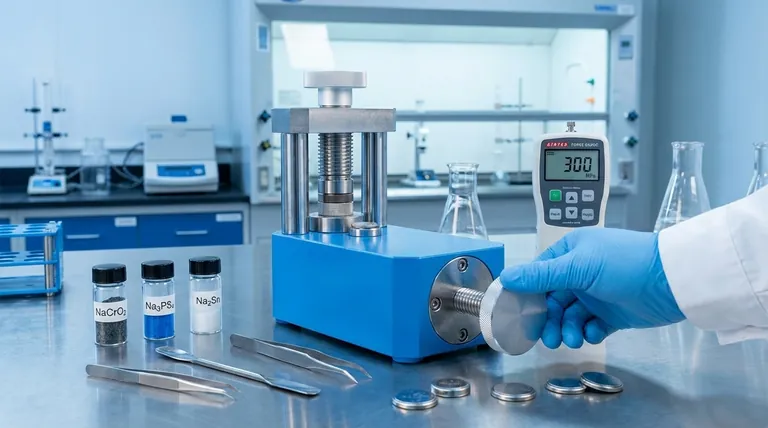
The application of 300 MPa of pressure is the decisive step that transforms loose powder components into a functional electrochemical device.
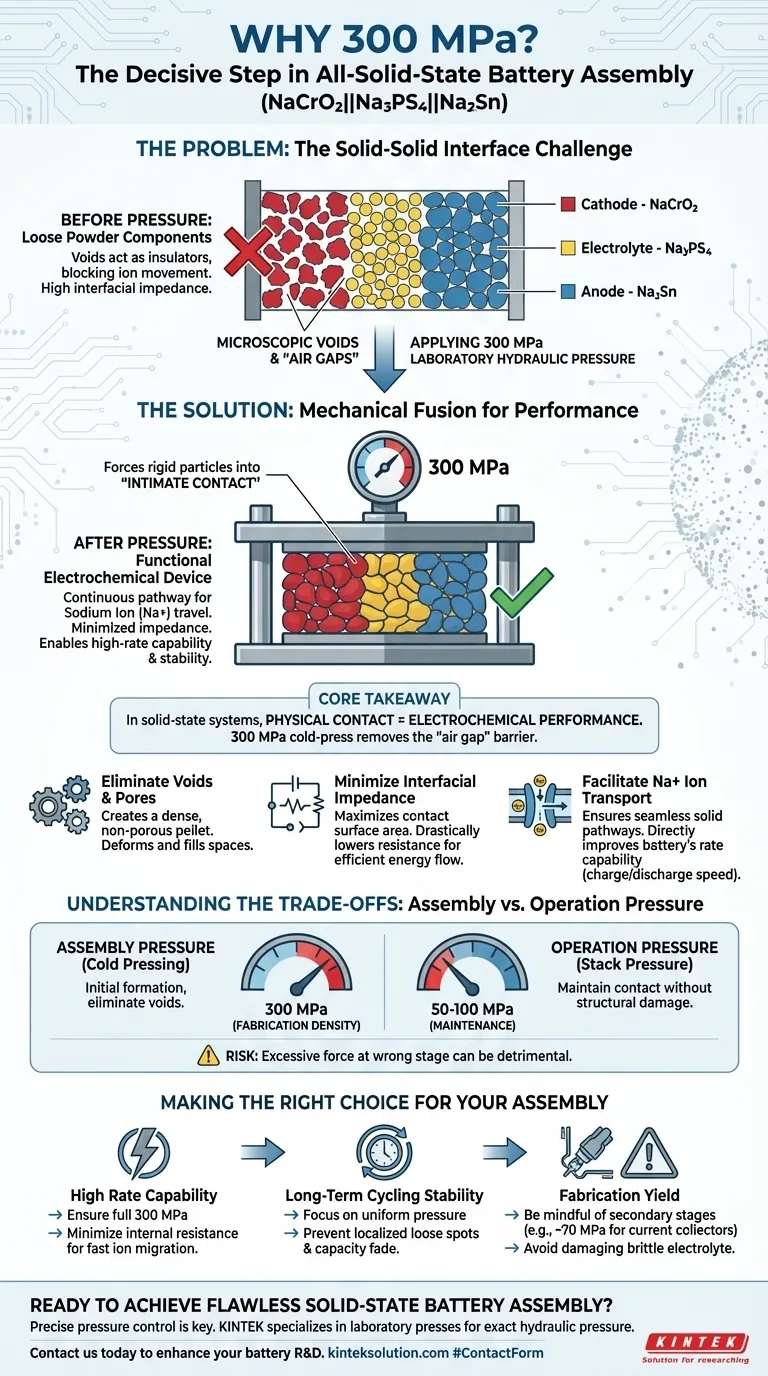
In an all-solid-state battery (ASSB) like NaCrO2||Na3PS4||Na2Sn, this specific hydraulic pressure is required to mechanically fuse the cathode, solid electrolyte, and anode layers. By applying this force, you eliminate microscopic voids and force the rigid particles into "intimate contact," creating a continuous pathway for sodium ions to travel. Without this densification, the internal resistance would be too high for the battery to operate.
Core Takeaway
In solid-state systems, physical contact equals electrochemical performance. The 300 MPa cold-press step effectively removes the "air gap" barrier between particles, minimizing interfacial impedance and enabling the smooth, rapid transport of sodium ions required for high-rate capability and stability.
Solving the Solid-Solid Interface Challenge
Liquid electrolytes naturally wet electrode surfaces, filling every pore. Solid electrolytes, like Na3PS4, do not have this luxury.
The 300 MPa step addresses the fundamental rigidity of solid materials.
Eliminating Voids and Pores
Before pressing, the interface between your NaCrO2 cathode and Na3PS4 electrolyte is full of microscopic gaps.
These voids act as insulators, blocking ion movement.
Applying 300 MPa creates a dense, non-porous pellet. It mechanically forces the electrolyte particles to deform and fill the spaces between the active material particles.
Minimizing Interfacial Impedance
Impedance (resistance) is the enemy of battery efficiency.
When layers are loose, the contact points are few, creating a bottleneck for current.
High-pressure assembly maximizes the surface area of contact between solids. This drastically lowers the interfacial impedance, allowing energy to flow with minimal loss.
Facilitating Sodium Ion Transport
For the battery to function, Sodium ions (Na+) must physically hop from the anode, through the electrolyte, to the cathode.
This transport cannot occur across open space; it requires a continuous solid pathway.
The 300 MPa pressure ensures these pathways are unbroken ("seamless"), directly improving the battery's rate capability—how fast it can charge and discharge.
Understanding the Trade-offs: Assembly vs. Operation
It is critical to distinguish between the pressure applied during assembly (Cold Pressing) and the pressure applied during testing (Stack Pressure).
The Distinction in Pressure Levels
You apply 300 MPa initially to form the structure. However, you generally do not maintain this extreme pressure during operation.
References suggest operating "stack pressures" are significantly lower (e.g., 50–100 MPa).
The 300 MPa is for fabrication density; the lower operating pressure is for maintenance of contact.
Risk of Structural Damage
While high pressure is necessary for density, excessive force at the wrong stage can be detrimental.
For example, secondary pressing stages (after the initial formation) often use lower pressures (e.g., ~70 MPa) to adhere current collectors without crushing the dense structure already formed.
Making the Right Choice for Your Assembly
When configuring your hydraulic press for NaCrO2||Na3PS4||Na2Sn cells, consider your specific performance targets.
- If your primary focus is High Rate Capability: Ensure you achieve the full 300 MPa to minimize internal resistance, as this dictates how quickly ions can migrate across the interface.
- If your primary focus is Long-Term Cycling Stability: Focus on the uniformity of the pressure distribution to prevent localized loose spots, which can lead to detachment and capacity fade over time.
- If your primary focus is Fabrication Yield: Be mindful of stepping down pressure during secondary assembly stages (attaching current collectors) to avoid damaging the brittle electrolyte layer you just formed.
Ultimately, the 300 MPa step is the bridge that turns a mixture of chemicals into a cohesive, conductive system capable of storing energy.
Summary Table:
| Pressure Purpose | Key Function | Outcome for NaCrO2||Na3PS4||Na2Sn Battery | |------------------|--------------|-----------------------------------------------| | Eliminate Voids | Force particles into intimate contact | Creates continuous pathway for sodium ion transport | | Minimize Impedance | Maximize solid-solid contact area | Lowers internal resistance, improves efficiency | | Facilitate Ion Transport | Ensure seamless particle interfaces | Enables high-rate charging/discharging capability | | Assembly vs. Operation | 300 MPa for fabrication, lower pressure for testing | Prevents structural damage while maintaining performance |
Ready to achieve flawless solid-state battery assembly?
Precise pressure control is the key to transforming your electrode and electrolyte powders into high-performance, functional cells. KINTEK specializes in laboratory press machines, including automatic lab presses and isostatic presses, designed to deliver the exact hydraulic pressure required for your specific battery chemistry.
Our equipment ensures uniform pressure distribution, critical for minimizing interfacial impedance and achieving the dense, non-porous layers necessary for superior sodium ion conductivity and long-term cycling stability in batteries like NaCrO2||Na3PS4||Na2Sn.
Contact us today to discuss how our lab press solutions can enhance your battery R&D and manufacturing yield. Let's build the future of energy storage, together.
Visual Guide
Related Products
- Laboratory Hydraulic Press Lab Pellet Press Button Battery Press
- Laboratory Hydraulic Press 2T Lab Pellet Press for KBR FTIR
- Laboratory Hydraulic Press Lab Pellet Press Machine for Glove Box
- 24T 30T 60T Heated Hydraulic Lab Press Machine with Hot Plates for Laboratory
- Automatic Laboratory Hydraulic Press Lab Pellet Press Machine
People Also Ask
- How is a laboratory hydraulic press used for HAP composite gels? Master Mineral Substrate Standardization
- What role does a laboratory hydraulic press play in reaction pellets? Optimizing Lunar Soil and Metal Fuel Density
- What role does a laboratory hydraulic press play in the preparation of piezoelectric ceramic discs for DC-PG? | KINTEK
- Why is a laboratory hydraulic press required for PBAT and PLA sample preparation? Achieve Flawless Characterization
- What role does a laboratory hydraulic press play in the assembly of all-solid-state battery test cells? Expert Guide



















