
The primary function of applying 300 MPa of pressure to Li6.4La3Zr1.4Ta0.6O12 (LLZT) powder is to consolidate the loose material into a cohesive, semi-dense "green body" prior to sintering. This mechanical compaction is essential for eliminating air voids and maximizing particle-to-particle contact, ensuring the pellet has sufficient structural integrity to withstand the subsequent high-temperature processing.
Core Insight: Compaction at 300 MPa is not merely about shaping the powder; it is a critical density-building step. By minimizing porosity at this stage, you establish the physical foundation required to achieve high ionic conductivity and suppress lithium dendrites in the final solid-state electrolyte.
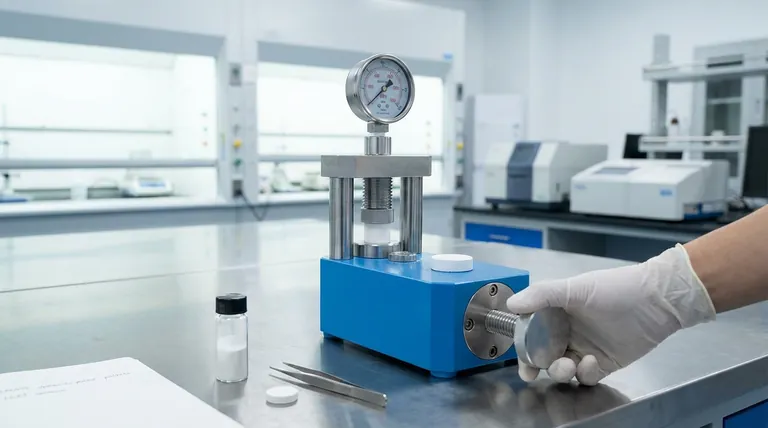
The Mechanics of Green Body Formation
Eliminating Interstitial Voids
The loose LLZT powder contains a significant volume of air and empty space between particles. Applying 300 MPa forces the particles closer together, mechanically collapsing these interstitial voids. This reduction in initial porosity is the first step toward creating a fully dense ceramic.
Maximizing Particle Contact
For the chemical reactions and densification that occur during sintering to be effective, particles must physically touch. High-pressure compaction ensures intimate contact between grains. This contact establishes continuous pathways that facilitate material diffusion later in the process.
Ensuring Mechanical Integrity
Before sintering, the pressed powder is known as a "green body." It must be strong enough to be ejected from the mold and handled without crumbling. The 300 MPa pressure provides adequate "green strength" to maintain the disk's shape during transfer to the sintering furnace.
Impact on Sintering and Final Properties
Facilitating Uniform Shrinkage
A denser green body leads to more predictable and uniform shrinkage during the sintering phase. Because the particles are already tightly packed, the material can densify further with less risk of deformation. This control is vital for preventing cracking or warping in the final ceramic disk.
Enhancing Ionic Conductivity
The ultimate goal of an LLZT electrolyte is to transport lithium ions efficiently. By reducing porosity early on, the final sintered pellet achieves a higher relative density. This high density creates unobstructed pathways for ion transport, directly resulting in superior ionic conductivity.
Suppressing Lithium Dendrites
Porosity in a solid electrolyte can allow lithium metal dendrites to penetrate the material, leading to short circuits. The high-density structure initiated by the 300 MPa compression acts as a physical barrier. A dense, low-porosity pellet is far more resistant to dendrite propagation, enhancing the safety of the battery.
Critical Considerations in Pressure Application
The Necessity of Uniformity
While high pressure is necessary, the application of that pressure must be uniform across the pellet. Ref 6 highlights the importance of a "uniform density gradient." If pressure is uneven, internal stresses can develop, leading to cracks during the sensitive sintering phase.
The Limits of Cold Pressing
It is important to recognize that 300 MPa creates a green density, not the final ceramic density. This step is a prerequisite for sintering, not a replacement for it. The mechanical strength achieved here is temporary and serves only to facilitate the thermal fusing of particles that follows.
Making the Right Choice for Your Goal
To maximize the effectiveness of your pelletizing process, align your technique with your specific performance targets:
- If your primary focus is High Ionic Conductivity: Ensure your pressure hold time is sufficient to fully deaerate the powder, as trapped air will result in residual porosity that blocks ion flow.
- If your primary focus is Mechanical Reliability: Prioritize the precision and alignment of your hydraulic press to ensure the pressure is applied uniformly, preventing density gradients that cause cracking.
Applying 300 MPa is the defining step that transforms a pile of loose powder into the precursor for a high-performance, safe solid-state electrolyte.
Summary Table:
| Purpose of 300 MPa Pressure | Key Outcome for LLZT Electrolyte |
|---|---|
| Consolidate Powder | Forms a cohesive, semi-dense "green body" with structural integrity. |
| Eliminate Air Voids | Reduces initial porosity, establishing a foundation for final densification. |
| Maximize Particle Contact | Ensures intimate contact for effective diffusion and sintering. |
| Ensure Mechanical Integrity | Provides sufficient green strength for handling before sintering. |
| Facilitate Uniform Sintering | Leads to predictable shrinkage, preventing cracks and warping. |
| Enhance Ionic Conductivity | Creates unobstructed pathways for superior lithium-ion transport. |
| Suppress Lithium Dendrites | Acts as a physical barrier to enhance battery safety. |
Ready to optimize your solid-state electrolyte research with precise and reliable compaction?
The correct application of high pressure is fundamental to developing high-performance LLZT pellets. KINTEK specializes in laboratory press machines—including automatic lab presses, isostatic presses, and heated lab presses—designed to deliver the uniform, high-pressure compaction your advanced materials require.
Our equipment ensures the density and integrity of your green bodies, directly contributing to the success of your sintering process and the final properties of your solid electrolytes. Let us help you achieve superior ionic conductivity and enhanced battery safety.
Contact our experts today to discuss your specific pelletizing needs and discover the perfect press for your laboratory.
Visual Guide

Related Products
- Automatic Laboratory Hydraulic Press Lab Pellet Press Machine
- Manual Laboratory Hydraulic Pellet Press Lab Hydraulic Press
- Laboratory Hydraulic Split Electric Lab Pellet Press
- Laboratory Hydraulic Press Lab Pellet Press Machine for Glove Box
- Laboratory Hydraulic Press Lab Pellet Press Button Battery Press
People Also Ask
- What is the primary purpose of a manual lab hydraulic pellet press? Ensure Accurate Sample Prep for XRF and FTIR
- What is the primary purpose of manual lab hydraulic pellet presses? Achieve High-Precision Sample Preparation for Spectroscopy
- Why are high-precision automatic hydraulic presses required for Martian ISRU? Ensure Reliable Regolith Forming
- How does an automatic laboratory hydraulic press improve KBr pellet preparation? Achieve Precision IR Spectroscopy
- What are the advantages of using an automatic laboratory hydraulic press? Enhance Precision in Sample Preparation



















