
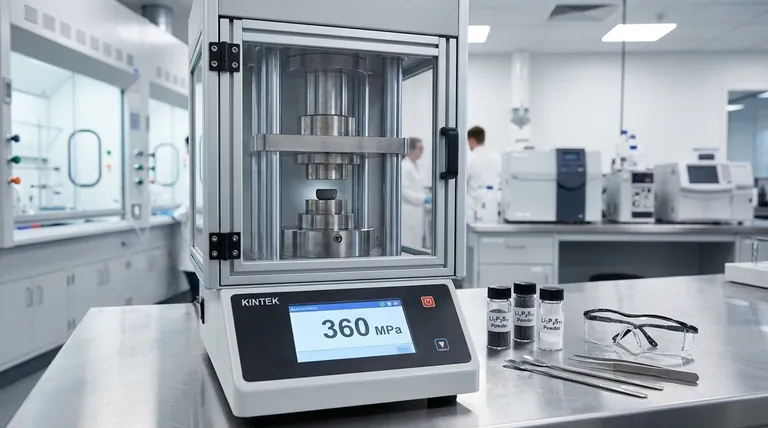
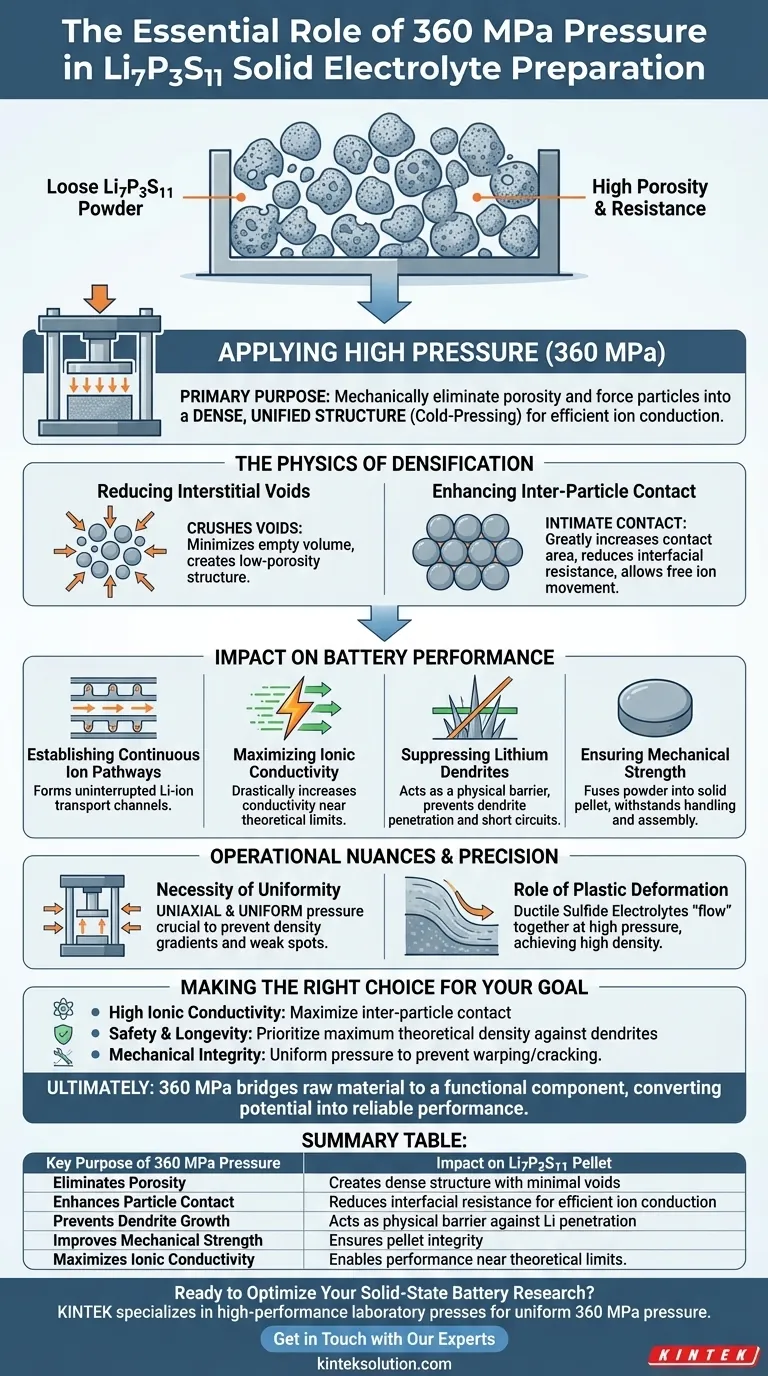
The primary purpose of applying high pressure, such as 360 MPa, is to mechanically eliminate porosity and force the Li7P3S11 powder particles into a dense, unified structure. This process, known as cold-pressing, is the critical step that transforms loose, resistive powder into a cohesive electrolyte layer capable of efficient ion conduction.
The Core Mechanics of Densification By applying high pressure, you are not merely shaping the material; you are engineering its microstructure. The force collapses interstitial voids and maximizes the surface area contact between particles, creating the continuous transport pathways required for high ionic conductivity and battery safety.
The Physics of High-Pressure Densification
To understand why 360 MPa is necessary, one must look at the microscopic behavior of sulfide-based solid electrolytes like Li7P3S11.
Reducing Interstitial Voids
Loose powder naturally contains significant gaps, or interstitial voids, between individual grains. These voids act as barriers to electricity and ion movement.
Applying high pressure creates a "dense" pellet by mechanically crushing these voids. This compaction minimizes the empty volume within the material, resulting in a low-porosity structure essential for performance.
Enhancing Inter-Particle Contact
Conductivity in solid-state batteries relies on ions "hopping" from one particle to the next. If particles are barely touching, the resistance at that interface is extremely high.
The pressure of 360 MPa forces particles into intimate physical contact. This greatly increases the contact area between grains, reducing interfacial resistance and allowing ions to move freely across grain boundaries.
Impact on Battery Performance
The physical changes induced by the laboratory press directly translate to the electrochemical capabilities of the final battery cell.
Establishing Continuous Ion Pathways
For a battery to function, lithium ions must travel from the anode to the cathode without interruption.
High-pressure compaction aligns the material to form continuous lithium-ion transport channels. Without this connectivity, ions would be trapped within isolated particles, rendering the electrolyte ineffective.
Maximizing Ionic Conductivity
The combination of reduced voids and enhanced particle contact leads to a drastic increase in overall ionic conductivity.
References indicate that high density is a fundamental requirement for achieving the high conductivity metrics associated with sulfide electrolytes. The pressure ensures the material performs near its theoretical limits rather than being hindered by its processing.
Suppressing Lithium Dendrites
Safety is a paramount concern in solid-state batteries, particularly regarding lithium dendrites—needle-like growths that can pierce the electrolyte and cause short circuits.
A dense, low-porosity pellet acts as a physical barrier. By eliminating the voids where dendrites typically initiate and grow, the high-pressure preparation helps effectively prevent dendrite penetration.
Ensuring Mechanical Strength
Beyond electrochemical performance, the electrolyte must be physically robust to withstand handling and cell assembly.
Compaction at pressures like 360 MPa fuses the powder into a solid pellet with adequate mechanical strength. This ensures the separator membrane maintains its integrity during operation and does not crumble or crack.
Operational Nuances and Precision
While applying pressure is the mechanism, the quality of that pressure determines the success of the pellet.
The Necessity of Uniformity
It is not enough to simply apply force; the pressure must be uniaxial and uniform.
A laboratory hydraulic press is used specifically to ensure that the 360 MPa is distributed evenly across the entire surface of the pellet. Uneven pressure results in density gradients, which create weak spots where dendrites can penetrate or where conductivity drops.
The Role of Plastic Deformation
Sulfide electrolytes like Li7P3S11 are somewhat unique because they are softer and more ductile than oxide ceramics.
This ductility allows them to undergo plastic deformation at high pressures (cold pressing). The 360 MPa pressure effectively "flows" the solid material together, achieving high density without the immediate need for high-temperature sintering in every context.
Making the Right Choice for Your Goal
When setting up your laboratory press parameters, align your pressure targets with your specific performance objectives.
- If your primary focus is High Ionic Conductivity: Ensure you reach pressures (e.g., 360 MPa) sufficient to maximize inter-particle contact and eliminate resistive grain boundaries.
- If your primary focus is Safety and Longevity: Prioritize achieving maximum theoretical density to minimize porosity, as this is your primary defense against lithium dendrite propagation.
- If your primary focus is Mechanical Integrity: Verify that the pressure is applied uniformly to prevent warping or cracking, ensuring the pellet can withstand downstream assembly processes.
Ultimately, the application of 360 MPa is the bridge between a raw material and a functional component, converting potential chemical energy into reliable electrochemical performance.
Summary Table:
| Key Purpose of 360 MPa Pressure | Impact on Li7P3S11 Pellet |
|---|---|
| Eliminates Porosity | Creates a dense, unified structure with minimal voids |
| Enhances Particle Contact | Reduces interfacial resistance for efficient ion conduction |
| Prevents Dendrite Growth | Acts as a physical barrier against lithium penetration |
| Improves Mechanical Strength | Ensures pellet integrity during handling and assembly |
| Maximizes Ionic Conductivity | Enables performance near theoretical limits |
Ready to Optimize Your Solid-State Battery Research?
Achieving precise, uniform pressure is essential for developing reliable Li7P3S11 solid electrolyte pellets. KINTEK specializes in high-performance laboratory presses, including automatic, isostatic, and heated models, designed to meet the exacting demands of solid-state battery development.
Our presses ensure the uniform 360 MPa pressure required to eliminate porosity, enhance ionic conductivity, and suppress dendrite growth—helping you create safer, more efficient batteries.
Contact us today to discuss how our lab press solutions can advance your research. Let's build the future of energy storage, together.
Visual Guide
Related Products
- Laboratory Hydraulic Split Electric Lab Pellet Press
- Manual Laboratory Hydraulic Pellet Press Lab Hydraulic Press
- Laboratory Hydraulic Press 2T Lab Pellet Press for KBR FTIR
- Laboratory Hydraulic Pellet Press for XRF KBR FTIR Lab Press
- Manual Laboratory Hydraulic Press Lab Pellet Press
People Also Ask
- What are the emerging trends in the design and materials of lab pellet presses? Modernize Your Lab Efficiency
- What are common lab pellet press issues? Expert Troubleshooting Guide for Reliable Material Research
- How do lab pellet presses support customization and flexibility? Optimize Your Sample Prep for Any Material
- What are the common operational types of lab pellet presses? Choosing the Right Manual, Automatic, or Hydraulic System
- Why use a laboratory pellet press for solid-state battery evaluation? Ensure Accuracy in Interface Stability Testing



















