
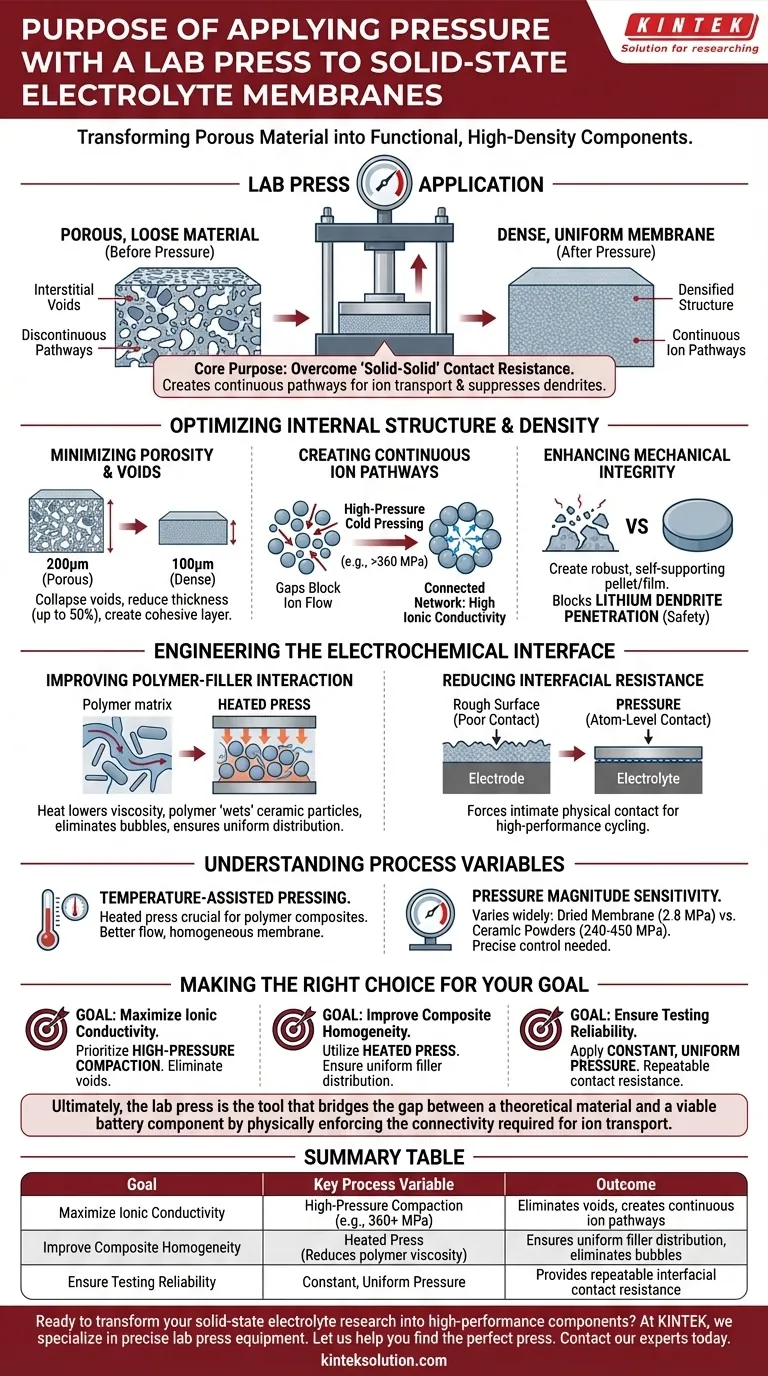
Applying pressure via a lab press is the fundamental manufacturing step required to transform a porous solid-state electrolyte into a functional, high-density component. This process mechanically compacts the material, significantly reducing its thickness—often by up to 50%—while eliminating internal voids to create a smooth, uniform structure essential for battery operation.
The core purpose of this compression is to overcome the inherent "solid-solid" contact resistance. By forcing particles into intimate physical contact, pressure creates continuous pathways for ion transport, directly dictating the membrane's ionic conductivity and mechanical capability to suppress dendrites.
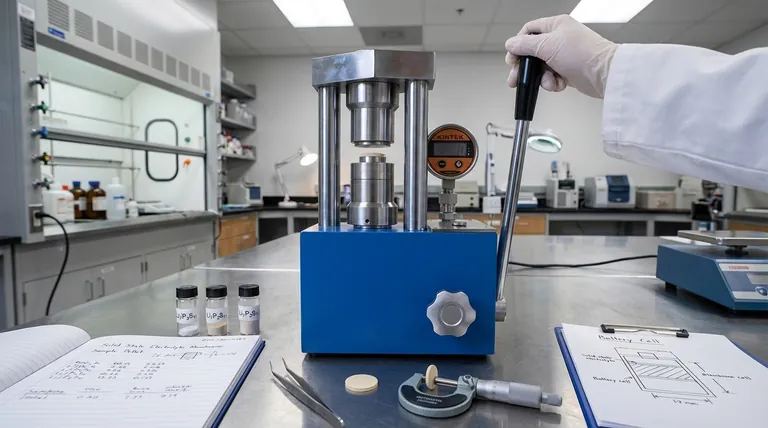
Optimizing Internal Structure and Density
Minimizing Porosity and Voids
The primary physical change induced by the lab press is densification. Whether working with dried polymer membranes or ceramic powders, the material naturally contains interstitial voids and pores.
Applying pressure (ranging from low MPa to hundreds of MPa) collapses these voids. For example, specific compaction processes can reduce a membrane's thickness from 200µm to 100µm, creating a tighter, more cohesive layer.
Creating Continuous Ion Pathways
In powder-based electrolytes (like Li7P3S11), loose particles create barriers to ion flow. High-pressure cold pressing—sometimes exceeding 360 MPa—is required to mash these particles together.
This eliminates the gaps between particles. The result is a continuous, connected network that allows ions to move freely, which is the definition of high ionic conductivity.
Enhancing Mechanical Integrity
A loose or porous membrane is structurally weak. Compaction creates a robust, self-supporting pellet or film.
This mechanical strength is not just for handling; a dense, low-porosity layer is critical for physically blocking lithium dendrite penetration, a primary safety failure mode in solid-state batteries.
Engineering the Electrochemical Interface
Improving Polymer-Filler Interaction
For composite electrolytes (mixing ceramic fillers with a polymer matrix), pressure ensures the polymer properly "wets" or coats the ceramic particles.
This is often improved by a heated press, which lowers the polymer's viscosity. This allows the matrix to flow into microscopic gaps, ensuring a uniform distribution of inorganic fillers and eliminating bubbles.
Reducing Interfacial Resistance
The greatest challenge in solid-state batteries is the solid-solid interface. Unlike liquid electrolytes, solids do not naturally flow into the surface roughness of electrodes.
Pressure acts as the forcing function to achieve atom-level contact between the electrolyte and the electrodes (cathode/anode). This intimate contact minimizes interfacial resistance, which is necessary for high-performance cycling.
Understanding Process Variables
Temperature-Assisted Pressing
While pressure alone is powerful, it has limitations with polymer composites. Using a heated laboratory press is often superior for these materials.
Heat reduces the viscosity of the polymer binder, allowing it to flow under pressure. This creates a more homogeneous membrane than pressure alone could achieve, effectively sealing internal voids.
Pressure Magnitude Sensitivity
The required pressure varies significantly based on the material state. Compacting a dried membrane might only require 2.8 MPa, while fusing ceramic powders or co-pressing cell layers often demands 240 MPa to 450 MPa.
Applying insufficient pressure leads to poor contact and high resistance. However, precise control is required to ensure the membrane is densified without damaging the structural integrity of the active materials.
Making the Right Choice for Your Goal
The application of pressure is not a "one size fits all" step; it must be tuned to the specific composition of your electrolyte and your performance targets.
- If your primary focus is Ionic Conductivity: Prioritize high-pressure compaction to maximize density and eliminate interstitial voids that act as bottlenecks for ion movement.
- If your primary focus is Composite Homogeneity: Utilize a heated press to lower polymer viscosity, ensuring the matrix perfectly encapsulates the ceramic fillers.
- If your primary focus is Testing Reliability: Apply constant, uniform pressure during assembly to ensure repeatable contact resistance measurements between samples.
Ultimately, the lab press is the tool that bridges the gap between a theoretical material and a viable battery component by physically enforcing the connectivity required for ion transport.
Summary Table:
| Goal | Key Process Variable | Outcome |
|---|---|---|
| Maximize Ionic Conductivity | High-Pressure Compaction (e.g., 360+ MPa) | Eliminates voids, creates continuous ion pathways |
| Improve Composite Homogeneity | Heated Press (Reduces polymer viscosity) | Ensures uniform filler distribution, eliminates bubbles |
| Ensure Testing Reliability | Constant, Uniform Pressure | Provides repeatable interfacial contact resistance |
Ready to transform your solid-state electrolyte research into high-performance components?
At KINTEK, we specialize in providing the precise lab press equipment—including automatic, isostatic, and heated lab presses—that is essential for achieving the high-density, low-porosity membranes required for reliable battery performance. Our machines deliver the uniform pressure and temperature control needed to optimize ionic conductivity and mechanical integrity.
Let us help you bridge the gap between material theory and a viable battery component. Contact our experts today to find the perfect press for your laboratory's needs.
Visual Guide
Related Products
- Warm Isostatic Press for Solid State Battery Research Warm Isostatic Press
- Assemble Square Lab Press Mold for Laboratory Use
- Automatic Laboratory Hydraulic Press for XRF and KBR Pellet Pressing
- Lab Round Bidirectional Press Mold
- Special Shape Lab Press Mold for Laboratory Applications
People Also Ask
- Why must composite cathodes be sealed in vacuum lamination bags for WIP? Ensure Battery Stability and Density
- What is the function of elastic molds in warm isostatic pressing? Achieve Uniform Density in Composite Particles
- How do sacrificial volume materials (SVM) maintain microchannels in isostatic pressing? Ensure Structural Integrity
- What is the process involved in warm isostatic pressing? Mastering Uniform Density with WIP Technology
- What is the function of hydraulic pressure in warm isostatic pressing? Achieve Uniform Material Density



















