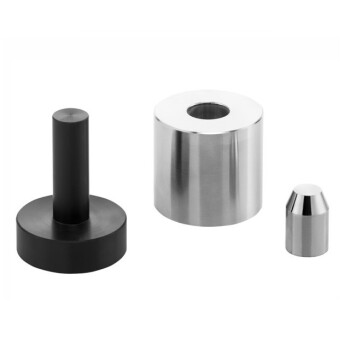
The secondary pressing at 140 MPa is a critical integration step designed to force rigid battery components into a unified, conductive stack. Specifically, this process establishes tight physical contact between the composite cathode, the solid electrolyte layer, and the current collector integrated with a MoS2 sacrificial layer. By applying this specific pressure, you mechanically substitute the wetting action of liquid electrolytes to ensure the cell functions as a cohesive unit.
Because solid-state materials lack the natural ability to flow and wet surfaces, high mechanical pressure is the only mechanism available to eliminate microscopic gaps. This pressing step is the fundamental prerequisite for reducing interfacial resistance and enabling efficient lithium-ion migration.
The Physical Challenge of Solid-State Assembly
The "Wetting" Deficit
In conventional batteries, liquid electrolytes naturally permeate porous electrodes, creating immediate ionic contact.
Solid-state batteries lack this capability completely. Without external intervention, the rigid interfaces between the cathode and electrolyte remain rough and disconnected on a microscopic level.
The Consequence of Poor Contact
If these layers are merely placed together without sufficient pressure, physical gaps remain at the interface.
These gaps act as insulators, causing extremely high impedance. This prevents lithium ions from crossing the boundary between the active material and the electrolyte, effectively rendering the battery non-functional.
The Function of the 140 MPa Secondary Pressing
Bonding the Composite Layers
The primary goal of pressing at 140 MPa is to fuse the disparate layers into a single mechanical entity.
This specific pressure targets the interface between the composite cathode, the solid electrolyte, and the current collector (specifically one with a MoS2 sacrificial layer). It ensures these chemically distinct layers interlock physically.
Reducing Charge Transfer Resistance
The application of 140 MPa minimizes the distance between particles at the solid-solid interface.
By maximizing the contact area, you significantly lower the interfacial charge transfer resistance. This allows for the smooth transmission of electrons and ions across boundaries that would otherwise be highly resistive.
Facilitating Ion Migration
A tight, gap-free interface creates a continuous pathway for lithium-ion diffusion.
This mechanical continuity ensures that ions can migrate smoothly during battery cycling. It is essential for realizing the theoretical capacity of the battery materials.
Understanding the Critical Variables
Precision is Non-Negotiable
While pressure is necessary, the uniformity provided by the laboratory press is just as critical as the magnitude (140 MPa).
Uneven pressure leads to localized delamination or "hot spots" of high resistance. The laboratory press ensures the force is applied axially and uniformly across the entire cell area.
The Limits of Mechanical Bonding
Pressure solves the contact issue, but it relies on the mechanical integrity of the materials.
The specific value of 140 MPa is chosen to be high enough to deform the materials into intimate contact, but it must be controlled to avoid crushing the active materials or damaging the current collector structure.
Making the Right Choice for Your Goal
To optimize your solid-state cell assembly, consider how this step aligns with your specific objectives:
- If your primary focus is Maximizing Conductivity: Prioritize the uniformity of the 140 MPa press to ensure the lowest possible interfacial impedance across the entire active area.
- If your primary focus is Mechanical Stability: ensure the pressing duration is sufficient to allow the composite cathode and MoS2 layer to bond permanently with the electrolyte, preventing delamination during cycling.
Ultimate Success: The 140 MPa secondary pressing is not merely a manufacturing step; it is the physical "activation" key that transforms isolated solid layers into a functioning electrochemical system.
Summary Table:
| Process Parameter | Purpose & Impact in Solid-State Assembly |
|---|---|
| Pressure Magnitude | 140 MPa: Fuses rigid cathode, electrolyte, and MoS2 layers |
| Interfacial Contact | Eliminates microscopic gaps to mimic liquid electrolyte 'wetting' |
| Impedance Control | Significantly reduces charge transfer resistance at solid-solid interfaces |
| Ion Migration | Creates a continuous pathway for efficient lithium-ion diffusion |
| Mechanical Goal | Ensures uniform axial force to prevent delamination and hot spots |
Elevate Your Battery Research with KINTEK Precision
Achieving the perfect 140 MPa interface requires more than just force—it requires absolute precision. KINTEK specializes in comprehensive laboratory pressing solutions tailored for the rigorous demands of all-solid-state battery assembly. Whether you need manual, automatic, heated, multifunctional, or glovebox-compatible models, our equipment ensures the uniform pressure distribution necessary to eliminate interfacial resistance and maximize cell performance.
From high-pressure secondary pressing to cold and warm isostatic applications, our solutions are designed to help researchers realize the full potential of their materials. Optimize your cell assembly today—Contact KINTEK for a Consultation!
References
- Dong‐Bum Seo, Sangbaek Park. Tailoring Artificial Solid Electrolyte Interphase via MoS2 Sacrificial Thin Film for Li-Free All-Solid-State Batteries. DOI: 10.1007/s40820-025-01729-w
This article is also based on technical information from Kintek Solution Knowledge Base .
Related Products
- Warm Isostatic Press for Solid State Battery Research Warm Isostatic Press
- Laboratory Hydraulic Press Lab Pellet Press Button Battery Press
- Button Battery Sealing Press Machine for Lab
- Lab Infrared Press Mold for Laboratory Applications
- Lab Button Battery Tablet Press Sealing Mold
People Also Ask
- Why must composite cathodes be sealed in vacuum lamination bags for WIP? Ensure Battery Stability and Density
- How do sacrificial volume materials (SVM) maintain microchannels in isostatic pressing? Ensure Structural Integrity
- What is the function of elastic molds in warm isostatic pressing? Achieve Uniform Density in Composite Particles
- What is the function of hydraulic pressure in warm isostatic pressing? Achieve Uniform Material Density
- What are the advantages of using a Warm Isostatic Press (WIP) for batteries? Achieve Superior Interface Contact