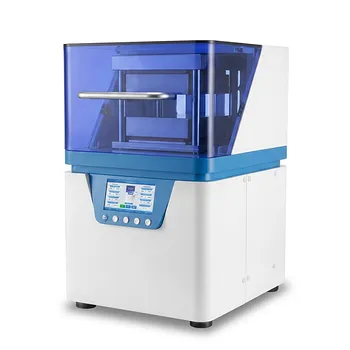
The integrated pressure gauge acts as the critical feedback mechanism for the hydraulic portable press. Its primary purpose is to allow the user to actively monitor the exact amount of force being applied during the pellet-making process, replacing estimation with verifiable data.
Precision is impossible without measurement. The gauge ensures that the force applied is not just a guess, but a known quantity, enabling the production of consistent and reliable pellets every time.
The Importance of Precise Control
Real-Time Monitoring
You cannot effectively manage a process you cannot measure. The integrated gauge provides immediate, visual confirmation of the pressure load as it builds.
Ensuring Reproducibility
Reliability in pellet making comes from repetition. By utilizing the gauge to hit the exact same pressure mark for every cycle, you ensure each pellet possesses uniform density.
Quality Assurance
Variation in pressure often leads to failed samples or inaccurate results. The gauge allows you to standardize the process, ensuring the final output is consistent across different batches.
Operational Considerations
The Human Element
It is important to remember that the gauge is a monitoring tool, not an automation feature. Achieving consistency requires the operator to pay close attention to the reading to prevent user-induced variations.
Knowing Your Target
The gauge provides data, but it does not determine the correct settings for you. The user must know the specific pressure requirements for their material to utilize the gauge effectively.
Making the Right Choice for Your Goal
To get the most out of your equipment, consider your specific objectives:
- If your primary focus is Scientific Accuracy: Use the gauge to document the exact pressure used for each sample to ensure your methods are reproducible in future experiments.
- If your primary focus is Sample Durability: Use the gauge to verify that you have reached the minimum threshold required to form a solid, stable pellet that will not crumble.
Mastering the use of the pressure gauge is the first step toward transforming raw material into reliable data.
Summary Table:
| Feature | Purpose | Benefit |
|---|---|---|
| Real-Time Monitoring | Visual confirmation of load | Prevents over-pressurization |
| Data Verification | Replaces estimation with facts | Ensures scientific accuracy |
| Standardization | Maintain uniform pressure levels | Consistent pellet density |
| Quality Control | Verifies material thresholds | Reduces sample crumbling |
Elevate Your Material Research with KINTEK
Precision measurement is the foundation of scientific success. KINTEK specializes in comprehensive laboratory pressing solutions, providing the tools you need for flawless sample preparation. Whether you require manual, automatic, heated, or multifunctional models—including glovebox-compatible and isostatic presses—we have the expertise to support your battery research and material science goals.
Ready to achieve perfect pellet consistency? Contact KINTEK today for a customized pressing solution
Related Products
- Automatic Hydraulic Hot Press with Large Plate and Precision Temperature Control for Advanced Material Sample Preparation and Industrial Research
- Automatic Hydraulic Heat Press Machine with Multi Stage Programmable Control and Integrated Water Cooling Plate Size 180x180mm
- Laboratory Hydraulic Press Lab Pellet Press Machine for Glove Box
- Laboratory Hydraulic Press 2T Lab Pellet Press for KBR FTIR
- Laboratory Hydraulic Pellet Press for XRF KBR FTIR Lab Press
People Also Ask
- What are the specific features and applications of hydraulic hot press machines? Precision Solutions for Modern Labs
- How does an automatic hydraulic press operate? Achieve Precision and Consistency in Lab Pelleting
- What are the advantages and common applications of an automatic hydraulic press? Elevate Your Lab's Precision
- What is the technical significance of setting a precise dwell time? Achieve Peak Material Density and Stability
- When is an automatic hydraulic press more suitable than a manual press? Scale Your Lab with Precision & Speed