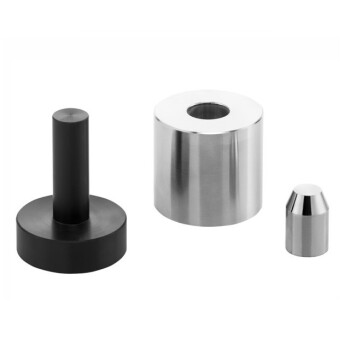
The primary purpose of a high-pressure pellet press in solid-state sodium battery research is to mechanically compact solid electrolyte powders, such as Na3PS4 or Na2O2-ZrCl4, into cohesive, dense pellets. This process is essential to reduce porosity, establish continuous pathways for ion transport, and ensure robust physical contact between the electrolyte and the cathode.
By eliminating air gaps and compressing loose particles, the press creates the continuous solid-solid interface required for ions to move efficiently, effectively substituting the "wetting" action found in traditional liquid batteries.
The Physics of Densification
Reducing Particle Porosity
Solid electrolyte materials often begin as loose powders. Air gaps between these powder particles act as insulators, blocking the flow of ions.
The high-pressure press applies significant force to compact these particles. This drastically reduces the void volume (porosity) within the material, creating a solid mass essential for basic battery functionality.
Establishing Ion Transport Paths
For a sodium battery to function, ions must travel seamlessly from one side of the electrolyte to the other.
Densification creates continuous ion transport paths. Without the high pressure applied by the press, the electrolyte would remain fragmented, resulting in low ionic conductivity and poor battery performance.
Optimizing the Solid-Solid Interface
Overcoming Interfacial Impedance
In liquid batteries, the electrolyte naturally flows into every crack and crevice of the electrode. Solid-state batteries do not have this luxury; they rely entirely on mechanical contact.
The press forces the solid electrolyte pellet against the cathode material. This tight physical adhesion is critical for reducing contact resistance (impedance), ensuring that sodium ions can cross the interface without significant energy loss.
Preventing Internal Short Circuits
A poorly formed electrolyte pellet with low density is structurally weak and prone to defects.
High-pressure processing enhances the physical integrity of the pellet. A dense, uniform electrolyte layer acts as a robust separator, preventing direct contact between the anode and cathode, thereby minimizing the risk of internal short circuits.
Understanding the Trade-offs
The Risk of Over-Densification or Cracking
While pressure is necessary, applying it incorrectly can damage the materials.
Excessive or uneven pressure can cause micro-cracks in the pellet or electrode materials. These defects can sever ion pathways rather than create them, leading to immediate failure or degraded performance.
Static vs. Dynamic Pressure Needs
Using a press to form a pellet is different from maintaining pressure during operation.
While the initial pressing creates the structure, the battery materials may expand and contract during cycling. A standard press creates the initial form, but research often requires precision pressure maintenance (as noted in supplementary data regarding lithium systems) to handle volume changes without losing contact.
Making the Right Choice for Your Goal
If your primary focus is Material Synthesis:
- Prioritize achieving maximum density and homogeneity in the pellet to ensure accurate measurements of the material's intrinsic ionic conductivity.
If your primary focus is Full Cell Assembly:
- Focus on the quality of the interface between layers to minimize resistance and ensure the structural integrity of the electrolyte-cathode boundary.
High-pressure densification is the critical first step in transforming theoretical sodium battery chemistry into a functional physical reality.
Summary Table:
| Key Function | Impact on Sodium Battery Performance | Research Objective |
|---|---|---|
| Densification | Reduces porosity and eliminates insulating air gaps. | Material Synthesis |
| Ion Path Formation | Creates continuous pathways for seamless sodium ion travel. | Conductivity Testing |
| Interface Contact | Minimizes impedance between solid electrolyte and cathode. | Full Cell Assembly |
| Structural Integrity | Prevents internal short circuits and electrode contact. | Safety & Reliability |
| Pressure Control | Avoids micro-cracking and material defects. | Process Optimization |
Elevate Your Battery Research with KINTEK Precision
Transitioning from liquid to solid-state sodium battery technology requires more than just chemistry—it requires the mechanical precision to create perfect interfaces. KINTEK specializes in comprehensive laboratory pressing solutions designed to meet the rigorous demands of energy research.
Whether you need manual, automatic, heated, or glovebox-compatible models, our equipment ensures the high-density compaction and uniform pressure required for superior ionic conductivity. From standard pellet preparation to advanced cold and warm isostatic presses, we provide the tools to eliminate porosity and prevent internal short circuits in your solid-state cells.
Ready to optimize your solid-state interface? Contact KINTEK today to find the ideal pressing solution for your laboratory's needs!
References
- Gwangeon Oh, Jang‐Yeon Hwang. Introduction of High‐Valent Metal in Transition Metal Layer as a Structural Reinforcement for a O3‐Type NaCrO <sub>2</sub> Sodium‐Ion Battery Cathode. DOI: 10.1002/sstr.202500400
This article is also based on technical information from Kintek Solution Knowledge Base .
Related Products
- Warm Isostatic Press for Solid State Battery Research Warm Isostatic Press
- Laboratory Hydraulic Press Lab Pellet Press Button Battery Press
- Automatic Laboratory Hydraulic Press for XRF and KBR Pellet Pressing
- Lab Infrared Press Mold for Laboratory Applications
- Laboratory Hydraulic Pellet Press for XRF KBR FTIR Lab Press
People Also Ask
- Why must composite cathodes be sealed in vacuum lamination bags for WIP? Ensure Battery Stability and Density
- What is the function of elastic molds in warm isostatic pressing? Achieve Uniform Density in Composite Particles
- How do sacrificial volume materials (SVM) maintain microchannels in isostatic pressing? Ensure Structural Integrity
- What is the significance of temperature control in Warm Isostatic Pressing? Unlock Uniform Densification and Process Stability
- What is the mechanism of a Warm Isostatic Press (WIP) on cheese? Master Cold Pasteurization for Superior Safety