
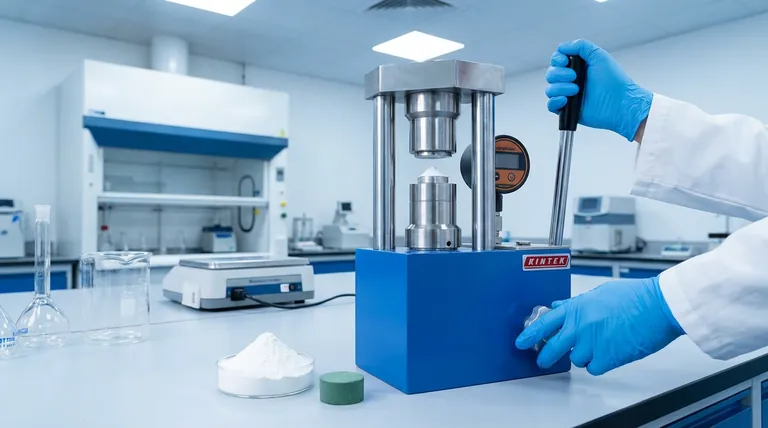
The primary purpose of using a hydraulic press for Li₆.₁₆Al₀.₂₈Zr₂La₃O₁₂ (LLZA) garnet powder is to consolidate loose particles into a cohesive "green body" with high initial density. By applying uniform, stable pressure, the press eliminates voids and forces particles into a tightly packed arrangement. This mechanical consolidation is a prerequisite for preventing defects and ensuring successful densification during the subsequent high-temperature sintering process.
While the immediate goal is to shape the powder, the deeper objective is to maximize particle-to-particle contact points. This initial proximity is the defining factor that allows for effective atomic diffusion during sintering, ultimately determining the material’s final ionic conductivity.
Establishing the "Green Body"
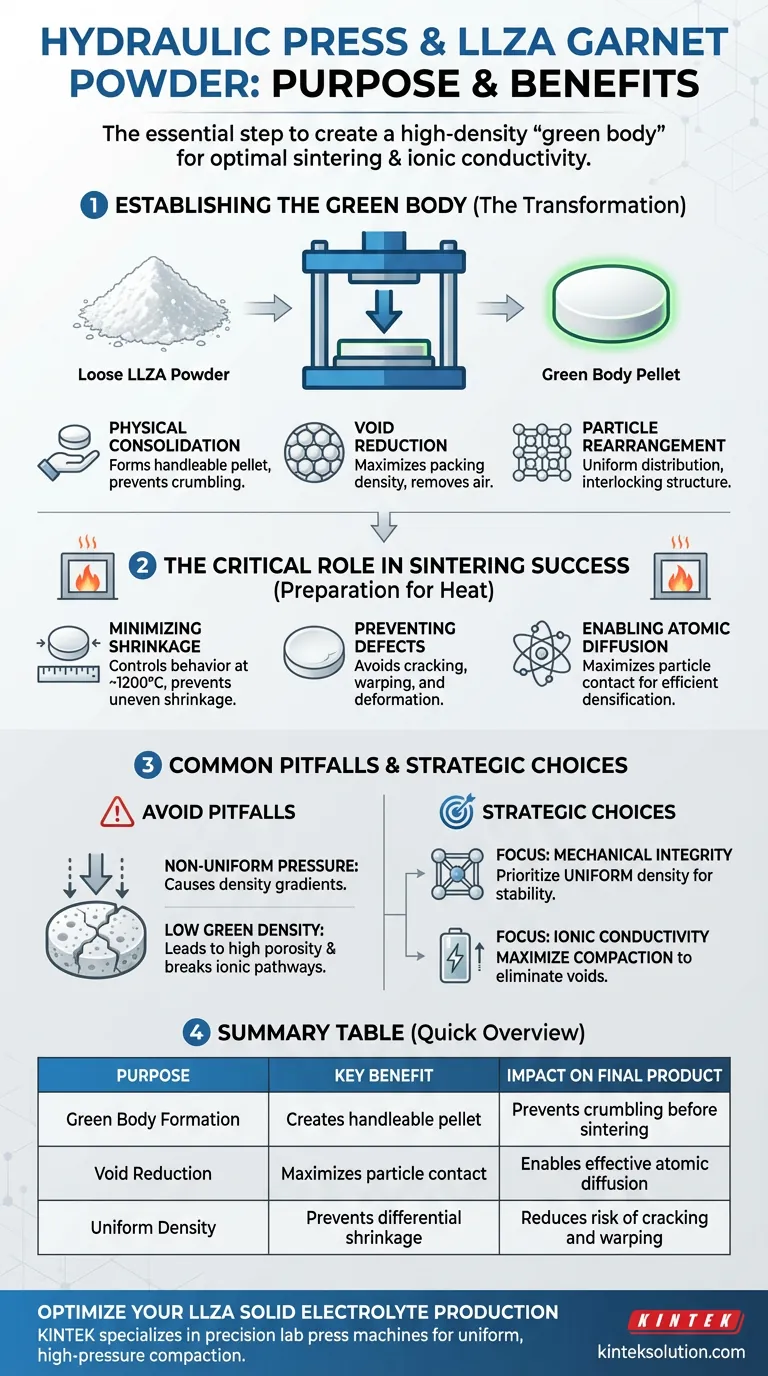
Physical Consolidation
The most immediate function of the hydraulic press is to transform loose LLZA powder into a solid form known as a green body. This pressed pellet possesses sufficient mechanical strength to be handled without crumbling before it undergoes heat treatment.
Void Reduction
The application of hydraulic pressure significantly reduces the volume of air or empty space between powder particles. By forcing the particles closer together, the press creates a structure with higher packing density, which is essential for the material's final properties.
Particle Rearrangement
Under high pressure, the powder particles undergo physical rearrangement and, in some cases, plastic deformation. This ensures a uniform distribution of mass, replacing a chaotic arrangement of loose powder with an ordered, interlocking structure.
The Critical Role in Sintering Success
Minimizing Shrinkage Issues
A well-compacted green body is crucial for controlling behavior during the high-temperature sintering stage (around 1200°C). If the initial density is too low, the material will undergo excessive or uneven shrinkage as it heats.
Preventing Structural Defects
By establishing a high initial density, the hydraulic press helps prevent macroscopic defects. A uniform green body minimizes the risk of cracking, warping, or deformation that often occurs when loose or unevenly packed powders are sintered.
Enabling Atomic Diffusion
The ultimate goal of sintering is to induce atomic diffusion and grain boundary migration to fuse particles together. The hydraulic press facilitates this by maximizing the contact area between particles, reducing the distance atoms must diffuse to form a dense ceramic.
Common Pitfalls to Avoid
The Risk of Non-Uniform Pressure
While high pressure is necessary, the uniformity of that pressure is equally critical. If the hydraulic press applies pressure unevenly, the green body will have density gradients.
Consequences of Low Green Density
Failing to achieve sufficient compaction leads to a final product with high porosity. In the context of solid electrolytes like LLZA, residual porosity breaks the continuous pathways required for ions to move, drastically reducing performance.
Making the Right Choice for Your Goal
To maximize the efficacy of your LLZA preparation, align your compaction strategy with your specific performance metrics.
- If your primary focus is Mechanical Integrity: Prioritize achieving a uniform green density to prevent differential shrinkage and cracking during the 1200°C sintering phase.
- If your primary focus is Ionic Conductivity: maximize the compaction pressure to eliminate voids and increase particle contact, ensuring a porosity-free final structure for efficient lithium-ion conduction.
The hydraulic press is not merely a shaping tool; it is the foundational step that dictates the microstructural quality and electrochemical efficiency of the final solid electrolyte.
Summary Table:
| Purpose | Key Benefit | Impact on Final Product |
|---|---|---|
| Green Body Formation | Creates a handleable pellet | Prevents crumbling before sintering |
| Void Reduction | Maximizes particle contact | Enables effective atomic diffusion |
| Uniform Density | Prevents differential shrinkage | Reduces risk of cracking and warping |
Ready to optimize your LLZA solid electrolyte production? The right compaction process is critical for achieving high ionic conductivity and mechanical integrity in your laboratory samples. KINTEK specializes in precision lab press machines, including automatic and heated lab presses, designed to deliver the uniform, high-pressure compaction your research demands. Contact our experts today to discuss how our hydraulic presses can enhance your solid-state battery development workflow.
Visual Guide
Related Products
- Laboratory Hydraulic Press Lab Pellet Press Machine for Glove Box
- Manual Laboratory Hydraulic Pellet Press Lab Hydraulic Press
- Laboratory Hydraulic Press 2T Lab Pellet Press for KBR FTIR
- Manual Laboratory Hydraulic Press Lab Pellet Press
- 24T 30T 60T Heated Hydraulic Lab Press Machine with Hot Plates for Laboratory
People Also Ask
- How does a laboratory hydraulic press contribute to the preparation of Li3-3xScxSb samples? Optimize Ionic Conductivity
- What is the function of a laboratory hydraulic press in FT-IR of curcumin-coated MWCNTs? Achieve Optical Clarity.
- Why is a laboratory hydraulic press required for compression molding boron-siloxane? Solve High-Loading Density Challenges
- What role does a laboratory hydraulic press play in reaction pellets? Optimizing Lunar Soil and Metal Fuel Density
- What role does a laboratory hydraulic press play in the preparation of piezoelectric ceramic discs for DC-PG? | KINTEK



















