
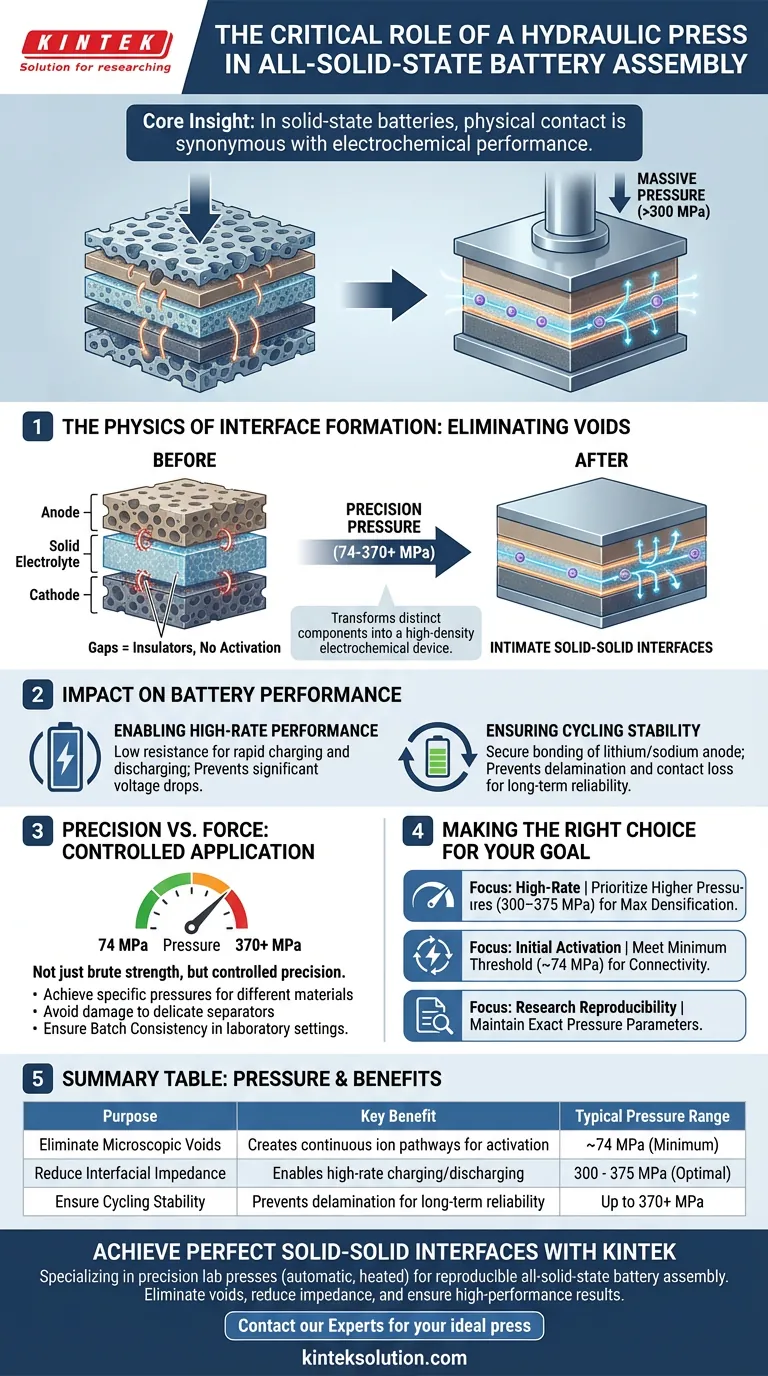
The primary purpose of using a hydraulic press in the final assembly of a multi-layered all-solid-state battery is to apply precise, massive consolidation pressure—often exceeding 300 MPa—to the completed cell stack.
Because these batteries lack liquid electrolytes to flow into and fill microscopic gaps, this mechanical pressure is the only mechanism available to eliminate voids. The press physically forces the cathode, solid electrolyte, and anode layers to merge, transforming distinct components into a unified, high-density electrochemical device.
The Core Insight In solid-state batteries, physical contact is synonymous with electrochemical performance. The hydraulic press does not merely hold the layers together; it plastically deforms the materials to eliminate surface roughness, ensuring the intimate solid-solid interfaces required for ions to move freely between layers.

The Physics of Interface Formation
The deep need for a hydraulic press stems from the microscopic realities of solid materials. Unlike liquid electrolytes that naturally wet surfaces, solid components have inherent surface roughness that creates gaps.
Eliminating Microscopic Voids
When layers are simply stacked, microscopic voids exist at the interfaces between the cathode, electrolyte, and anode.
These voids act as insulators. Without the high pressure (e.g., 74 to 370 MPa) applied by the press, these gaps remain, preventing the battery from functioning.
Reducing Interfacial Impedance
The hydraulic press compresses the stack until the materials achieve intimate contact.
This drastically reduces interfacial impedance (resistance). By minimizing the distance and barriers between particles, the press ensures that the internal resistance of the battery is low enough for practical operation.
Creating Continuous Ion Pathways
The ultimate goal of this densification is to create a continuous "highway" for lithium (or sodium) ions.
The pressure creates a seamless solid-solid interface. This allows ions to transport efficiently from the anode, through the electrolyte, to the cathode, which is the fundamental requirement for the battery's activation.
Impact on Battery Performance
The mechanical bonding achieved during this final pressing step directly dictates the electrochemical capabilities of the finished cell.
Enabling High-Rate Performance
High-rate performance refers to the battery's ability to charge and discharge quickly.
By creating a densified microstructure with low resistance, the press ensures that ions and electrons can move rapidly. Without this step, the battery would suffer from significant voltage drops under load.
Ensuring Cycling Stability
Long-term stability relies on the integrity of these interfaces.
A hydraulic press bonds the lithium or sodium metal anode securely to the electrolyte stack. This secure bond helps maintain performance over repeated charge and discharge cycles, preventing the delamination or contact loss that leads to cell failure.
Understanding the Trade-offs: Precision vs. Force
While the application of force is necessary, the use of a hydraulic press is also about control and precision, not just brute strength.
The Necessity of Controlled Pressure
References indicate a wide range of necessary pressures depending on the specific step and materials, ranging from roughly 74 MPa to over 370 MPa.
A key advantage of laboratory hydraulic presses is the ability to dial in these specific pressures. Applying too little pressure leaves voids (high resistance), while uncontrolled force could damage delicate separator structures.
Batch Consistency
In a laboratory setting, reproducibility is critical.
Hydraulic presses provide a consistent application of force that is difficult to achieve with manual methods. This ensures that variances in battery performance are due to material chemistry, not inconsistent assembly techniques.
Making the Right Choice for Your Goal
The specific pressure you apply should be dictated by the material limits of your electrolyte and the performance goals of your cell.
- If your primary focus is High-Rate Performance: Prioritize higher pressures (around 300–375 MPa) to maximize densification and minimize internal resistance for rapid ion transport.
- If your primary focus is Initial Activation: Ensure you meet the minimum threshold (e.g., ~74 MPa) required to overcome surface roughness and establish basic ionic connectivity.
- If your primary focus is Research Reproducibility: Utilize the precision features of the press to maintain exact pressure parameters across all samples to isolate chemical variables.
The hydraulic press is not just a clamp; it is the tool that mechanically activates the chemistry of an all-solid-state battery.
Summary Table:
| Purpose | Key Benefit | Typical Pressure Range |
|---|---|---|
| Eliminate Microscopic Voids | Creates continuous ion pathways for battery activation | ~74 MPa (Minimum) |
| Reduce Interfacial Impedance | Enables high-rate charging/discharging performance | 300 - 375 MPa (Optimal) |
| Ensure Cycling Stability | Prevents delamination for long-term reliability | Up to 370+ MPa |
Ready to achieve perfect solid-solid interfaces in your battery research? KINTEK specializes in precision lab press machines, including automatic and heated lab presses, designed to deliver the exact, consistent pressure (from 74 to over 370 MPa) required for reproducible all-solid-state battery assembly. Our presses help you eliminate voids, reduce impedance, and ensure high-performance results. Contact our experts today to find the ideal press for your laboratory's needs.
Visual Guide
Related Products
- Warm Isostatic Press for Solid State Battery Research Warm Isostatic Press
- Laboratory Hydraulic Press Lab Pellet Press Button Battery Press
- Automatic Laboratory Hydraulic Press for XRF and KBR Pellet Pressing
- Laboratory Hydraulic Press 2T Lab Pellet Press for KBR FTIR
- Lab Button Battery Tablet Press Sealing Mold
People Also Ask
- Why must composite cathodes be sealed in vacuum lamination bags for WIP? Ensure Battery Stability and Density
- How do sacrificial volume materials (SVM) maintain microchannels in isostatic pressing? Ensure Structural Integrity
- What is the function of elastic molds in warm isostatic pressing? Achieve Uniform Density in Composite Particles
- What is the role of the flexible material in warm isostatic pressing? Key to Uniform Density & Precision
- What are the advantages of using a Warm Isostatic Press (WIP) for batteries? Achieve Superior Interface Contact



















