
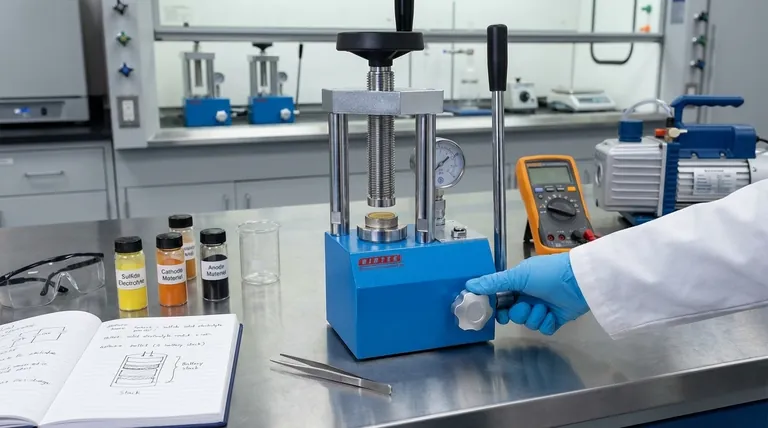
A laboratory hydraulic press acts as the primary tool for establishing ionic continuity in all-solid-state batteries using sulfide electrolytes. It applies precise, uniform mechanical force to "cold sinter" the materials, utilizing high pressure to plastically deform the soft sulfide powder into a dense, void-free layer that allows lithium ions to move freely between the cathode, electrolyte, and anode.
The Core Insight Unlike ceramic oxides that require high-temperature sintering, sulfide electrolytes possess unique intrinsic plasticity and ductility. The hydraulic press leverages this property to fuse discrete powder particles into a cohesive solid through mechanical force alone, effectively solving the "solid-solid contact" problem that plagues solid-state battery performance.
The Mechanics of Densification
Exploiting Plasticity and Ductility
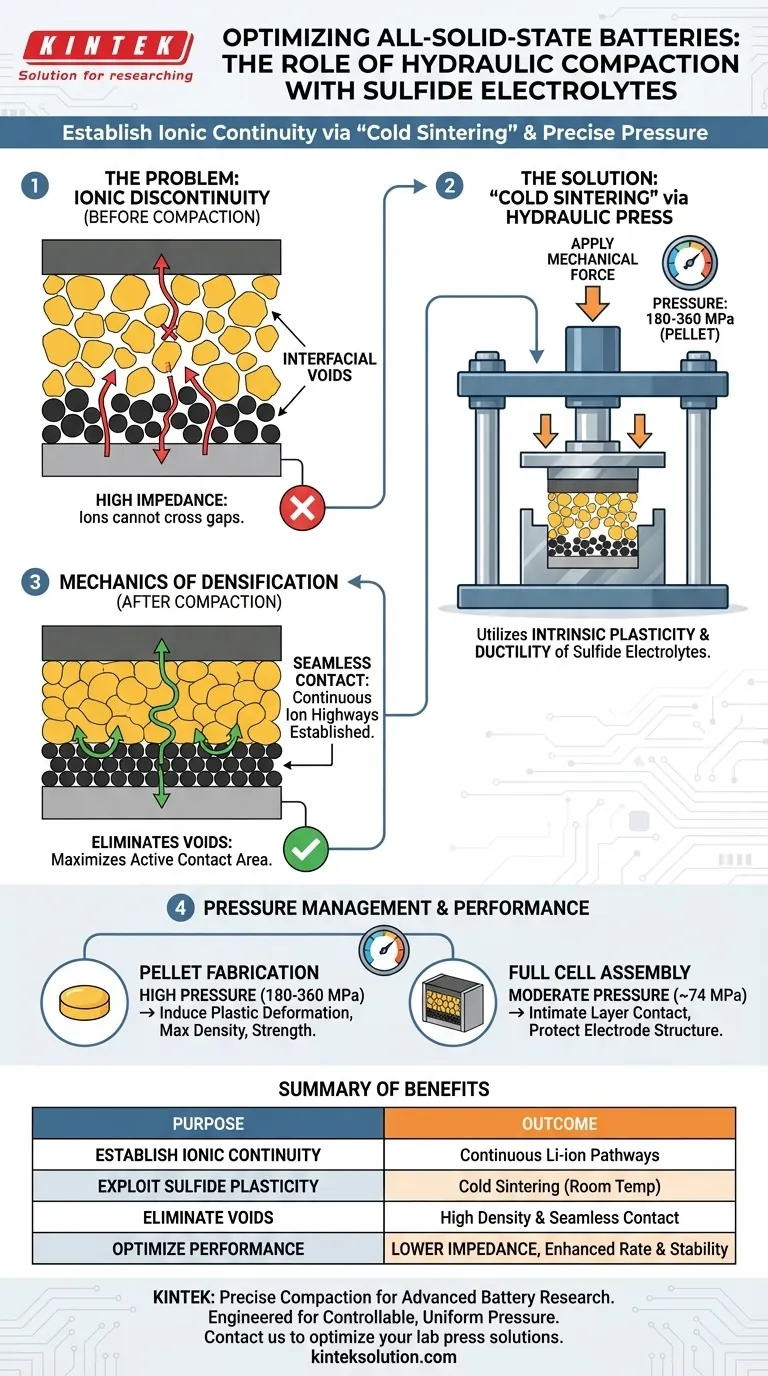
The fundamental advantage of sulfide electrolytes is that they are relatively soft. When you apply significant pressure (typically 180 to 360 MPa) via a hydraulic press, the sulfide particles undergo plastic deformation.
Instead of fracturing or remaining as loose powder, the particles deform and flow into one another. This allows you to achieve high material density and tight interfacial contact at room temperature (cold pressing) or with mild heating, eliminating the need for complex high-temperature sintering processes.
Eliminating Interfacial Voids
In a solid-state system, any gap between particles is a barrier that lithium ions cannot cross. The hydraulic press applies uniform pressure to collapse these microscopic voids.
By physically forcing the materials together, the press creates a seamless physical contact between the composite cathode, the solid electrolyte separator, and the anode. This elimination of porosity is a prerequisite for a functioning battery.
Optimizing Electrochemical Performance
Establishing Ion Transport Pathways
The primary purpose of compaction is to lower impedance. Without sufficient pressure, the contact resistance between grains (grain boundary resistance) remains too high.
High-pressure forming creates continuous lithium-ion conduction pathways. By maximizing the active contact area between particles, the press ensures that ions have a direct "highway" to travel through, which is essential for achieving high ionic conductivity.
Enhancing Rate Performance and Stability
Reducing the internal resistance via compaction directly impacts how the battery operates under load. A well-pressed cell exhibits significantly lower solid-solid interfacial impedance.
This reduction in resistance allows the battery to charge and discharge efficiently (rate performance) and maintains the structural integrity of the interfaces over repeated cycles (cycling stability).
Understanding the Trade-offs: Pressure Management
The Two-Stage Pressure Requirement
It is critical to distinguish between pellet formation and stacking assembly. While forming the electrolyte pellet requires high pressure (up to 360 MPa) to maximize density, the final assembly of the full stack often requires a calculated, lower pressure (e.g., roughly 74 MPa).
Risks of Improper Compaction
While pressure is vital, uniformity is equally important. A laboratory press must deliver controllable and uniform force.
Uneven pressure can lead to density gradients, warping, or microscopic cracking within the electrode layers. Furthermore, while sulfides are ductile, excessive pressure on the final stack could potentially damage the active cathode materials or current collectors if not carefully regulated.
Making the Right Choice for Your Goal
To maximize the utility of your hydraulic press, apply pressure based on the specific stage of assembly:
- If your primary focus is Electrolyte Pellet Fabrication: Apply high pressure (180–360 MPa) to induce plastic deformation and achieve maximum relative density and mechanical strength.
- If your primary focus is Full Cell Assembly: Apply a moderate "stacking pressure" (approx. 74 MPa) to ensure intimate contact between layers without crushing the electrode structures or causing short circuits.
Ultimately, the hydraulic press is not just a shaping tool; it is the mechanism that activates the electrochemical potential of sulfide materials by mechanically bridging the gap between solid particles.
Summary Table:
| Purpose / Function | Key Parameter / Outcome |
|---|---|
| Establish Ionic Continuity | Creates continuous lithium-ion pathways |
| Exploit Sulfide Plasticity | Applies 180-360 MPa for cold sintering |
| Eliminate Interfacial Voids | Achieves high density and seamless contact |
| Optimize Electrochemical Performance | Lowers impedance, enhances rate capability & stability |
| Pressure Management | Pellet fabrication: High pressure (180-360 MPa) Full cell assembly: Moderate pressure (~74 MPa) |
Ready to optimize your solid-state battery research with precise compaction?
KINTEK's laboratory hydraulic presses are engineered to deliver the controllable, uniform pressure essential for cold-sintering sulfide electrolytes and assembling reliable all-solid-state battery cells. Our automatic lab presses, isostatic presses, and heated lab presses provide the accuracy and repeatability your laboratory needs to achieve perfect ionic contact and superior electrochemical performance.
Contact us today to discuss how our lab press solutions can advance your battery development. Let's build the future of energy storage, together.
Visual Guide
Related Products
- 24T 30T 60T Heated Hydraulic Lab Press Machine with Hot Plates for Laboratory
- Automatic Heated Hydraulic Press Machine with Heated Plates for Laboratory
- Automatic Laboratory Hydraulic Press for XRF and KBR Pellet Pressing
- Laboratory Hydraulic Press 2T Lab Pellet Press for KBR FTIR
- Lab Round Bidirectional Press Mold
People Also Ask
- Function of a Laboratory Hydraulic Press with Heated Platens in SSE? Enhance Battery Density & Conductivity
- Why is a laboratory hydraulic press with heating plates required for PLA/TEC films? Achieve Precise Sample Integrity
- What role does a laboratory heated hydraulic press play in LTCC? Essential for High-Density Ceramic Lamination
- Why reduce load when applying composite strengthening tabs? Protect Specimen Integrity and Data Accuracy
- Why is a laboratory heated hydraulic press utilized during the lamination stage of NASICON green tapes?



















