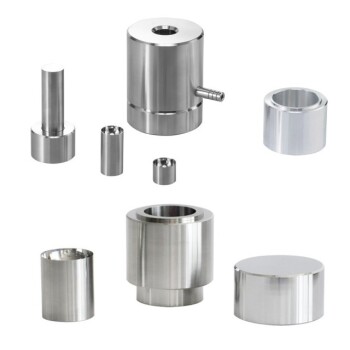
Tungsten carbide molds are the critical interface for transforming loose, calcined diopside powder into a cohesive, cylindrical structure. Their primary function is to provide a rigid, high-endurance boundary that compacts the powder into a "green body" capable of withstanding the mechanical stresses of subsequent processing steps.
Core Takeaway By leveraging superior hardness and wear resistance, tungsten carbide molds maintain strict dimensional accuracy over repeated high-pressure cycles. This consistency is vital for producing diopside green bodies that possess sufficient mechanical strength to survive the transition to cold isostatic pressing.
The Engineering Value of Tungsten Carbide
The choice of mold material is not arbitrary; it is dictated by the physical demands of compressing abrasive ceramic powders.
Superior Wear Resistance
Tungsten carbide is selected specifically for its high hardness.
When pressing calcined diopside powder, the mold walls experience significant friction. A softer material would degrade quickly, but tungsten carbide resists this abrasion effectively.
Maintaining Dimensional Accuracy
Reliability over time is a key factor in mass production.
Because tungsten carbide resists wear, the mold cavity retains its precise shape even after repeated pressing cycles. This ensures that every cylinder produced meets the exact dimensional specifications required.
Surface Finish Quality
The quality of the mold directly dictates the quality of the pressed part.
The wear resistance of the material preserves the smoothness of the mold cavity. This results in a green body with a smooth, uniform surface, reducing defects before the part undergoes further densification.
The Function of the Pre-Forming Stage
The molding process serves as the bridge between raw powder and the final densification method.
Creating the Green Body
The immediate goal of using the mold is to consolidate calcined diopside powder.
The mold applies an initial mechanical constraint to the loose particles. This pressure forces the particles together to form a "green body"—a solid, yet unfired, cylindrical shape.
Enabling Cold Isostatic Pressing (CIP)
The green body is an intermediate stage, not the final product.
The specific purpose of the tungsten carbide mold is to impart sufficient strength to the diopside cylinder. This structural integrity is non-negotiable, as the part must be strong enough to be handled and transferred into a Cold Isostatic Pressing (CIP) unit without crumbling.
Operational Constraints and Considerations
While tungsten carbide offers significant advantages, it is important to understand the limits of this specific process step.
The Limits of Green Strength
The mold provides the initial form, but the resulting "green body" is still relatively fragile compared to a sintered part.
The process is designed only to achieve "sufficient strength" for the next step (CIP). It does not produce a fully dense or mechanically finished component. The mold's job is purely preparatory, ensuring the powder holds together well enough to survive the next, more aggressive pressurization stage.
Dependency on Mold Condition
The process relies entirely on the mold's ability to resist deformation.
If the mold surface were to compromise due to wear (using a lesser material), the friction during ejection could damage the green body. Therefore, the success of the pre-forming stage is inextricably linked to the continued hardness and surface integrity of the tungsten carbide.
Making the Right Choice for Your Goal
To ensure the success of your diopside ceramic production, focus on the specific role this molding stage plays in your workflow.
- If your primary focus is Process Reliability: Prioritize tungsten carbide for its wear resistance to prevent dimensional drift during high-volume, repeated pressing cycles.
- If your primary focus is Handling Strength: Ensure the molding pressure is sufficient to create a green body that can safely transition to the Cold Isostatic Pressing stage without breakage.
The use of tungsten carbide is not just about shaping the powder; it is about guaranteeing the structural baseline required for the entire manufacturing chain to succeed.
Summary Table:
| Feature | Benefit for Diopside Pre-forming |
|---|---|
| High Hardness | Resists abrasion from calcined powder during compression. |
| Wear Resistance | Maintains strict dimensional accuracy over repeated cycles. |
| Surface Finish | Produces smooth green bodies with minimal surface defects. |
| Structural Support | Imparts sufficient mechanical strength for safe handling and CIP. |
Elevate Your Ceramic Research with KINTEK Precision Solutions
High-quality green bodies are the foundation of successful ceramic engineering. KINTEK specializes in comprehensive laboratory pressing solutions designed to handle the most demanding materials. Whether you are working with diopside for battery research or advanced ceramics, our range of manual, automatic, heated, and multifunctional presses, alongside professional-grade isostatic presses, ensures your samples meet exact specifications.
Don't let mold wear or inconsistent pressure compromise your results. Partner with KINTEK for durable, high-performance equipment that brings reliability to your laboratory workflow.
Contact KINTEK Today to Find Your Perfect Pressing Solution
References
- S.K. Ghosh, Takehiko Hiraga. Diffusion Creep of Diopside. DOI: 10.1029/2020jb019855
This article is also based on technical information from Kintek Solution Knowledge Base .
Related Products
- Carbide Lab Press Mold for Laboratory Sample Preparation
- XRF KBR Steel Ring Lab Powder Pellet Pressing Mold for FTIR
- XRF KBR Plastic Ring Lab Powder Pellet Pressing Mold for FTIR
- Lab Anti-Cracking Press Mold
- Lab Double Plate Heating Mold for Laboratory Use
People Also Ask
- What is the purpose of incorporating cartridge heaters into a lab press mold for MLCC block compression? Optimize Results
- What is the function of a pressing tool in thermoplastic panels? Master Precision Shaping & Fusion Bonding
- Why is precise cooling management of the lab press mold necessary? Protect Core Integrity in Thermoforming
- How does the geometry of laboratory molds influence mycelium-based composites? Optimize Density and Strength
- What is the significance of standardized molds in lab presses? Ensure Precise Seal Material Evaluation