
The primary rationale for increasing applied pressure to 360 MPa is to exploit the high ductility of sodium metal to engineer a perfect physical interface. At this specific pressure level, sodium undergoes plastic deformation, essentially flowing to fill the microscopic irregularities of the solid electrolyte surface. This mechanical fusing eliminates voids, ensuring the intimate contact required for efficient battery operation.
Core Insight: In solid-state batteries, solids do not naturally bond well. 360 MPa is not just about holding layers together; it is a transformative processing step that forces solid sodium to behave fluidly, creating a void-free interface that minimizes electrical resistance.
Overcoming the Solid-Solid Interface Challenge
The fundamental hurdle in all-solid-state batteries is the solid-solid interface. Unlike liquid electrolytes that naturally wet electrode surfaces, solid electrolytes retain their rigid shape, leading to poor contact points and high resistance.
Inducing Plastic Flow
Sodium metal is distinct because of its high ductility. When subjected to 360 MPa, the metal is pushed beyond its yield point.
Instead of cracking or resisting, the sodium plastically deforms. It flows almost like a viscous liquid, adapting its shape to the opposing surface without requiring high heat.
Eliminating Interfacial Voids
Solid electrolyte pellets may appear smooth to the naked eye, but they possess microscopic surface roughness. Low-pressure assembly leaves gaps (voids) between the anode and the electrolyte.
Applying 360 MPa forces the sodium into every microscopic valley and crevice of the electrolyte. This creates a uniform, dense, and void-free boundary where the two materials are physically locked together.
Electrochemical Implications
The mechanical integrity of the stack is secondary to the electrochemical benefits derived from this high-pressure treatment.
Minimizing Interfacial Resistance
Voids at the interface act as electrical insulators. By eliminating these gaps through high pressure, you maximize the effective contact area.
This creates a low-impedance pathway, allowing sodium ions to transport freely between the anode and the electrolyte. Lower resistance directly correlates to higher power output and efficiency.
Promoting Uniform Ion Transport
When contact is patchy, ion flux becomes concentrated at the few points where the materials actually touch.
A pressure-densified interface ensures uniform current distribution across the entire surface. This uniformity is critical for cycling stability, as it prevents localized stress and degradation during charging and discharging.
Understanding the Trade-offs
While 360 MPa is effective for interface engineering, it introduces mechanical risks that must be managed carefully.
Electrolyte Fracture Risk
Solid electrolytes are often ceramic-based and brittle. While the sodium anode is ductile, the electrolyte is not.
Applying 360 MPa requires precise control. If the pressure is not applied uniformly, shear stresses can cause the solid electrolyte pellet to crack, leading to immediate device failure or short circuits.
Equipment Constraints
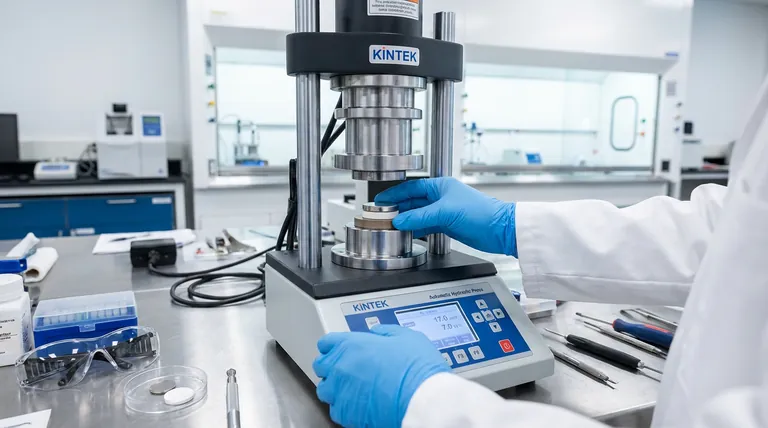
Achieving 380 MPa (or similar high pressures) requires specialized laboratory presses capable of delivering massive force.
Standard coin cell crimpers or light clamps are insufficient. You must use equipment designed to maintain mechanical integrity under extreme loads to ensure the layers consolidate without shifting.
Making the Right Choice for Your Goal
The decision to apply 360 MPa should be driven by your specific fabrication targets.
- If your primary focus is Minimizing Impedance: Prioritize high pressure to maximize the effective contact area and eliminate voids, ensuring the lowest possible interfacial resistance.
- If your primary focus is Material Integrity: Ensure your pressing tooling applies force uniformly to prevent fracturing the brittle solid electrolyte layer while seeking the ductility limit of the anode.
Summary: Increasing pressure to 360 MPa is a targeted strategy to mechanically force ductile sodium into a seamless, low-resistance junction with the solid electrolyte.
Summary Table:
| Aspect | Key Takeaway |
|---|---|
| Primary Goal | Exploit sodium's ductility to create a perfect physical interface with the solid electrolyte. |
| Mechanical Effect | Forces sodium to plastically deform, filling microscopic surface irregularities and eliminating voids. |
| Electrochemical Benefit | Maximizes contact area, minimizing interfacial resistance for efficient ion transport. |
| Critical Consideration | Risk of fracturing the brittle solid electrolyte if pressure is not applied uniformly. |
Ready to Achieve Perfect Electrode Interfaces in Your Lab?
Fabricating high-performance all-solid-state batteries requires precise control over pressure to ensure material integrity and minimize interfacial resistance. KINTEK specializes in high-performance lab press machines, including automatic and isostatic presses, designed to deliver the uniform, extreme pressures (like 360 MPa) essential for your research.
We help you:
- Eliminate Interfacial Voids: Achieve the intimate contact needed for low-resistance, high-efficiency battery cells.
- Ensure Material Integrity: Our presses provide the precise, uniform force control required to prevent fracturing brittle solid electrolytes.
- Accelerate Your R&D: Reliable, repeatable pressing results let you focus on innovation, not equipment limitations.
Don't let equipment constraints limit your battery development. Contact our experts today to find the perfect lab press solution for your solid-state battery fabrication needs!
Visual Guide

Related Products
- Warm Isostatic Press for Solid State Battery Research Warm Isostatic Press
- Electric Lab Cold Isostatic Press CIP Machine
- Automatic Lab Cold Isostatic Pressing CIP Machine
- Manual Cold Isostatic Pressing CIP Machine Pellet Press
- Lab Isostatic Pressing Molds for Isostatic Molding
People Also Ask
- Why must composite cathodes be sealed in vacuum lamination bags for WIP? Ensure Battery Stability and Density
- What is the function of elastic molds in warm isostatic pressing? Achieve Uniform Density in Composite Particles
- How do sacrificial volume materials (SVM) maintain microchannels in isostatic pressing? Ensure Structural Integrity
- What is the function of hydraulic pressure in warm isostatic pressing? Achieve Uniform Material Density
- How does Warm Isostatic Pressing differ from traditional pressing methods? Unlock Uniform Density for Complex Parts



















