
For most food and plant-based applications, the recommended pressing limit is typically 4 tonnes or less. Exceeding this threshold frequently causes internal oils to migrate to the surface, potentially compromising the sample's chemical composition or damaging the pressing equipment, unless your specific objective is oil extraction.
Core Insight: Organic materials possess a cellular structure distinct from inorganic compounds. The standard high-pressure protocols used for minerals or metals will rupture these cells, forcing natural oils out of the matrix and altering the fundamental nature of your sample.
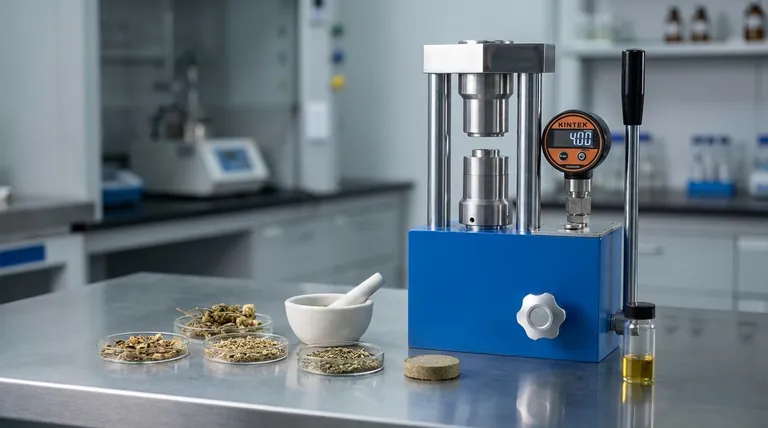
The Mechanics of Organic Samples
To understand the tonnage recommendation, you must understand the material's behavior under stress. Unlike dry industrial powders, food and plant matter are biologically complex.
The Cellular Reservoir
Plant-based materials are essentially cellular structures that encapsulate fluids and lipids.
Even materials that appear dry to the touch often contain significant reserves of internal oils.
The Pressure Threshold
When you apply pressure, you are compressing these cellular walls.
Up to approximately 4 tonnes, the material generally compacts without rupturing the cellular integrity significantly.
Beyond this point, the mechanical force overcomes the cell walls, causing them to burst and release their contents.
The Phenomenon of Seepage
Once the cells rupture, the internal oils are forced outward to the surface of the pellet or sample.
This results in a wet, oily surface that can contaminate your die set and the pressing machinery.
Understanding the Trade-offs
While keeping pressure low preserves the sample's chemical makeup, it introduces physical challenges that you must manage.
Integrity vs. Stability
The primary trade-off in pressing organics is balancing sample integrity against physical stability.
Low pressure (under 4 tonnes) keeps the oil inside, ensuring the sample remains chemically representative of the original material.
However, lower pressure often results in a "looser" pellet that may be more friable (prone to crumbling) than a high-pressure mineral pellet.
Contamination Risks
Attempting to increase density by raising the tonnage creates a high risk of cross-contamination.
If oil seeps out, it requires rigorous cleaning of the die set between every cycle.
Failure to clean this residue will contaminate subsequent samples, skewing analytical results.
Making the Right Choice for Your Goal
Your optimal tonnage depends entirely on what you are trying to achieve with the sample.
- If your primary focus is Sample Analysis (e.g., XRF/IR): Maintain pressure at 4 tonnes or less to ensure the oil remains within the matrix and the chemical composition is unaltered.
- If your primary focus is Oil Extraction: You may intentionally exceed 4 tonnes to rupture the cells and force the oils out for collection.
By respecting the biological limits of your material, you ensure your processing method supports, rather than hinders, your analytical objectives.
Summary Table:
| Goal | Recommended Tonnage | Key Consideration |
|---|---|---|
| Sample Analysis (XRF/IR) | 4 tonnes or less | Preserves sample integrity by preventing oil seepage. |
| Oil Extraction | Exceed 4 tonnes | Intentionally ruptures cells to release internal oils. |
Achieve perfect pellets for accurate analysis with the right lab press.
Pressing organic materials requires precise control to avoid damaging your samples. KINTEK specializes in lab press machines, including automatic lab presses and heated lab presses, designed to deliver the consistent, low-tonnage pressure needed for food and plant-based materials.
Our experts can help you select the ideal press to preserve sample integrity and prevent contamination. Contact us today to discuss your laboratory needs and ensure your pressing process supports your analytical goals.
Contact KINTEK for a Consultation
Visual Guide

Related Products
- Laboratory Hydraulic Press Lab Pellet Press Button Battery Press
- Laboratory Hydraulic Press Lab Pellet Press Machine for Glove Box
- Automatic High Temperature Heated Hydraulic Press Machine with Heated Plates for Lab
- Manual Heated Hydraulic Lab Press with Integrated Hot Plates Hydraulic Press Machine
- Laboratory Hydraulic Press 2T Lab Pellet Press for KBR FTIR
People Also Ask
- How is a laboratory hydraulic press used for HAP composite gels? Master Mineral Substrate Standardization
- What role does a laboratory hydraulic press play in reaction pellets? Optimizing Lunar Soil and Metal Fuel Density
- What role does a laboratory hydraulic press play in the preparation of piezoelectric ceramic discs for DC-PG? | KINTEK
- Why is a laboratory hydraulic press required for PBAT and PLA sample preparation? Achieve Flawless Characterization
- What role does a laboratory hydraulic press play in the assembly of all-solid-state battery test cells? Expert Guide



















