
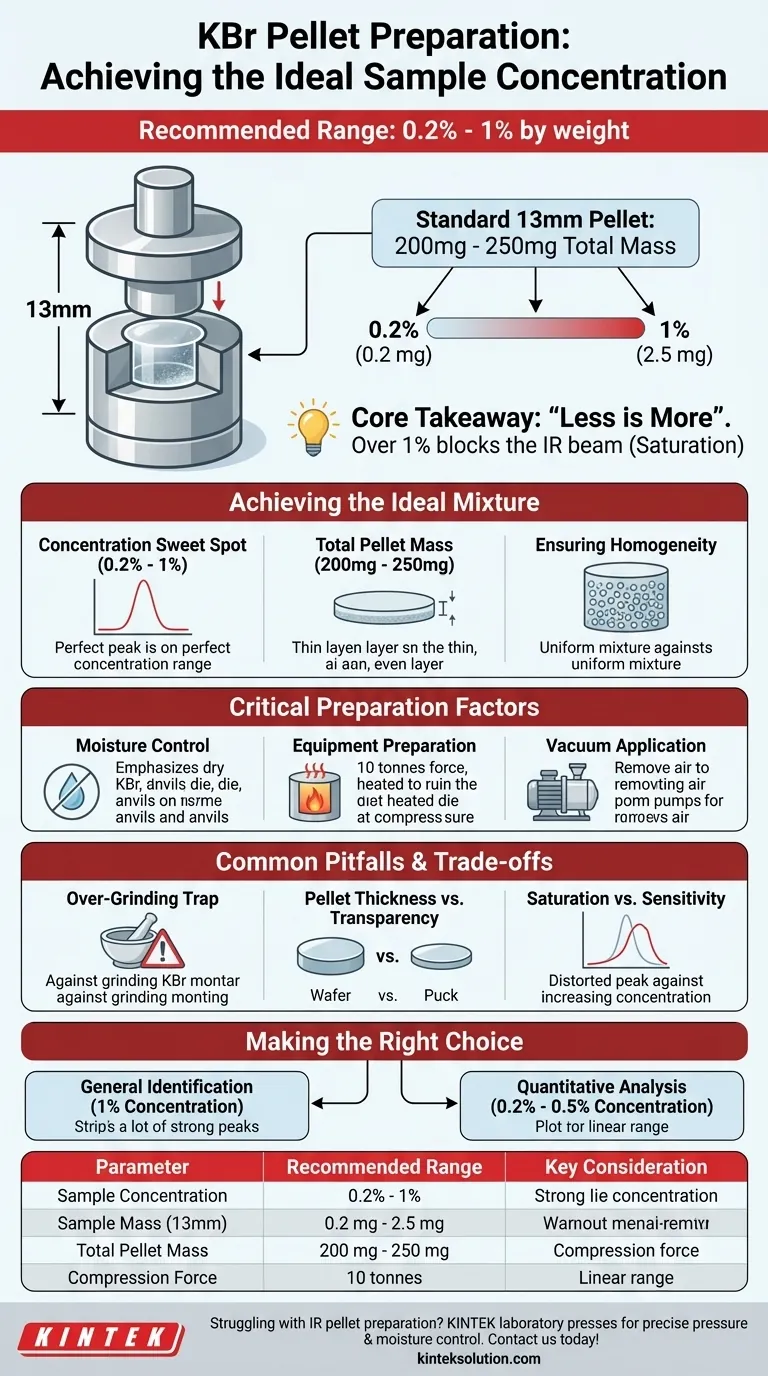
The recommended sample concentration is typically between 0.2% and 1% by weight. For a standard 13 mm diameter pellet, this translates to mixing approximately 0.2 mg to 2.5 mg of your sample into 200 mg to 250 mg of fine KBr powder. Exceeding this ratio often leads to total absorbance or scattering, rendering the resulting spectrum unusable.
Core Takeaway In KBr pellet preparation, "less is more." The goal is to create a transparent medium where the sample particles are suspended; a concentration higher than 1% usually blocks the infrared beam (saturation) rather than improving signal quality.
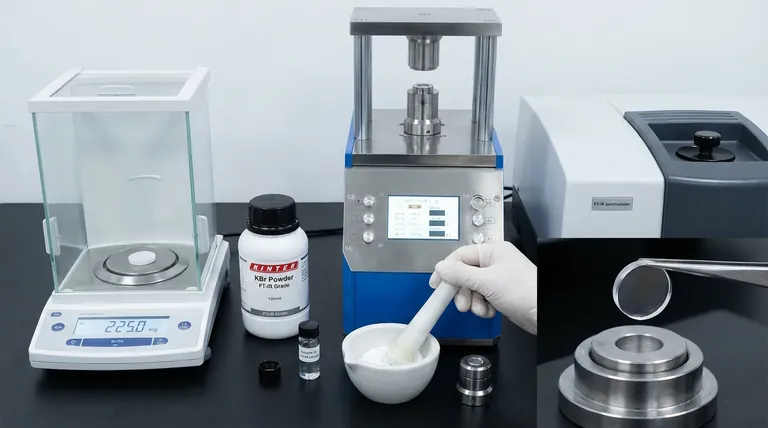
Achieving the Ideal Mixture
The Concentration Sweet Spot
For most organic compounds, a concentration range of 0.2% to 1% provides the best balance.
If the concentration is too low, your peaks will be indistinguishable from baseline noise. If the concentration is too high, you risk complete absorption of the IR beam, resulting in "flat-topped" peaks that hide chemical information.
Total Pellet Mass
While the ratio matters, the total amount of powder used is equally critical.
For a 13 mm die, 200 mg to 250 mg of total mixture is standard. However, you should use the minimum amount necessary to coat the anvils with a thin, even layer.
Ensuring Homogeneity
The sample must be uniformly distributed throughout the KBr matrix.
Inconsistent mixing leads to scattering and noisy spectra. The sample itself should be fine, but the mixture must be homogeneous to ensure the beam interacts evenly with the material.
Critical Preparation Factors
Moisture Control
Moisture is the primary enemy of a clear KBr pellet.
You must ensure the KBr powder, the die set, and the anvils are completely dry and at the same temperature. Differences in temperature can cause moisture condensation, leading to cloudy, wet pellets.
Equipment Preparation
Before pressing, heat the anvils and the body of the die set.
This step ensures dryness and prepares the metal surfaces for compression. A load of 10 tonnes applied to a 13 mm die is generally sufficient to fuse the powder into a transparent disc.
Vacuum Application
If your die set allows for it, applying a vacuum is highly recommended.
Ensure seals are in good condition and positioned correctly. Removing air from the die reduces scattering and helps fuse the pellet into a clear glass-like state.
Common Pitfalls and Trade-offs
The "Over-Grinding" Trap
While your sample needs to be fine, you must be careful when mixing it with the salt.
Do not grind the KBr powder itself excessively. Grinding KBr exposes new crystal facets that are highly hygroscopic, causing them to absorb atmospheric moisture rapidly.
Pellet Thickness vs. Transparency
A common mistake is using too much total powder, creating a thick "puck" rather than a wafer.
Thick pellets are difficult to compress evenly. This frequently leads to wedging or the appearance of white, opaque spots due to trapped air or uneven pressure distribution.
Saturation vs. Sensitivity
Increasing sample concentration to find weak peaks is a risky trade-off.
While it may amplify minor features, it will almost certainly distort your major peaks through saturation. It is usually better to rely on software magnification of a clean, low-concentration spectrum.
Making the Right Choice for Your Goal
To ensure the best results, tailor your approach to your specific analytical needs:
- If your primary focus is general identification: stick to a 1% concentration, as this provides strong, recognizable peaks for library matching.
- If your primary focus is quantitative analysis: reduce the concentration to 0.2% - 0.5% to ensure all peaks remain within the linear range of the detector (avoiding saturation).
- If your primary focus is avoiding moisture bands: minimize the time the KBr is exposed to air and avoid grinding the salt matrix; simply mix the sample into it.
precision in weighing and strict moisture control are far more valuable than adding more sample material.
Summary Table:
| Parameter | Recommended Range | Key Consideration |
|---|---|---|
| Sample Concentration | 0.2% - 1% by weight | Higher concentrations cause IR beam saturation and unusable spectra |
| Sample Mass (13mm die) | 0.2 mg - 2.5 mg | For 200-250 mg total KBr mixture |
| Total Pellet Mass | 200 mg - 250 mg | Minimum amount for thin, even layer coverage |
| Compression Force | 10 tonnes | Standard for 13mm die to create transparent disc |
Struggling with IR pellet preparation? KINTEK's laboratory presses deliver the precise, consistent pressure needed for perfect KBr pellets every time. Our automatic lab presses and heated presses ensure optimal moisture control and homogeneous sample distribution – critical factors for achieving clear, reliable IR spectra. Whether you're performing general identification or quantitative analysis, KINTEK equipment helps you avoid common pitfalls like beam saturation and moisture contamination. Contact us today (#ContactForm) to discuss how our lab press solutions can improve your sample preparation workflow and spectral results.
Visual Guide
Related Products
- XRF KBR Plastic Ring Lab Powder Pellet Pressing Mold for FTIR
- Laboratory Hydraulic Press 2T Lab Pellet Press for KBR FTIR
- XRF KBR Steel Ring Lab Powder Pellet Pressing Mold for FTIR
- Automatic Laboratory Hydraulic Press for XRF and KBR Pellet Pressing
- Laboratory Hydraulic Pellet Press for XRF KBR FTIR Lab Press
People Also Ask
- What is the purpose of making KBr pellets for FTIR? Achieve Precise Molecular Analysis with Solid Samples
- What factors should be considered when choosing a lab press for XRF pellet preparation? Ensure Accurate and Consistent Results
- Why are pellets used in XRF analysis, and what is their limitation? Boost Accuracy and Speed in Your Lab
- How are pellets prepared for XRF analysis and what is a potential drawback? Master XRF Sample Prep and Accuracy
- What should be included in a checklist for making XRF pellets? Ensure Accurate and Repeatable XRF Analysis















