
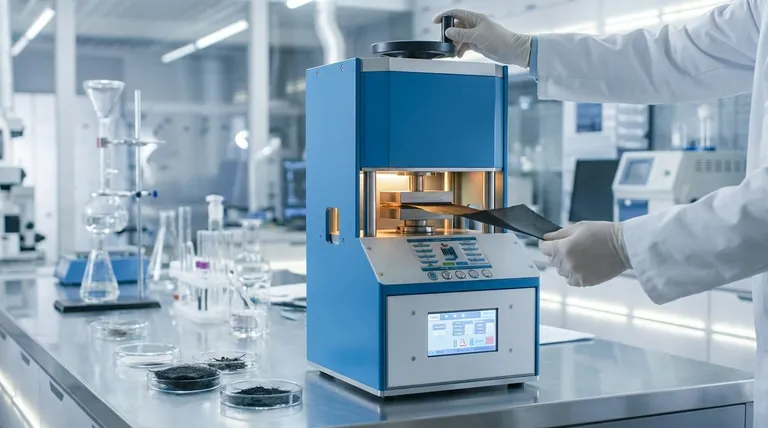
A hot-pressing machine functions as a critical densification tool in the fabrication of 3D nanofiber anodes. By applying simultaneous thermal energy and mechanical force, it transforms loose, porous nanofiber membranes into compact, high-performance electrode structures. This process is essential for overcoming the natural "fluffiness" of spun fibers to create a dense, conductive, and mechanically stable material.
While electrospinning creates the potential for high surface area, hot-pressing activates the electrode's performance. It acts as the bridge between a fragile, loose membrane and a robust, low-resistance anode capable of efficient energy storage.
Enhancing Physical Structure and Stability
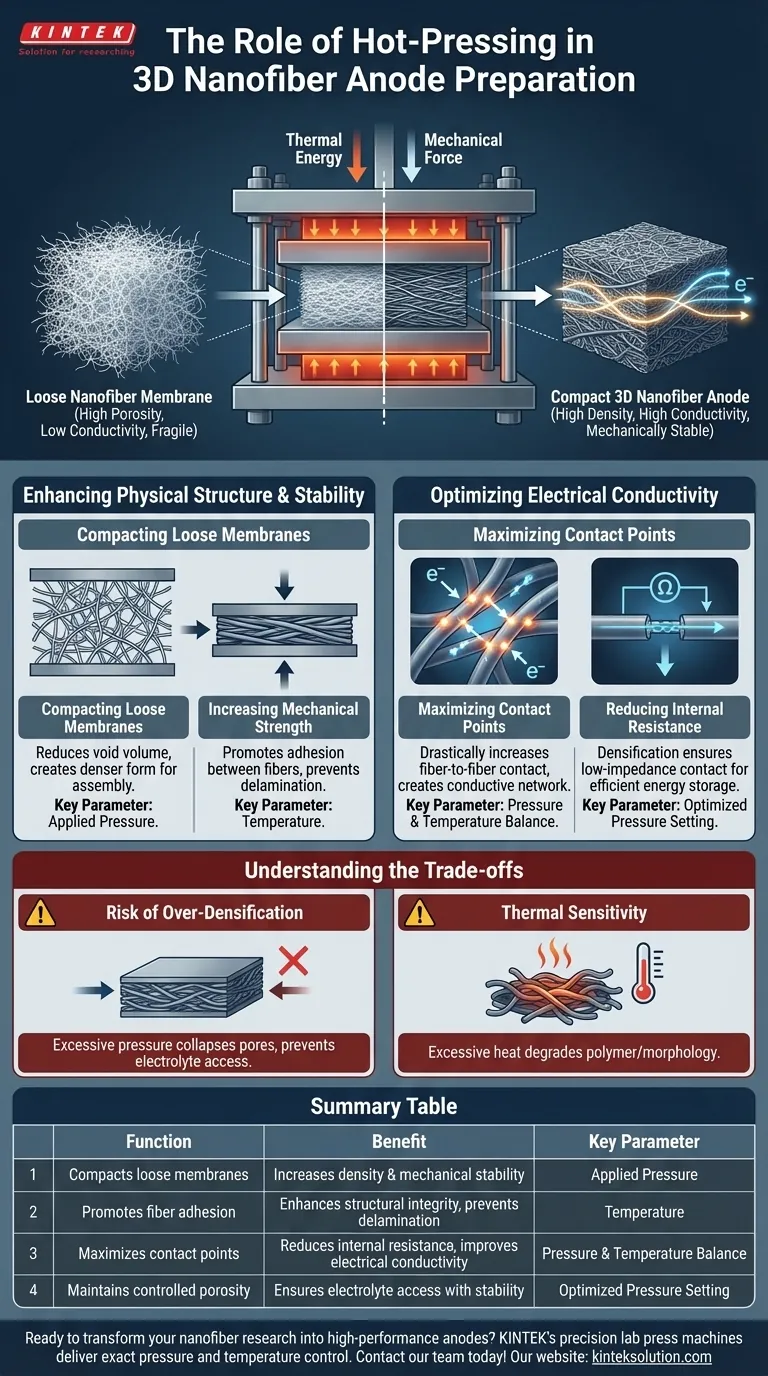
Compacting Loose Membranes
Nanofibers, particularly those generated through electrospinning, are inherently loose and voluminous. A hot-pressing machine applies mechanical pressure to compress this network.
This compaction reduces unnecessary void volume within the 3D structure. It transforms a delicate mesh into a denser, more usable form for battery assembly.
Increasing Mechanical Strength
The application of heat during the pressing process promotes adhesion between individual fibers.
This results in a significant increase in mechanical strength. A hot-pressed anode is far less likely to delaminate or disintegrate during the physical stress of cell fabrication.
Optimizing Electrical Conductivity
Maximizing Contact Points
The most critical role of the hot-pressing machine is to force fibers closer together. This drastically increases the number of contact points between individual nanofibers.
More contact points mean more pathways for electrons to travel. This creates a continuous conductive network essential for high-performance anodes.
Reducing Internal Resistance
Loose fiber networks suffer from high electrical resistance due to poor connectivity. By densifying the material, hot-pressing significantly reduces the internal resistance of the electrode.
This ensures stable, low-impedance physical contact between the electrode material, the current collector, and the electrolyte.
Understanding the Trade-offs
The Risk of Over-Densification
While compaction is necessary, applying excessive pressure can be detrimental.
If the membrane is pressed too tightly, the porous structure may collapse completely. This prevents the electrolyte from permeating the anode, rendering the high surface area of the nanofibers useless.
Thermal Sensitivity
The heat settings on the machine must be precisely controlled.
Excessive heat can degrade the polymer components of the nanofiber or alter its chemical structure. The goal is to soften the material enough for bonding, not to melt or destroy the fiber morphology.
Making the Right Choice for Your Goal
Achieving the ideal anode requires balancing the need for conductivity with the need for electrolyte accessibility.
- If your primary focus is electrical conductivity: Prioritize higher compression to maximize fiber-to-fiber contact and minimize internal resistance.
- If your primary focus is electrolyte wettability: Utilize moderate pressure to maintain sufficient porosity for ion transport while still stabilizing the structure.
Mastering the temperature and pressure parameters of the hot-pressing machine is the key to converting raw nanofibers into a commercially viable battery component.
Summary Table:
| Function | Benefit | Key Parameter |
|---|---|---|
| Compacts loose membranes | Increases density and mechanical stability | Applied pressure |
| Promotes fiber adhesion | Enhances structural integrity and prevents delamination | Temperature |
| Maximizes contact points | Reduces internal resistance and improves electrical conductivity | Pressure & temperature balance |
| Maintains controlled porosity | Ensures electrolyte access while providing stability | Optimized pressure setting |
Ready to transform your nanofiber research into high-performance anodes? KINTEK's precision lab press machines, including automatic, isostatic, and heated lab presses, are engineered to deliver the exact pressure and temperature control required for optimizing 3D nanofiber anode density, conductivity, and stability. Let our expertise in laboratory densification solutions help you achieve reproducible, high-quality results. Contact our team today to discuss your specific application needs!
Visual Guide
Related Products
- Automatic Heated Hydraulic Press Machine with Hot Plates for Laboratory
- Automatic High Temperature Heated Hydraulic Press Machine with Heated Plates for Lab
- 24T 30T 60T Heated Hydraulic Lab Press Machine with Hot Plates for Laboratory
- Automatic Heated Hydraulic Press Machine with Heated Plates for Laboratory
- Laboratory Split Manual Heated Hydraulic Press Machine with Hot Plates
People Also Ask
- Function of a Laboratory Hydraulic Press with Heated Platens in SSE? Enhance Battery Density & Conductivity
- Why is a laboratory hydraulic press with heating plates required for PLA/TEC films? Achieve Precise Sample Integrity
- How does a laboratory heated hydraulic press facilitate PBN sample prep for WAXS? Achieve Precise X-Ray Scattering
- What are the requirements for electrode pressing with high-viscosity ionic liquids like EMIM TFSI? Optimize Performance
- What are the industrial applications of heated hydraulic presses? Master Heat & Force for Precision Manufacturing



















