
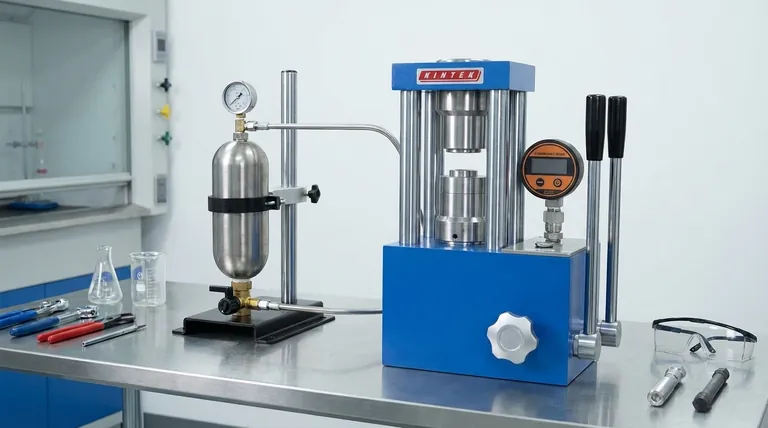
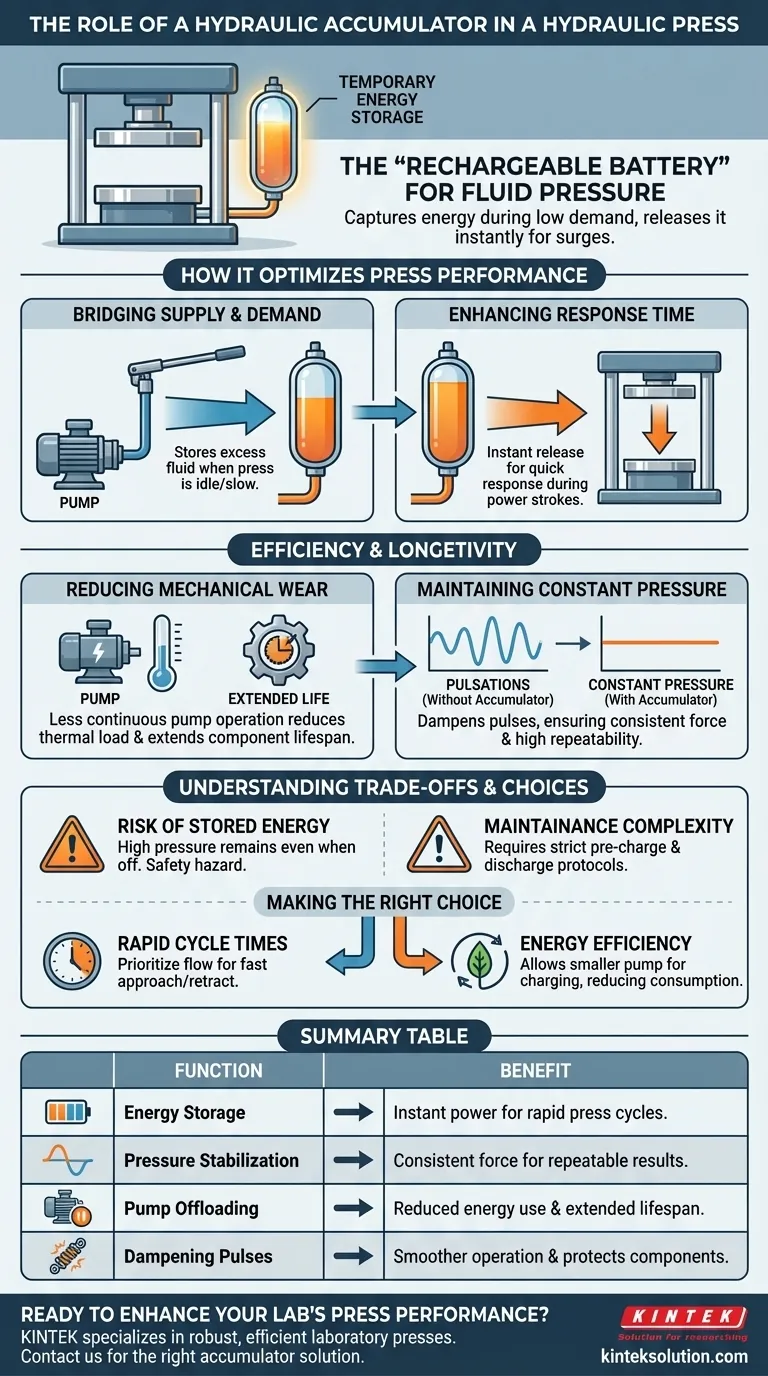
The hydraulic accumulator serves as a temporary energy storage reservoir within a hydraulic press system. It captures pressurized fluid during periods of low demand and releases it instantly when the press requires a sudden surge of power or speed. This capability allows the system to maintain consistent pressure and responsiveness without forcing the hydraulic pump to run at peak capacity continuously.
The Core Takeaway A hydraulic accumulator acts like a rechargeable battery for fluid pressure. By bridging the gap between the pump's steady output and the press's fluctuating demands, it ensures rapid response times, stabilizes system pressure, and significantly reduces energy consumption and mechanical wear.
How the Accumulator Optimizes Press Performance
The fundamental operation of a hydraulic press relies on Pascal's Law, where pressure applied to a confined fluid is transmitted equally to generate force. However, the demand for this force is rarely static. The accumulator optimizes how this pressure is delivered.
Bridging Supply and Demand
A standard hydraulic pump generates flow at a relatively constant rate. However, a press often needs high flow for rapid movement (the approach stroke) and high pressure for the actual pressing (the power stroke).
The accumulator stores excess pressurized fluid when the press is idle or moving slowly. When the cycle demands a burst of speed or force, the accumulator discharges this stored energy to assist the pump.
Enhancing Response Time
Because the fluid is already stored under pressure, the release is nearly instantaneous. This allows the press to respond quickly to sudden demands.
Without an accumulator, the system would be limited entirely by the instantaneous output of the pump, resulting in sluggish cycle times during peak loads.
Efficiency and System Longevity
Beyond immediate performance, the accumulator plays a critical role in the operational health of the machine.
Reducing Mechanical Wear
References indicate that the accumulator reduces the need for the hydraulic pump to operate continuously. By offloading work during peak demands, the pump cycles less frequently.
This reduction in duty cycle lowers the thermal load on the system. It minimizes wear on the pump bearings and seals, extending the overall lifespan of the hydraulic components.
Maintaining Constant Pressure
Hydraulic systems are prone to pressure fluctuations and pulsations, especially when valves open or close.
The accumulator dampens these pulses, ensuring the constant pressure required for consistent operation. This leads to higher repeatability in the manufacturing process, ensuring the same force is applied to every part.
Understanding the Trade-offs
While the benefits are significant, integrating an accumulator introduces specific operational considerations that must be managed.
The Risk of Stored Energy
The accumulator’s primary strength—storing energy—is also its main safety challenge. Even when the machine is turned off and the pump is stopped, the accumulator may still hold fluid under high pressure.
Maintenance Complexity
Adding an accumulator introduces another pressurized vessel to the circuit. This requires strict maintenance protocols to ensure the pre-charge (gas pressure) is correct and the vessel integrity is uncompromised. Failing to discharge the accumulator before maintenance can result in dangerous, sudden releases of hydraulic fluid.
Making the Right Choice for Your Goal
Whether your system requires a large accumulator depends on the specific operational profile of your press.
- If your primary focus is rapid cycle times: Prioritize a properly sized accumulator to provide the high flow rates needed for fast approach and retract speeds.
- If your primary focus is energy efficiency: Use the accumulator to allow for a smaller, lower-horsepower pump that charges the system during idle times, rather than a large pump running constantly.
Ultimately, the hydraulic accumulator transforms a press from a reactive machine into a responsive, energy-efficient system capable of handling dynamic workloads.
Summary Table:
| Function | Benefit |
|---|---|
| Energy Storage | Provides instant power for rapid press cycles |
| Pressure Stabilization | Ensures consistent force application for repeatable results |
| Pump Offloading | Reduces energy use and extends pump lifespan |
| Dampening Pulses | Smoothes operation and protects system components |
Ready to enhance your lab's hydraulic press performance?
At KINTEK, we specialize in designing and supplying robust laboratory equipment, including hydraulic presses optimized for efficiency and reliability. Whether you need an automatic lab press, an isostatic press, or a heated lab press, our solutions are engineered to meet the demanding needs of your laboratory.
Let our experts help you select the right press with an accumulator system to boost your cycle times, improve consistency, and reduce operational costs. Contact us today to discuss your specific application and discover the KINTEK advantage!
Visual Guide
Related Products
- Laboratory Hydraulic Pellet Press for XRF KBR FTIR Lab Press
- Laboratory Hydraulic Press 2T Lab Pellet Press for KBR FTIR
- Laboratory Hydraulic Split Electric Lab Pellet Press
- Automatic Laboratory Hydraulic Press Lab Pellet Press Machine
- Laboratory Hydraulic Press Lab Pellet Press Button Battery Press
People Also Ask
- Laboratory Pellet Press for Solar PV Recycling: Ensuring High-Precision Material Analysis and Purity
- Why is a professional laboratory pellet press required for XRF of silica sand? Achieve +/- 0.10% Precision
- Why is precise pressure-holding control critical for biomass pellets? Master Your Densification Results
- What is the necessity of a laboratory pellet press for alcohol by-product fuels? Maximize Energy Density & Consistency
- What are the different types of pellet-making tools available for labs? Choose the Right Press for Your Sample


















