
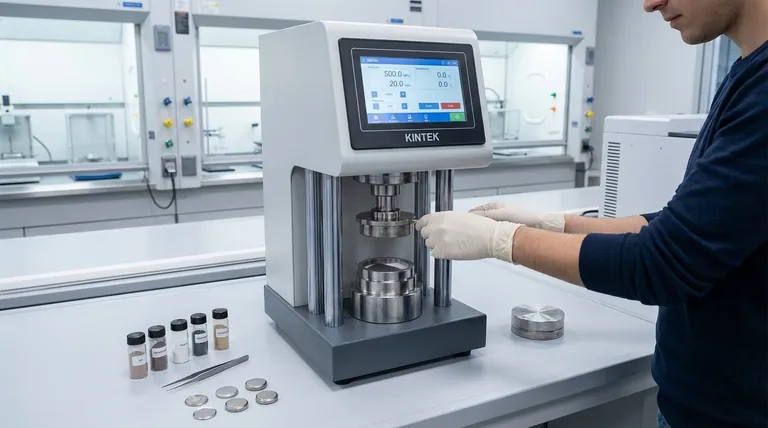
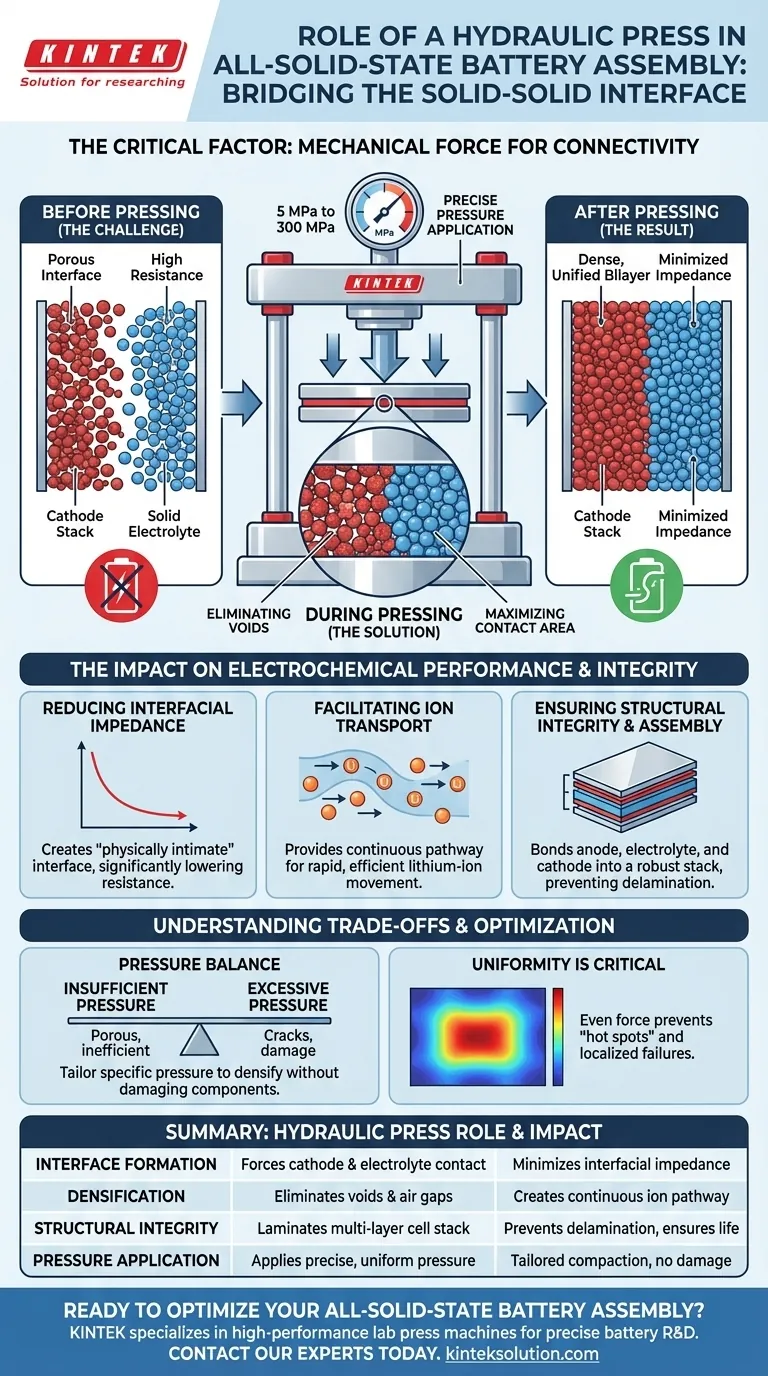
The primary role of a hydraulic press in this context is to mechanically force the cathode and solid electrolyte materials into intimate physical contact. By applying precise pressure—ranging from moderate levels like 5 MPa to high intensities of 300 MPa—the press eliminates microscopic voids between the layers. This transforms loose powders or separate sheets into a dense, unified bilayer with a seamless solid-solid interface.
Core Takeaway Unlike liquid electrolytes that naturally "wet" electrode surfaces, solid-state batteries require significant mechanical force to establish connectivity. The hydraulic press bridges this gap by compacting materials to maximize surface area contact, which is the single most critical factor in minimizing electrical resistance and enabling the battery to function.
Overcoming the Solid-Solid Interface Challenge
Eliminating Inter-particle Voids
In an all-solid-state battery (ASSB), the cathode and electrolyte are often initially composed of dry powders or composite sheets.
Without external force, air gaps and voids exist between these particles. The hydraulic press applies force (often up to 240 MPa or 300 MPa) to physically crush these voids, compacting the materials into a dense state.
Maximizing Contact Area
Efficient battery operation requires the largest possible surface area for ions to travel between the cathode and the electrolyte.
The pressing process flattens surface irregularities, ensuring the cathode composite firmly abuts the electrolyte. This increases the active contact area, which is essential for the electrochemical reaction to occur uniformly.
The Impact on Electrochemical Performance
Reducing Interfacial Impedance
The greatest barrier to performance in ASSBs is high interfacial impedance—essentially, the resistance ions face when moving from one material to another.
By creating a "physically intimate" interface, the hydraulic press significantly lowers this resistance. A high-quality press ensures the contact resistance at the solid-solid interface is minimized, directly improving the battery's efficiency.
Facilitating Ion Transport
Lithium ions cannot travel through air gaps; they require a continuous solid path.
The high-density pellets or membranes created by the press provide this continuous pathway. This seamless integration allows for rapid, efficient lithium-ion transport, which determines the battery's rate performance and power output.
Structural Integrity and Assembly
Lamination of the Cell Stack
Beyond just the cathode-electrolyte interface, the press is used to laminate the entire multi-layer cell structure.
It bonds the lithium metal anode, the solid electrolyte (such as Li2.5Y0.5Zr0.5Cl6), and the cathode into a single, robust stack. This prevents delamination during battery operation, which is vital for long-term cycle life.
Ensuring Repeatability
In laboratory settings, the press provides the precise control needed for prototype development.
It ensures that the sealing of the anode, cathode, separator, and casing is uniform and repeatable. This consistency is required to generate reliable data regarding the structural integrity and performance of test cells.
Understanding the Trade-offs
While pressure is essential, applying it correctly involves balancing competing physical factors.
Pressure Magnitude vs. Material Integrity
Applying insufficient pressure results in a porous interface with high resistance, rendering the battery inefficient.
However, excessive pressure can crush active material particles or crack the solid electrolyte layer. The specific pressure (e.g., 5 MPa vs. 300 MPa) must be tailored to the specific materials used (like SPE-NCM811 vs. ceramic electrolytes) to densify the cell without damaging its components.
Uniformity is Critical
The pressure must be applied uniformly across the entire surface area of the cell.
Uneven pressure leads to "hot spots" of current density or structural weak points. The hydraulic press must deliver force evenly to prevent localized failures that could shorten the battery's lifespan.
Making the Right Choice for Your Goal
The specific application of the hydraulic press depends on which aspect of battery development you are optimizing.
- If your primary focus is reducing internal resistance: Utilize high-pressure ranges (240–300 MPa) to maximize particle compaction and minimize voids at the solid-solid interface.
- If your primary focus is assembly and lamination: Focus on moderate, sustained pressure to bond the anode, cathode, and electrolyte layers without cracking brittle components.
- If your primary focus is prototype consistency: Prioritize a press with high precision and repeatability to ensure every test cell has identical structural parameters.
The hydraulic press is not just a tool for assembly; it is the fundamental enabler of ion transport in solid-state chemistry.
Summary Table:
| Aspect | Role of Hydraulic Press | Impact on Battery Performance |
|---|---|---|
| Interface Formation | Forces cathode & electrolyte into intimate contact | Minimizes interfacial impedance and resistance |
| Densification | Eliminates microscopic voids and air gaps | Creates a continuous pathway for efficient ion transport |
| Structural Integrity | Laminates the entire multi-layer cell stack | Prevents delamination and ensures long-term cycle life |
| Pressure Application | Applies precise, uniform pressure (5 MPa to 300 MPa) | Tailored compaction without damaging brittle materials |
Ready to Optimize Your All-Solid-State Battery Assembly?
KINTEK specializes in high-performance lab press machines, including automatic, isostatic, and heated lab presses designed for the precise demands of battery R&D. Our equipment delivers the uniform pressure and repeatability you need to create flawless solid-solid interfaces, reduce resistance, and accelerate your prototype development.
Contact our experts today to discuss how our hydraulic press solutions can enhance your battery performance and reliability.
Visual Guide
Related Products
- Automatic High Temperature Heated Hydraulic Press Machine with Heated Plates for Lab
- Manual Heated Hydraulic Lab Press with Integrated Hot Plates Hydraulic Press Machine
- Heated Hydraulic Press Machine with Heated Plates for Vacuum Box Laboratory Hot Press
- Laboratory Hydraulic Press 2T Lab Pellet Press for KBR FTIR
- Laboratory Hydraulic Press Lab Pellet Press Machine for Glove Box
People Also Ask
- Function of a Laboratory Hydraulic Press with Heated Platens in SSE? Enhance Battery Density & Conductivity
- How does a laboratory heated hydraulic press facilitate PBN sample prep for WAXS? Achieve Precise X-Ray Scattering
- What are the requirements for electrode pressing with high-viscosity ionic liquids like EMIM TFSI? Optimize Performance
- What are the industrial applications of heated hydraulic presses? Master Heat & Force for Precision Manufacturing
- Why is a laboratory hydraulic press with heating plates required for PLA/TEC films? Achieve Precise Sample Integrity



















