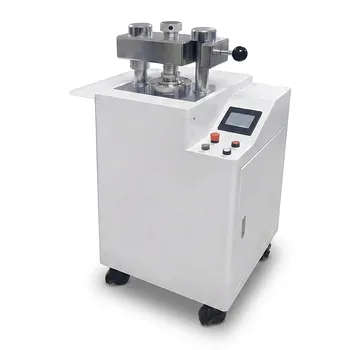
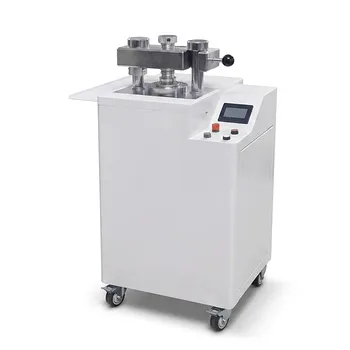
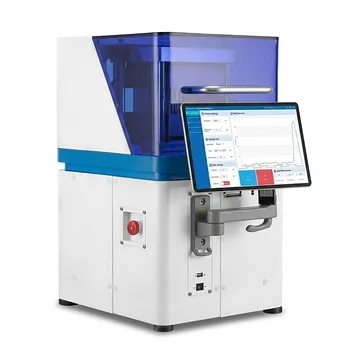
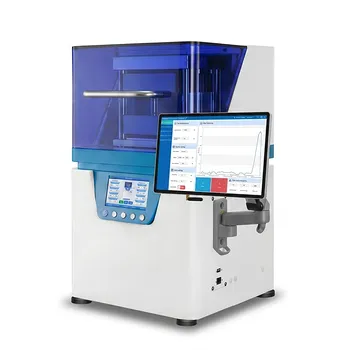
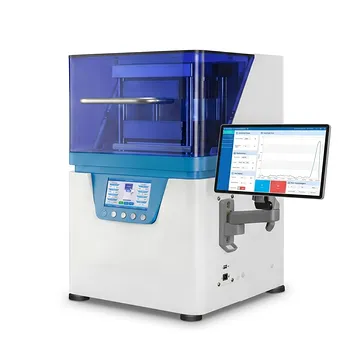
A lab pellet press is the standard mechanism for converting loose powdered samples into solid, uniform discs required for high-precision spectroscopic analysis. By applying controlled high pressure, the press eliminates physical inconsistencies—such as voids or surface irregularities—that would otherwise distort analytical data in techniques like Fourier Transform Infrared Spectroscopy (FTIR) and X-ray Fluorescence (XRF).
Core Takeaway: The pellet press acts as a sample standardization tool. By compressing powders into high-density, flat-surfaced pellets, it minimizes light scattering and ensures molecular-level homogeneity, which is a prerequisite for reproducible and accurate spectral readings.
The Engineering Behind Sample Integrity
Achieving Critical Density and Homogeneity
The primary function of a lab pellet press is to compact powder reagents into a solid form with uniform density. Loose powders naturally contain air gaps and exhibit random particle distribution.
By applying high tonnage, the press forces particles into molecular-level contact. This minimizes the risk of segregation (where elements separate unevenly) and ensures that the portion analyzed is truly representative of the whole sample.
Ensuring Surface Flatness
For accurate spectroscopy, the geometry of the sample is as important as its chemistry. The press creates test flakes or pellets with perfectly flat surfaces.
Irregular surfaces cause inconsistent scattering of the analysis signal. A hydraulically pressed pellet provides a smooth, standardized surface that eliminates these geometric errors.
Application in Fourier Transform Infrared Spectroscopy (FTIR)
Creating Transparent KBr Pellets
In FTIR analysis, the press is most commonly used to create Potassium Bromide (KBr) pellets. KBr is mixed with the sample because it is transparent to infrared light.
The press fuses this mixture into a clear disc. This transparency allows the infrared spectrometer to capture the vibration characteristics of functional groups (such as O-H and C=O) without interference.
Improving Optical Quality
High-pressure molding is vital for eliminating light scattering between powder particles.
When the pellet is perfectly compressed, the optical quality improves significantly. This results in a higher signal-to-noise ratio, revealing clear chemical bonding information that might otherwise be lost in the noise of a loosely packed sample.
Application in X-ray Fluorescence (XRF)
Minimizing Gap Effects
For XRF, the press is used to form dense pellets, often combining the sample with a binder like wax. The massive pressure eliminates the "gap effects" (voids) between powder particles.
These gaps can disrupt the path of X-rays. By removing them, the press ensures the stability of radiation excitation, which is fundamental for obtaining high-precision data on elemental concentrations.
Reducing Scattering Errors
Surface irregularities on a powder sample can scatter X-rays unpredictably. A pressed pellet offers a fixed, repeatable geometry.
This physical uniformity ensures that variations in the data are caused by the chemical composition of the soil or material, rather than the physical roughness of the sample surface.
Understanding the Trade-offs
The Necessity of Precision Pressure
While pressure is the solution, incorrect pressure is a problem. The press must provide stable and repeatable force.
If the pressure is too low, the pellet will lack the required density and may crumble or contain voids. If the pressure is applied unevenly, the pellet may suffer from density gradients, leading to inconsistent spectroscopic results.
Sample Preparation Variables
The press relies on the quality of the mixture. In XRF, a binder is often required to maintain structural integrity; in FTIR, the ratio of KBr to sample must be exact.
The press cannot correct for a poorly mixed sample. It effectively "freezes" the distribution of particles in place, so the initial mixing and grinding of the powder before pressing are just as critical as the pressing force itself.
Making the Right Choice for Your Goal
The type of pressing required depends entirely on the analytical technique you are employing.
- If your primary focus is FTIR: Your goal is optical transparency; you need a press capable of fusing KBr mixtures into clear discs to minimize light scattering.
- If your primary focus is XRF: Your goal is physical density; you need a press that can apply sufficient force to eliminate voids and create a perfectly flat surface for stable radiation excitation.
A lab pellet press transforms a variable, loose powder into a consistent analytical standard, providing the physical foundation necessary for reliable chemical data.
Summary Table:
| Feature | Role in FTIR Analysis | Role in XRF Analysis |
|---|---|---|
| Primary Goal | Achieve optical transparency | Ensure physical density & flatness |
| Mechanism | Fuses KBr mixture into clear discs | Eliminates voids & "gap effects" |
| Data Impact | Reduces light scattering; clear signals | Stabilizes radiation excitation |
| Preparation | Requires IR-transparent binders (KBr) | Often requires wax or cellulose binders |
Elevate Your Analytical Precision with KINTEK
Don't let sample inconsistencies compromise your research data. KINTEK specializes in comprehensive laboratory pressing solutions designed for the rigorous demands of spectroscopic analysis.
Our versatile range includes:
- Manual & Automatic Presses: For repeatable force application.
- Heated & Multifunctional Models: To handle complex material transformations.
- Glovebox-Compatible & Isostatic Presses: Perfect for advanced battery research and sensitive materials.
Whether you are preparing KBr pellets for FTIR or dense discs for XRF, KINTEK provides the stability and uniformity your lab requires. Contact us today to find the perfect press for your application.
Related Products
- Automatic Fluorescence Sample Preparation Press 40 Ton Lab Pellet Press for XRF Analysis
- Automatic Laboratory Hydraulic Press Lab Pellet Press Machine
- Laboratory Hydraulic Press 2T Lab Pellet Press for KBR FTIR
- Laboratory Hydraulic Pellet Press for XRF KBR FTIR Lab Press
- Laboratory Hydraulic Press Lab Pellet Press Machine for Glove Box
People Also Ask
- What is the general process for preparing a sample pellet for XRF? Master Consistency for Accurate Analysis
- What are the advantages of preparing a sample as a dense pellet for XRF? Unlock High-Precision Trace Element Analysis
- What are the common operational types of lab pellet presses? Choosing the Right Manual, Automatic, or Hydraulic System
- What are the emerging trends in the design and materials of lab pellet presses? Modernize Your Lab Efficiency
- What are common lab pellet press issues? Expert Troubleshooting Guide for Reliable Material Research