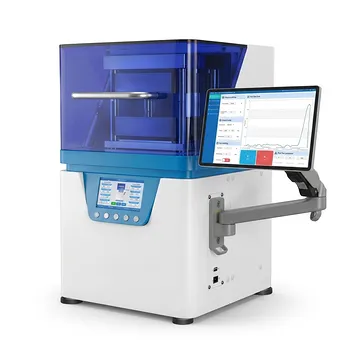
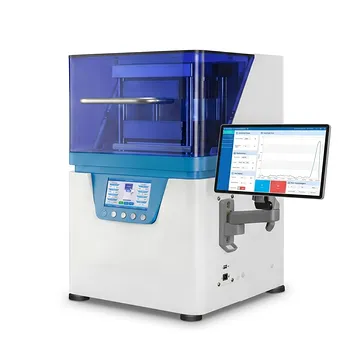
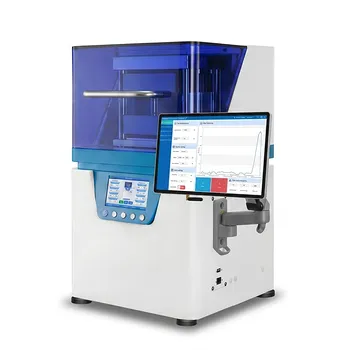
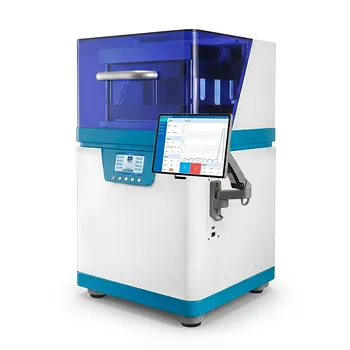
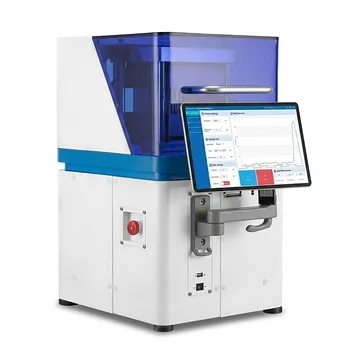
The laboratory hydraulic press is the primary instrument used to transform loose mixtures of nano-active materials, conductive agents, and binders into solid, high-performance electrode sheets. By applying precise and uniform pressure, the press compacts these materials onto a current collector to achieve specific densities and thicknesses. This process is fundamental to ensuring the electrode can effectively store and transport electrical energy.
Core Takeaway: A laboratory hydraulic press serves as a critical bridge between raw nanomaterials and a functional battery component by optimizing the electrode's physical structure to minimize electrical resistance and maximize energy density.
Optimizing the Physical Architecture of the Electrode
Achieving Precise Density and Thickness
The hydraulic press allows researchers to compress nano-powders into "green bodies" or electrode sheets with exacting density specifications. This compaction is vital for increasing the volumetric energy density, ensuring that more active material is packed into the limited space of a battery cell.
Consistent pressure across the entire surface ensures that the electrode thickness remains uniform. This thickness consistency prevents localized stress points and ensures an even distribution of current during battery operation.
Enhancing Electrical Connectivity
Nano-electrodes rely on a continuous network of particles to move electrons. The hydraulic press forces active particles and conductive agents into tight physical contact, which significantly reduces interfacial and contact resistance.
By eliminating internal voids between nanoparticles, the press creates a robust conductive pathway. This physical integration is essential for maintaining electrical performance, especially during the high-rate charging and discharging common in lithium-ion applications.
Structural Integrity and Performance Stability
Strengthening the Bond to the Current Collector
The press facilitates a high-strength bond between the electrode material and the metallic current collector. High-precision pressure control increases the adhesion force, preventing the active material from delaminating or peeling off during the repeated expansion and contraction of battery cycles.
This mechanical stability is a prerequisite for cycling stability. Without the uniform pressure provided by a hydraulic press, the electrode would likely suffer from structural failure, leading to a rapid loss of battery capacity.
Managing Porosity for Ion Transport
While the press increases density, it is also the tool used to strictly control porosity. By adjusting the applied force, researchers can leave enough microscopic "tunnels" for the liquid electrolyte to penetrate the electrode.
Properly calibrated porosity ensures that lithium ions can move freely through the material. This balance between high density (for energy) and adequate porosity (for power) is the key to optimizing the electrochemical activity of nanomaterials.
Understanding the Trade-offs
The Risk of Over-Compression
Applying excessive pressure can lead to "over-compaction," which collapses the essential pore structure of the electrode. If porosity is too low, the electrolyte cannot reach the active materials, significantly increasing internal resistance and slowing down ion transport.
The Danger of Insufficient Pressure
If the pressure is too low, the electrode will have high contact resistance and poor mechanical integrity. This often results in "shedding," where the nano-active materials lose contact with the conductive network, leading to premature battery failure.
How to Apply This to Your Project
Making the Right Choice for Your Goal
To achieve the best results with a laboratory hydraulic press, the pressure settings must be aligned with the specific requirements of your battery chemistry.
- If your primary focus is High Energy Density: Use higher pressure settings to maximize the compaction density of the active materials, while monitoring for potential electrolyte starvation.
- If your primary focus is Fast-Charging (Power): Aim for moderate pressure to maintain higher porosity, ensuring that ion transport paths remain open and efficient.
- If your primary focus is Long-Term Cycling Stability: Prioritize the bond strength between the material and the current collector by ensuring uniform pressure distribution across the entire electrode surface.
Ultimately, the laboratory hydraulic press is not merely a compaction tool, but a precision instrument for tuning the delicate balance between the mechanical and electrochemical properties of nano-electrodes.
Summary Table:
| Key Role | Impact on Battery Performance | Risk of Incorrect Pressure |
|---|---|---|
| Compaction Density | Increases volumetric energy density and thickness uniformity. | Over-compaction blocks ion transport channels. |
| Electrical Connectivity | Reduces interfacial resistance by creating tight particle contact. | Insufficient pressure increases internal resistance. |
| Structural Adhesion | Prevents delamination from current collectors during cycling. | Weak bonding leads to material shedding and failure. |
| Porosity Control | Manages electrolyte penetration for efficient ion transport. | Low porosity increases internal heat and slows charging. |
Optimize Your Battery Research with KINTEK Precision
Take the guesswork out of electrode formation. KINTEK specializes in comprehensive laboratory pressing solutions tailored for cutting-edge battery research. Whether you are scaling up a new nano-active material or refining electrode architecture, our equipment provides the uniform pressure and precision necessary to maximize energy density and cycling stability.
Our versatile range includes:
- Manual & Automatic Presses for routine electrode preparation.
- Heated & Multifunctional Models for advanced material processing.
- Glovebox-Compatible Presses for air-sensitive battery chemistries.
- Cold and Warm Isostatic Presses for complex nanomaterial structural integrity.
Contact KINTEK today to find the perfect pressing solution for your lab!
References
- Yong Zeng. Study And Application of Nanotechnology in Lithium Batteries. DOI: 10.54097/h19wrh82
This article is also based on technical information from Kintek Solution Knowledge Base .
Related Products
- Laboratory Hydraulic Press Lab Pellet Press Machine for Glove Box
- Laboratory Hydraulic Press 2T Lab Pellet Press for KBR FTIR
- 24T 30T 60T Heated Hydraulic Lab Press Machine with Hot Plates for Laboratory
- Laboratory Hydraulic Press Lab Pellet Press Button Battery Press
- Laboratory Hydraulic Pellet Press for XRF KBR FTIR Lab Press
People Also Ask
- How does a laboratory hydraulic press contribute to the preparation of Li3-3xScxSb samples? Optimize Ionic Conductivity
- What is the function of a laboratory hydraulic press in FT-IR of curcumin-coated MWCNTs? Achieve Optical Clarity.
- Why is a laboratory hydraulic press required for compression molding boron-siloxane? Solve High-Loading Density Challenges
- What role does a laboratory hydraulic press play in reaction pellets? Optimizing Lunar Soil and Metal Fuel Density
- What role does a laboratory hydraulic press play in the preparation of piezoelectric ceramic discs for DC-PG? | KINTEK