
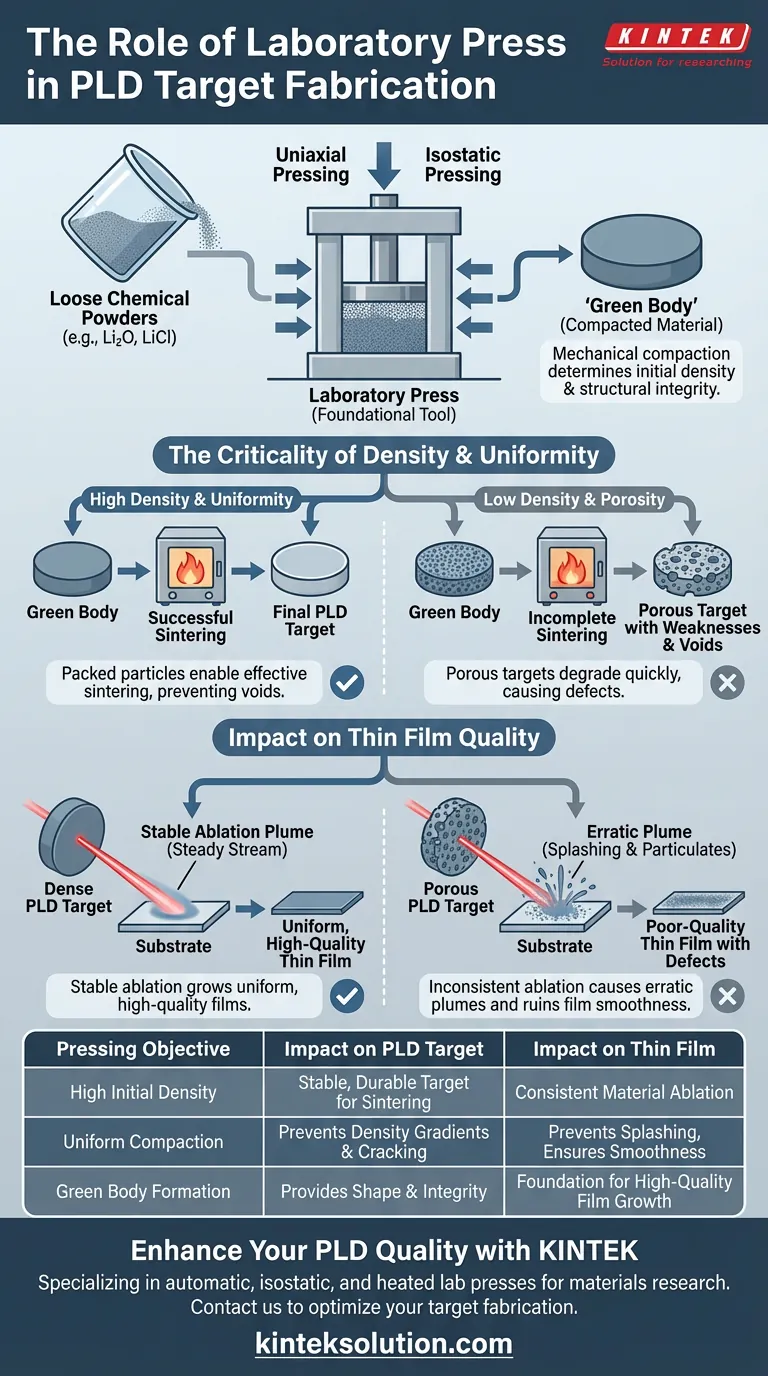
A laboratory press acts as the foundational tool for creating the solid source material required for Pulsed Laser Deposition (PLD). Its primary function is to compress loose chemical powders—such as composites of Li₂O and LiCl—into a solid, shaped puck known as a "green body." This mechanical compaction is the critical first step in determining the density and structural integrity of the final target used in the laser deposition process.
The laboratory press transforms loose powder into a dense, uniform "green body," setting the stage for successful sintering. Without this initial high-density compaction, the PLD target will lack the stability required for consistent material ablation, directly compromising the quality of the resulting thin film.
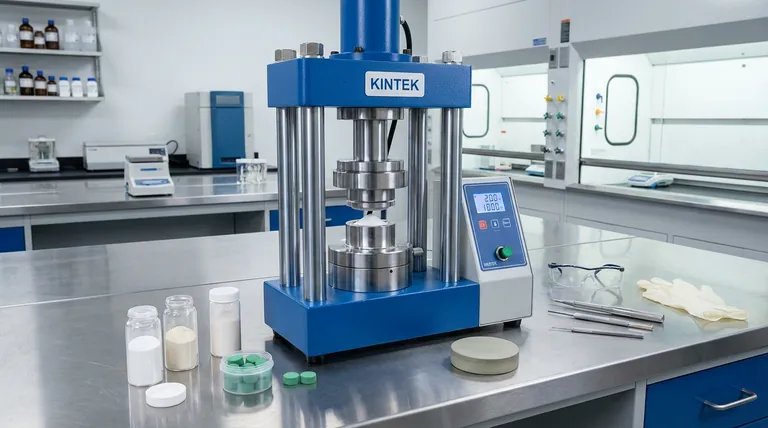
Transforming Powder into a Solid Form
The Creation of the "Green Body"
The initial role of the laboratory press is to take raw source powders and force them into a cohesive shape. By applying significant pressure, the machine creates a "green body."
This term refers to the compacted material before it has been fired or sintered. While it has the shape of the final target, it relies on mechanical interlocking of particles rather than chemical bonding to hold together.
Methods of Compaction
The reference highlights that this pressing can be achieved through two primary methods: uniaxial or isostatic pressing.
Uniaxial pressing applies force from a single direction, which is common for simple puck shapes. Isostatic pressing applies pressure from all sides, which is often used to achieve higher uniformity in more complex scenarios.
The Criticality of Density and Uniformity
Preparing for Sintering
The press is not just about shaping; it is about achieving high initial density. The closer the particles are packed during this stage, the more effective the subsequent sintering process will be.
If the green body is too porous or low-density, the final ceramic target will likely contain voids or structural weaknesses after firing.
Ensuring Material Uniformity
A key objective of the pressing stage is achieving specific uniformity throughout the target. The press ensures that the composite materials (like the Li₂O and LiCl mix) are distributed and compacted evenly.
This uniformity prevents density gradients, which could lead to cracking or warping when the target is later heated.
Impact on Thin Film Quality
Enabling Stable Ablation
The ultimate goal of PLD is to strike the target with a laser to eject material. A well-prepared, dense target ensures that this ablation process is stable and predictable.
If the target density is inconsistent due to poor pressing, the laser interaction will fluctuate. This leads to erratic plumes of material rather than a steady stream.
Growing High-Quality Films
The quality of the thin film grown on the substrate is directly dependent on the quality of the target.
Stable material ablation, made possible by a dense target, is necessary for growing uniform, high-quality thin films. Any defects introduced at the pressing stage will propagate through to the final deposited layer.
Understanding the Trade-offs
The Risk of Inadequate Pressure
If the laboratory press fails to achieve sufficient pressure, the resulting green body will have low density.
This leads to a porous final target that may degrade quickly under the laser. A porous target often results in "splashing" (ejecting large particulates), which ruins the smoothness of the thin film.
Uniformity vs. Speed
Achieving high uniformity often requires precise control over the pressing process. Rushing this step to produce targets quickly can result in internal stresses.
These hidden stresses may cause the target to shatter during the sintering phase or during the thermal shock of the laser deposition process.
Making the Right Choice for Your Goal
To maximize the effectiveness of your PLD system, focus on the pressing stage as a determinant of final film quality.
- If your primary focus is target durability: Ensure your press achieves maximum density to prevent target degradation during the sintering and ablation phases.
- If your primary focus is film smoothness: Prioritize pressing uniformity to ensure stable ablation and prevent particulate splashing on your substrate.
A precise pressing process is the unsung prerequisite for high-performance laser deposition.
Summary Table:
| Pressing Objective | Impact on PLD Target | Impact on Thin Film |
|---|---|---|
| High Initial Density | Creates a stable, durable target for sintering | Enables consistent material ablation |
| Uniform Compaction | Prevents density gradients and cracking | Prevents particulate splashing, ensures film smoothness |
| Green Body Formation | Provides the shape and integrity for the final target | Lays the foundation for high-quality film growth |
Ready to enhance your PLD thin film quality with precision-pressed targets?
KINTEK specializes in laboratory press machines, including automatic lab presses, isostatic presses, and heated lab presses, designed specifically for the demanding needs of materials research and fabrication. Our equipment ensures the high density and uniformity required for superior PLD target performance, directly contributing to the success of your deposition process.
Contact us today to discuss how our lab presses can optimize your target fabrication and improve your research outcomes.
Visual Guide
Related Products
- Manual Laboratory Hydraulic Pellet Press Lab Hydraulic Press
- Laboratory Hydraulic Split Electric Lab Pellet Press
- Laboratory Hydraulic Press Lab Pellet Press Machine for Glove Box
- Automatic Laboratory Hydraulic Press Lab Pellet Press Machine
- Laboratory Hydraulic Press Lab Pellet Press Button Battery Press
People Also Ask
- What is the primary purpose of a manual lab hydraulic pellet press? Ensure Accurate Sample Prep for XRF and FTIR
- What is the primary purpose of manual lab hydraulic pellet presses? Achieve High-Precision Sample Preparation for Spectroscopy
- What is the purpose of initial axial molding using a lab hydraulic press? Optimizing Electrolyte Green Bodies
- What is the primary function of a laboratory hydraulic press in evaluating the ionic conductivity of Li6PS5X (LMSX)?
- What role does a lab hydraulic press play in researching squishy granular matter? Expert Insights into Material Physics



















