
The primary role of a laboratory press in preparing ceramic sputtering targets is to compact loose powders, such as Li-La-Zr-O (LLZO) or Li₂O, into a dense, solid form known as a "green body."
This process applies high, uniaxial pressure to physically lock powder particles together, removing air and reducing porosity. This initial compaction provides the necessary mechanical strength for the material to be handled and processed during the subsequent high-temperature sintering stage.
Core Insight: The laboratory press is not just a shaping tool; it is a density-management device. The uniformity and density achieved during this cold-pressing stage directly dictate the structural integrity of the final target and the stability of the sputtering process.
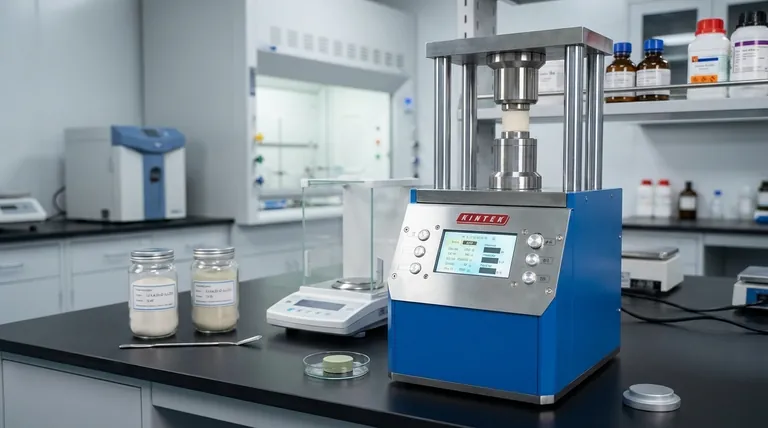
The Mechanism of Target Formation
Creating the "Green Body"
Before a ceramic target can be sintered (heated to a solid state), it must exist as a cohesive shape. The laboratory press takes loose precursor powders and subjects them to significant force, often exceeding 100 MPa.
Reducing Internal Porosity
The immediate goal is to minimize the empty space between particles. By applying precise pressure, the press forces particles to rearrange and pack tightly, significantly reducing the void volume within the material.
Ensuring Mechanical Integrity
A "green body" is unsintered and fragile. The press must apply enough force to create cold-welds or mechanical interlocks between particles, ensuring the pellet is strong enough to be ejected from the die and transferred to a furnace without crumbling.
Impact on Sputtering Performance
Establishing Uniform Density
For a sputtering target to perform well, its density must be consistent across the entire surface. The press ensures that the powder is distributed and compacted evenly, preventing localized weak spots.
Enabling Consistent Deposition
If a target has varying density, the sputtering rate will fluctuate, leading to uneven thin film deposition. A properly pressed target ensures a stable interaction with the plasma, resulting in reliable material transfer.
Minimizing Sintering Defects
The pressing stage is a preventative measure against future defects. By creating a uniform density gradient now, the press helps prevent warping, cracking, or uneven shrinkage when the material is eventually fired at high temperatures.
Understanding the Trade-offs
The Risk of Density Gradients
While pressing increases overall density, friction between the powder and the die walls can cause uneven pressure distribution. This leads to density gradients, where the edges of the target are denser than the center, potentially causing warping during sintering.
The Danger of Over-Pressing
More pressure is not always better. Excessive force can cause lamination cracks—microscopic fractures perpendicular to the pressing direction. These cracks act as stress concentrators that can cause the target to shatter when exposed to the thermal shock of the sputtering process.
Binding Agent Dependencies
The press relies on the physics of the powder, but some ceramics (like LLZO) may require binders to hold together under pressure. The introduction of these binders requires a careful "burn-out" phase later, adding complexity to the fabrication workflow.
Making the Right Choice for Your Goal
When selecting or operating a laboratory press for ceramic targets, consider your specific end-goal requirements.
- If your primary focus is High-Density Targets: Prioritize a press with programmable pressure cycles to allow trapped air to escape slowly, maximizing particle packing.
- If your primary focus is Mechanical Reliability: Ensure the press tooling (die) has a high-quality finish to reduce wall friction, ensuring uniform density gradients and preventing cracks.
- If your primary focus is Material Characterization: Utilize the press not just for fabrication but also for mechanical testing (like three-point bending) to validate the strength of your solid-state electrolyte films before sputtering.
The quality of your final thin film is determined the moment the pressure is applied to the powder.
Summary Table:
| Aspect | Role of the Laboratory Press | Impact on Final Target |
|---|---|---|
| Primary Function | Compacts powder into a cohesive 'green body' | Provides mechanical strength for handling and sintering |
| Density Management | Applies high pressure (>100 MPa) to reduce porosity | Determines structural integrity and sputtering stability |
| Uniformity | Ensures even pressure distribution (with quality tooling) | Prevents warping, cracking, and inconsistent deposition |
| Key Consideration | Balances pressure to avoid density gradients and lamination cracks | Critical for the mechanical reliability of the sintered target |
Achieve Superior Ceramic Sputtering Targets with KINTEK
The precision of your laboratory press directly defines the quality of your ceramic sputtering targets and the thin films they produce. Don't let inconsistent density or mechanical defects compromise your research on solid-state electrolytes like LLZO.
KINTEK specializes in high-performance lab press machines—including automatic, isostatic, and heated presses—designed to meet the exacting demands of advanced ceramic fabrication. Our equipment helps you:
- Achieve unparalleled density and uniformity with programmable pressure cycles.
- Ensure mechanical reliability with precision-engineered tooling that minimizes wall friction.
- Optimize your entire workflow for materials characterization and high-quality target production.
Ready to press for perfection? Contact our experts today to find the ideal laboratory press for your specific ceramic sputtering target needs.
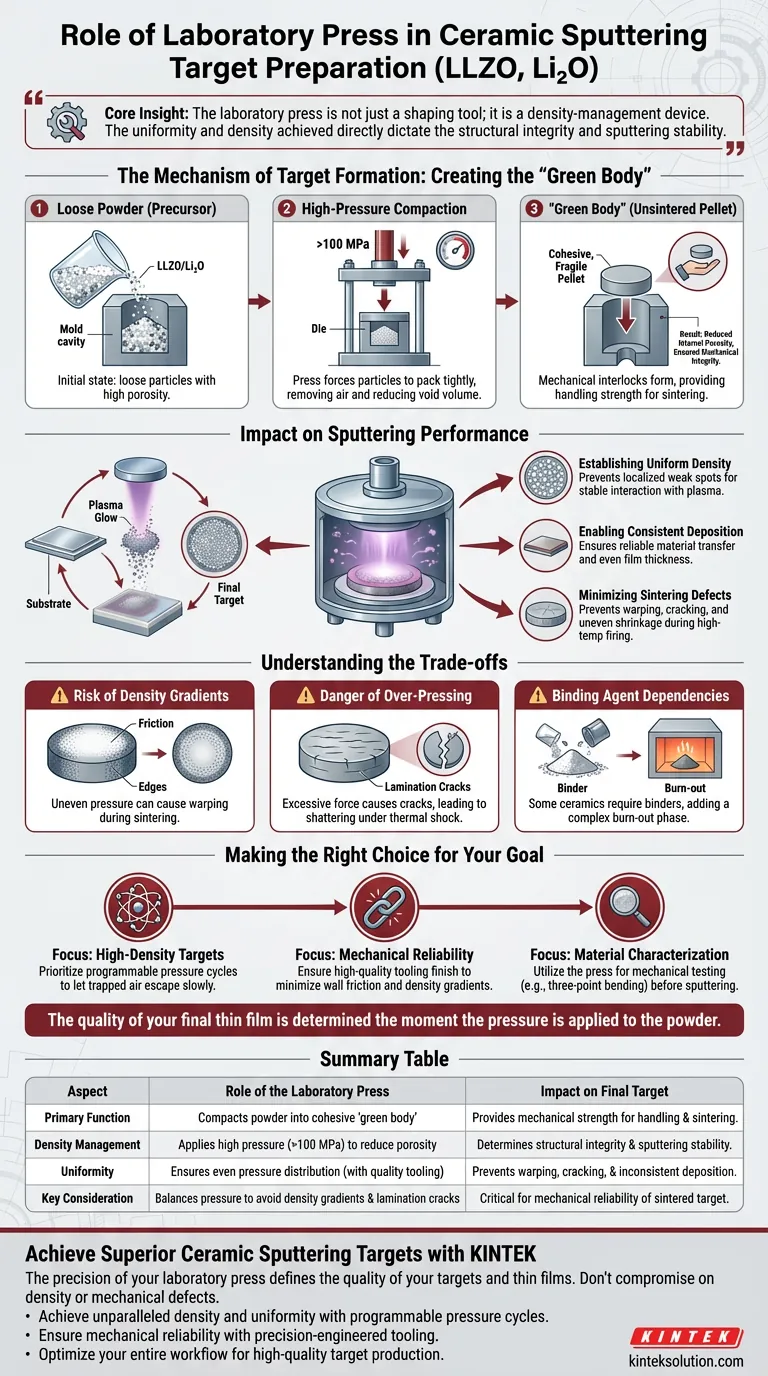
Visual Guide
Related Products
- Lab Round Bidirectional Press Mold
- Square Lab Press Mold for Laboratory Use
- Assemble Square Lab Press Mold for Laboratory Use
- Special Shape Lab Press Mold for Laboratory Applications
- Carbide Lab Press Mold for Laboratory Sample Preparation
People Also Ask
- What is the purpose of incorporating cartridge heaters into a lab press mold for MLCC block compression? Optimize Results
- Why is precise cooling management of the lab press mold necessary? Protect Core Integrity in Thermoforming
- What is the function of a pressing tool in thermoplastic panels? Master Precision Shaping & Fusion Bonding
- Why is a high-performance laboratory molding press critical for in-situ electrolyte formation? Unlock Battery Success
- How do the design and geometric precision of pressing molds and mandrels affect the quality of PTFE composite samples?



















