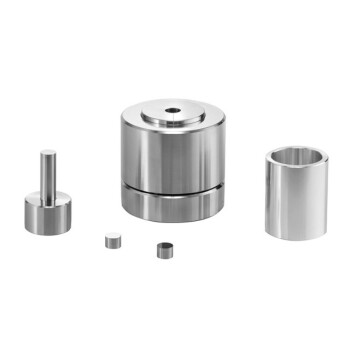
The primary role of stainless steel precision molds in this process is to provide a rigid, high-tolerance geometric constraint that withstands the extreme conditions of compression molding. These molds enable the simultaneous production of multiple silicone rubber particles, ensuring identical dimensions—such as 5mm spheres—while guaranteeing weight consistency and material homogeneity.
Core Takeaway: By resisting deformation under high heat and pressure, stainless steel molds ensure that every silicone particle produced possesses the uniform physical properties required for stable friction and damping performance.
Ensuring Dimensional Precision and Uniformity
Defining Exact Geometry
The fundamental purpose of the mold is to impose a specific shape on the raw silicone material.
In this specific application, the mold is engineered to produce 5mm diameter spherical particles. The stainless steel construction ensures that the cavity dimensions remain true, preventing variations that would alter the particle's volume.
Achieving Homogeneity Across Batches
Precision molds allow for the simultaneous creation of multiple particles in a single cycle.
Because the mold applies uniform constraints, it ensures high consistency in weight and internal structure (homogeneity) across all particles. This eliminates the variability that often plagues single-batch or less rigid molding methods.
Withstanding the Processing Environment
Resistance to High Temperatures
Compression molding of silicone requires elevated temperatures to cure the rubber.
Stainless steel is selected specifically for its ability to withstand these high thermal loads without warping or degrading. This ensures that the mold shape does not fluctuate during the heating and cooling cycles.
Rigidity Under Pressure
The molding process applies significant compressive force to densify the material.
The high rigidity of stainless steel prevents the mold from deforming under this pressure. This structural integrity is critical for maintaining the geometric accuracy of the particles, ensuring they are not crushed or distorted during formation.
The Impact on Damping Performance
Stabilizing Friction Characteristics
The ultimate goal of using precision molds is to control the behavior of the final product.
By guaranteeing exact dimensions and homogeneity, the molds ensure the particles exhibit stable friction characteristics. This is vital for their use as damping materials, where predictable physical interaction is required.
Consistent Collision Dynamics
In damping applications, how particles collide and absorb energy is paramount.
Precision molding ensures that every particle reacts the same way under stress. This leads to consistent collision characteristics, allowing the damping system to perform reliably over time.
Understanding the Trade-offs
Thermal Inertia vs. Stability
While stainless steel provides excellent stability, it has significant thermal mass.
This means the molds may require more time or energy to reach the desired temperature compared to softer, less durable tooling. However, once heated, they offer superior temperature uniformity.
Machining Complexity
Achieving the high precision required for 5mm spherical cavities demands advanced machining.
This increases the initial tooling cost and complexity. However, this investment is necessary to prevent the micro-deformations that would render the damping particles inconsistent and ineffective.
Making the Right Choice for Your Goal
When evaluating mold requirements for silicone rubber particles, consider your end-use priorities:
- If your primary focus is Damping Consistency: Prioritize high-grade stainless steel to ensure the rigid geometric constraints necessary for stable friction and collision behaviors.
- If your primary focus is Mass Production: Leverage the mold's ability to produce multiple particles simultaneously to maintain strict weight and dimensional uniformity across large batches.
Success in silicone compression molding relies not just on the material used, but on the unyielding precision of the steel that shapes it.
Summary Table:
| Feature | Role in Silicone Molding | Impact on Final Product |
|---|---|---|
| Geometric Constraint | Defines exact 5mm spherical shape | Consistent collision dynamics |
| Thermal Stability | Resists warping at high temperatures | Maintains batch-to-batch uniformity |
| High Rigidity | Withstands compressive molding forces | Prevents dimensional distortion |
| Material Homogeneity | Ensures uniform density and weight | Stable friction & damping performance |
Optimize Your Material Research with KINTEK Precision
Achieve uncompromising accuracy in your compression molding projects with KINTEK. As specialists in comprehensive laboratory pressing solutions, we provide the high-tolerance equipment and expertise needed to ensure your silicone particles meet the strictest standards for damping and friction performance.
Whether you require manual, automatic, heated, or multifunctional presses, or specialized cold and warm isostatic presses for battery research, our solutions are designed to deliver uniform results every time.
Ready to elevate your lab's efficiency? Contact our technical experts today to find the perfect pressing solution for your specific application.
References
- Utsav Koshti, Sharadkumar P. Purohit. Prototype silicone rubber based passive seismic damper: Development, characterization and implementation. DOI: 10.17515/resm2024.201ma0229rs
This article is also based on technical information from Kintek Solution Knowledge Base .
Related Products
- Lab Polygon Press Mold
- Lab Anti-Cracking Press Mold
- XRF KBR Plastic Ring Lab Powder Pellet Pressing Mold for FTIR
- Lab Isostatic Pressing Molds for Isostatic Molding
- Lab Ball Press Mold
People Also Ask
- What is the purpose of incorporating cartridge heaters into a lab press mold for MLCC block compression? Optimize Results
- How do the design and geometric precision of pressing molds and mandrels affect the quality of PTFE composite samples?
- What role do precision positioning and pressure molds play in single-lap joints? Ensure 100% Data Integrity
- What are the requirements for pressing molds when using SSCG? Key Materials for Complex Single Crystal Production
- How do industrial-grade pressure molds affect zinc metal pouch cells? Maximize Energy Density & Performance