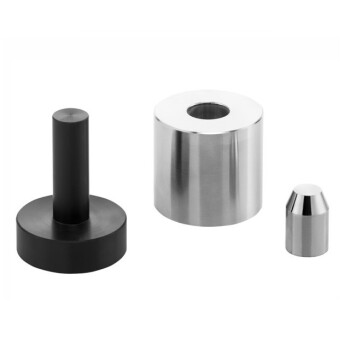
In the preparation of lithium battery cathode plates, the laboratory press serves a critical mechanical densification function. It applies precise and uniform pressure to the active material layer that has been coated onto the aluminum foil current collector. This process transforms the initially loose, porous coating into a compact, structurally sound electrode sheet suitable for testing and assembly.
The primary goal of the laboratory press is to significantly increase the compaction density of the electrode. By physically compressing the material, it enhances electronic contact between components and reduces interfacial impedance, which is essential for maximizing energy density and ensuring accurate performance data.
The Mechanics of Electrode Densification
Increasing Compaction Density
The immediate function of the press is to compress the loose coating of active materials. This physical modification increases the compaction density, allowing for more active material to be packed into the same volume. Higher density directly correlates to improved volumetric energy density in the final cell.
Enhancing Electronic Connectivity
A loose coating suffers from poor electrical pathways. The press forces the active materials, conductive agents, and the current collector (aluminum foil) into tight contact. This creates a robust conductive network, ensuring electrons can move efficiently during charge and discharge cycles.
Reducing Interfacial Impedance
By smoothing and densifying the electrode, the press effectively lowers the interfacial contact impedance. This is particularly critical at the boundary between the cathode and the electrolyte (specifically solid polymer electrolytes), where poor contact leads to high resistance and performance loss.
Improving Surface Flatness
The coating process can leave the electrode surface uneven. The laboratory press levels these microscopic irregularities, improving surface flatness. A uniform surface is vital for preventing localized stress points and ensuring consistent contact with the separator or solid electrolyte layer.
Understanding the Trade-offs
The Porosity Paradox
While high density is desirable, over-pressing is a common pitfall. If the electrode is compressed too tightly, you eliminate the porosity required for electrolyte infiltration. Without sufficient pore volume, lithium ions cannot migrate efficiently through the active material, severely hampering rate performance.
Structural Integrity Risks
Applying excessive pressure can damage the delicate aluminum foil current collector, causing it to wrinkle or tear. Furthermore, extreme pressure may crush the active material particles themselves, disrupting their internal structure and reducing the battery's long-term cycling stability.
Optimizing the Pressing Process for Your Goals
Different research objectives require different pressing strategies. Here is how to align the process with your specific targets:
- If your primary focus is High Energy Density: Apply higher pressure to maximize compaction density, fitting the most active material possible into the electrode volume.
- If your primary focus is High Rate Performance (Fast Charging): Use moderate pressure to maintain sufficient porosity, ensuring the electrolyte can fully infiltrate the electrode for rapid ion transport.
- If your primary focus is Interface Stability: Prioritize surface flatness and uniformity to minimize contact resistance between the cathode and the solid electrolyte.
The laboratory press is not just a flattening tool; it is the gatekeeper between a raw material coating and a functional, high-performance electrode.
Summary Table:
| Function | Benefit to Battery Performance | Key Optimization Factor |
|---|---|---|
| Densification | Increases volumetric energy density | Compaction Density |
| Connectivity | Creates robust conductive network | Interfacial Impedance |
| Surface Leveling | Ensures uniform contact & prevents stress | Surface Flatness |
| Porosity Control | Enables efficient electrolyte infiltration | Ion Migration Rate |
Maximize Your Battery Research with KINTEK Precision
Are you looking to achieve the perfect balance between compaction density and porosity in your electrode development? KINTEK specializes in comprehensive laboratory pressing solutions designed specifically for the rigorous demands of battery research.
Whether your workflow requires manual, automatic, heated, or multifunctional models, or specialized cold and warm isostatic presses, our equipment ensures the precise pressure control needed to enhance electronic connectivity and reduce impedance without compromising structural integrity.
Ready to elevate your lab's efficiency and data accuracy?
Contact KINTEK experts today to find the ideal pressing solution for your lithium-ion or solid-state battery projects.
References
- Minchen Hou, Xia Lu. Carbon Nitrides‐Based Heterojunction for High‐Efficient Li Salt Dissociation. DOI: 10.1002/idm2.70021
This article is also based on technical information from Kintek Solution Knowledge Base .
Related Products
- Laboratory Hydraulic Press Lab Pellet Press Button Battery Press
- Lab Cylindrical Press Mold for Laboratory Use
- Automatic Laboratory Hydraulic Press for XRF and KBR Pellet Pressing
- Lab Button Battery Tablet Press Sealing Mold
- Lab Infrared Press Mold for Laboratory Applications
People Also Ask
- How is a laboratory hydraulic press used for HAP composite gels? Master Mineral Substrate Standardization
- What role does a laboratory hydraulic press play in the preparation of piezoelectric ceramic discs for DC-PG? | KINTEK
- What role does a laboratory hydraulic press play in reaction pellets? Optimizing Lunar Soil and Metal Fuel Density
- What role does a laboratory hydraulic press play in the assembly of all-solid-state battery test cells? Expert Guide
- Why is a laboratory hydraulic press required for PBAT and PLA sample preparation? Achieve Flawless Characterization