
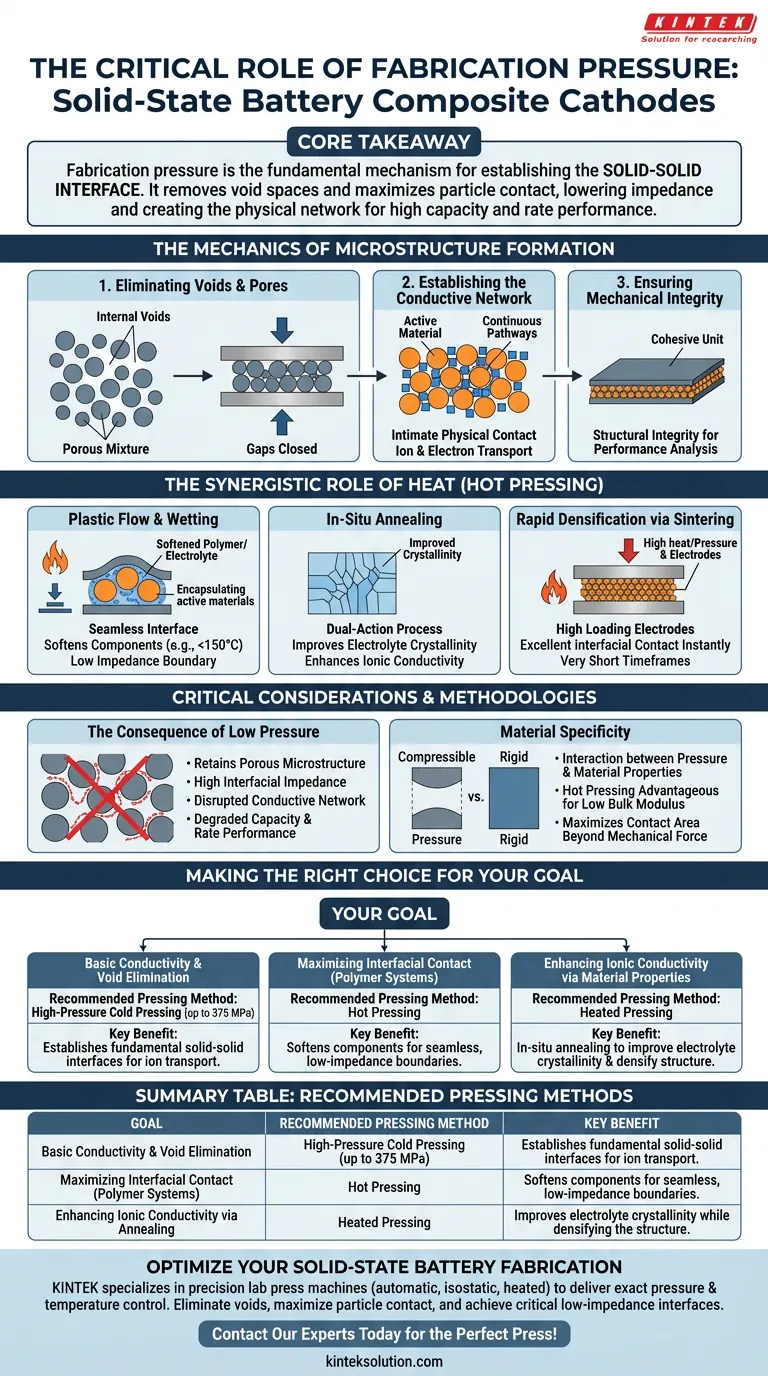
The specific role of fabrication pressure applied by a lab press is to mechanically compel the active materials and solid electrolytes into a unified, dense structure. This process eliminates internal voids and forces individual particles into intimate physical contact, creating the continuous pathways required for ion and electron transport. Without this mechanical densification, the electrode would remain a porous powder mixture with high interfacial impedance, rendering the battery inefficient.
Core Takeaway The application of pressure is not merely about shaping the electrode; it is the fundamental mechanism for establishing the solid-solid interface. By removing void spaces and maximizing particle contact, you lower impedance and create the physical network necessary for high capacity and rate performance.

The Mechanics of Microstructure Formation
Eliminating Voids and Pores
The primary physical effect of applying high pressure (up to 375 MPa in cold pressing) is the removal of inter-particle voids. Solid-state cathodes begin as powder mixtures; the press compacts these loose particles, effectively closing the gaps that naturally exist between the solid electrolyte and the active material.
Establishing the Conductive Network
Once voids are eliminated, the pressure forces the active material and electrolyte particles into intimate, extensive contact. This physical connection is critical because it establishes the initial, continuous network required for both ionic and electronic conduction throughout the composite.
Ensuring Mechanical Integrity
Beyond conductivity, the pressure ensures the mechanical stability of the various material layers. A well-pressed cathode forms a cohesive unit that maintains its structural integrity, a prerequisite for accurate subsequent performance analysis.
The Synergistic Role of Heat (Hot Pressing)
Plastic Flow and Wetting
When using a heated lab press, pressure works in tandem with controlled temperature (e.g., below 150°C) to soften polymeric components or electrolytes. This promotes plastic flow, allowing the electrolyte to "wet" and encapsulate the active material particles, creating a seamless interface that cold pressing alone may not achieve.
In-Situ Annealing
The hot-pressing procedure functions as a dual-action process, serving simultaneously as a fabrication step and an in-situ annealing treatment. This can improve the crystallinity of the electrolyte, which directly enhances the ionic conductivity within the composite electrode.
Rapid Densification via Sintering
Techniques like high-pressure, high-temperature sintering utilize this synergy to achieve high material densification in very short timeframes. This is particularly effective for producing high-loading electrodes by ensuring excellent interfacial contact almost instantly.
Critical Considerations and Methodologies
The Consequence of Low Pressure
If the applied pressure is insufficient, the electrode retains a porous microstructure. These voids act as barriers to ion transport, resulting in high interfacial impedance. A lack of intimate contact disrupts the conductive network, significantly degrading capacity and rate performance.
Material Specificity
The interaction between pressure and material properties is significant. For materials with low bulk modulus and high compressibility, hot pressing is particularly advantageous as it leverages the material's ability to deform and flow, maximizing the contact area beyond what mechanical force could achieve on rigid particles.
Making the Right Choice for Your Goal
The method of pressure application should be dictated by the specific material limitations and performance targets of your cathode.
- If your primary focus is establishing basic conductivity: Utilize high-pressure cold pressing (up to 375 MPa) to eliminate voids and form the fundamental solid-solid interfaces required for ion transport.
- If your primary focus is maximizing interfacial contact in polymer-based systems: Employ a hot press to soften the components, enabling the electrolyte to wet the active material and form a seamless, low-impedance boundary.
- If your primary focus is enhancing ionic conductivity via material properties: Use heated pressing as an in-situ annealing step to improve electrolyte crystallinity while simultaneously densifying the structure.
Ultimately, the correct fabrication pressure acts as the bridge between raw powder potential and realized battery performance.
Summary Table:
| Goal | Recommended Pressing Method | Key Benefit |
|---|---|---|
| Basic Conductivity & Void Elimination | High-Pressure Cold Pressing (up to 375 MPa) | Establishes fundamental solid-solid interfaces for ion transport. |
| Maximizing Interfacial Contact (Polymer Systems) | Hot Pressing | Softens components for seamless, low-impedance boundaries. |
| Enhancing Ionic Conductivity via Annealing | Heated Pressing | Improves electrolyte crystallinity while densifying the structure. |
Ready to optimize your solid-state battery electrode fabrication? KINTEK specializes in precision lab press machines (automatic lab press, isostatic press, heated lab press, etc.) designed to deliver the exact pressure and temperature control your research demands. Our equipment helps you eliminate voids, maximize particle contact, and achieve the low-impedance interfaces critical for high capacity and rate performance. Let us help you bridge the gap between raw powder potential and realized battery performance. Contact our experts today to find the perfect press for your laboratory needs!
Visual Guide
Related Products
- Laboratory Hydraulic Press 2T Lab Pellet Press for KBR FTIR
- 24T 30T 60T Heated Hydraulic Lab Press Machine with Hot Plates for Laboratory
- Manual Heated Hydraulic Lab Press with Integrated Hot Plates Hydraulic Press Machine
- Laboratory Hydraulic Press Lab Pellet Press Button Battery Press
- Laboratory Hydraulic Pellet Press for XRF KBR FTIR Lab Press
People Also Ask
- What is the role of a laboratory pressure machine and KBr in FTIR? Master Sample Preparation for Flame Retardants
- What is the role of a laboratory hydraulic press in high-loading NCM811 cathode prep for solid-state batteries?
- Why is a laboratory hydraulic press necessary for sample preparation? Precise Pelleting for Spiro Heterocyclic Analysis
- What role does a laboratory hydraulic press play in reaction pellets? Optimizing Lunar Soil and Metal Fuel Density
- How is a laboratory hydraulic press used for pre-loading SST-LWAC specimens? Ensure Accurate Data Integrity.



















