
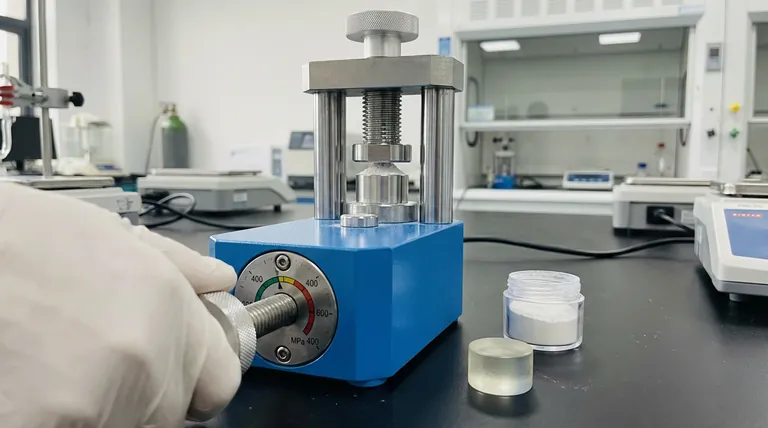
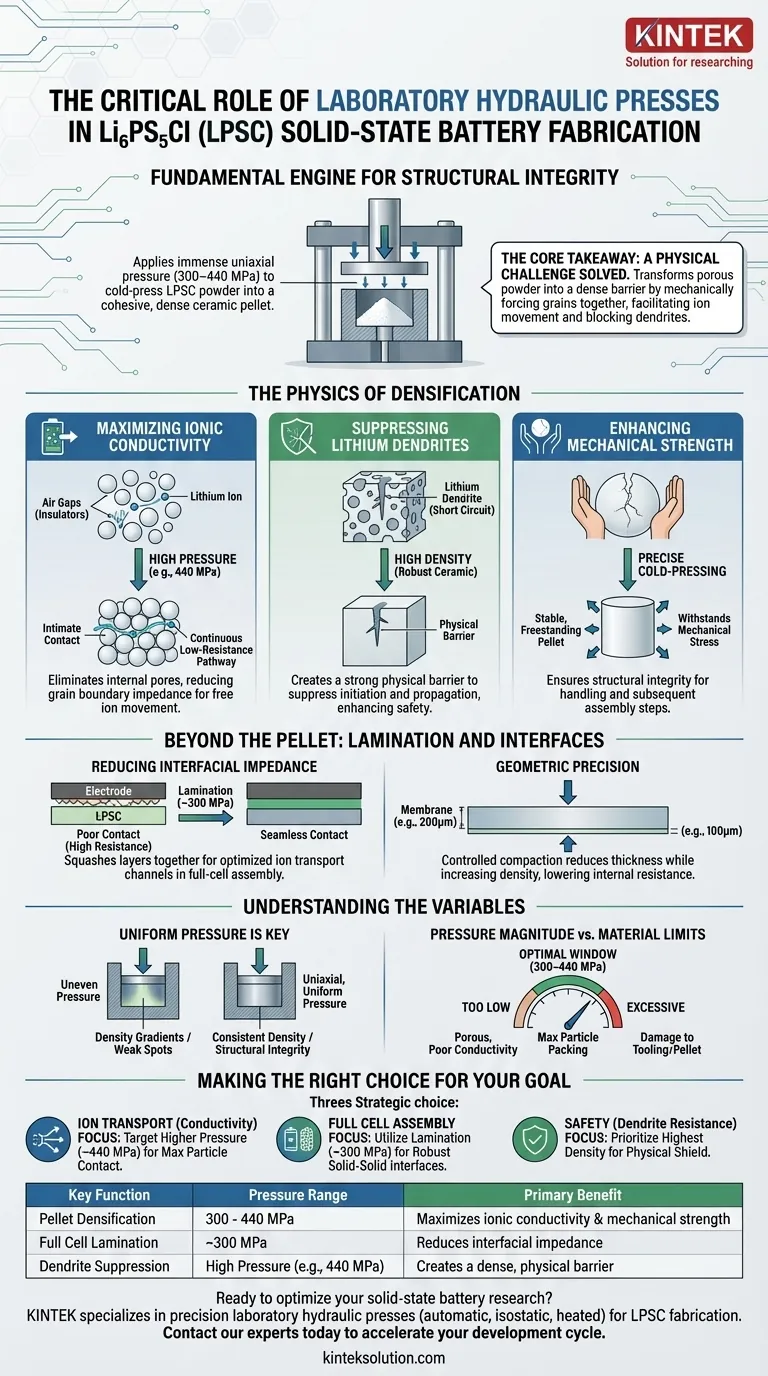
A laboratory hydraulic press is the fundamental engine for establishing structural integrity in Li₆PS₅Cl (LPSC) solid-state batteries. It functions by applying immense uniaxial pressure—typically between 300 MPa and 440 MPa—to cold-press loose LPSC powder into a cohesive, dense ceramic pellet. This mechanical compaction is the primary variable determining the electrolyte’s final ionic conductivity and physical durability.
The Core Takeaway Producing a functional LPSC membrane is not a chemical challenge, but a physical one. The hydraulic press solves the problem of "particle isolation" by mechanically forcing grains together, transforming a porous powder into a dense barrier that facilitates ion movement and blocks lithium dendrites.
The Physics of Densification
The performance of a solid-state electrolyte is directly proportional to its density. A hydraulic press allows you to manipulate the microstructure of the LPSC material to achieve three critical performance goals.
Maximizing Ionic Conductivity
Loose LPSC powder consists of discrete particles separated by air gaps (pores). These gaps act as insulators, stopping lithium ions in their tracks.
By applying pressures as high as 440 MPa, the press eliminates these internal pores. This forces the electrolyte particles into intimate contact, reducing grain boundary impedance. The result is a continuous, low-resistance pathway that allows ions to move freely through the membrane.
Suppressing Lithium Dendrites
Lithium dendrites are metallic filaments that grow through the electrolyte, causing short circuits. Dendrites thrive in soft, porous materials where they can easily penetrate voids.
A hydraulic press compacts the LPSC into a mechanically robust ceramic with minimal porosity. This high density creates a physical barrier that is strong enough to suppress the initiation and propagation of these dendrites, significantly enhancing battery safety.
Enhancing Mechanical Strength
Handling thin ceramic membranes is difficult; they are naturally brittle. A precise cold-pressing process ensures the powder consolidates into a stable, freestanding pellet.
This structural integrity is essential not just for performance, but for the manufacturing process itself. It allows the membrane to withstand the mechanical stresses of subsequent assembly steps without cracking.
Beyond the Pellet: Lamination and Interfaces
While the primary use is pelletizing the LPSC, the press serves a secondary, equally vital role in full-cell assembly.
Reducing Interfacial Impedance
In an all-solid-state battery, the contact between the electrode (cathode/anode) and the electrolyte is a solid-to-solid interface. Poor contact here leads to high resistance.
The hydraulic press is used to laminate the multi-layer cell structure, often at pressures around 300 MPa. This "squashes" the layers together, ensuring seamless contact between the LPSC and the active materials. This optimizes the transport channels for sodium or lithium ions across the entire cell.
Geometric Precision
Using a hydraulic press allows for the precise reduction of membrane thickness.
Controlled compaction can reduce membrane thickness significantly (e.g., from 200µm to 100µm) while simultaneously increasing density. Thinner membranes reduce the distance ions must travel, further lowering internal resistance.
Understanding the Variables
While the press is a powerful tool, it requires precise operation to avoid diminishing returns or material failure.
The Necessity of Uniform Pressure
The pressure applied must be uniaxial and uniform across the entire surface area of the die. Uneven pressure leads to density gradients, creating "weak spots" where dendrites can penetrate or where the pellet may crack under stress.
Pressure Magnitude vs. Material Limits
There is a specific window of effective pressure.
- Too Low: The material remains porous, resulting in poor conductivity and mechanical weakness.
- Optimal (300–440 MPa): Achieves maximum particle packing and optimal conductivity for LPSC.
- Excessive: While rare in this specific context, uncontrolled pressure can damage the tooling or induce stress fractures in the pellet upon release.
Making the Right Choice for Your Goal
How you utilize the hydraulic press depends on the specific stage of your fabrication process.
- If your primary focus is Ion Transport (Conductivity): Target the higher pressure range (approx. 440 MPa) to maximize particle-to-particle contact and minimize grain boundary impedance.
- If your primary focus is Full Cell Assembly: Utilize the press for lamination (approx. 300 MPa) to establish robust solid-solid interfaces between the LPSC layer and the electrodes.
- If your primary focus is Safety (Dendrite Resistance): Prioritize achieving the highest possible density to eliminate internal porosity, creating a physical shield against lithium penetration.
Your hydraulic press is not merely a shaping tool; it is the instrument that dictates the ultimate efficiency and safety profile of your solid-state battery.
Summary Table:
| Key Function | Pressure Range | Primary Benefit |
|---|---|---|
| Pellet Densification | 300 - 440 MPa | Maximizes ionic conductivity & mechanical strength |
| Full Cell Lamination | ~300 MPa | Reduces interfacial impedance |
| Dendrite Suppression | High Pressure (e.g., 440 MPa) | Creates a dense, physical barrier |
Ready to optimize your solid-state battery research? KINTEK specializes in precision laboratory hydraulic presses (including automatic, isostatic, and heated models) designed to meet the exacting demands of LPSC membrane fabrication. Our equipment delivers the uniform, high-pressure compaction you need to achieve superior density, conductivity, and safety in your prototypes. Contact our experts today to discuss how our solutions can accelerate your development cycle.
Visual Guide
Related Products
- Warm Isostatic Press for Solid State Battery Research Warm Isostatic Press
- Laboratory Hydraulic Split Electric Lab Pellet Press
- Manual Laboratory Hydraulic Pellet Press Lab Hydraulic Press
- Automatic Laboratory Hydraulic Press Lab Pellet Press Machine
- Laboratory Hydraulic Press 2T Lab Pellet Press for KBR FTIR
People Also Ask
- Why must composite cathodes be sealed in vacuum lamination bags for WIP? Ensure Battery Stability and Density
- What is the function of elastic molds in warm isostatic pressing? Achieve Uniform Density in Composite Particles
- How do sacrificial volume materials (SVM) maintain microchannels in isostatic pressing? Ensure Structural Integrity
- How does Warm Isostatic Pressing differ from traditional pressing methods? Unlock Uniform Density for Complex Parts
- What is the significance of temperature control in Warm Isostatic Pressing? Unlock Uniform Densification and Process Stability













