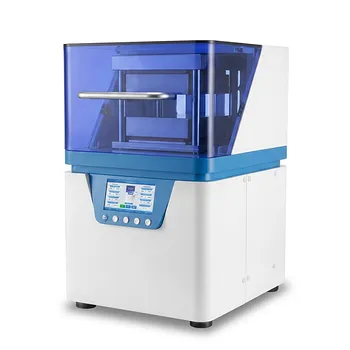
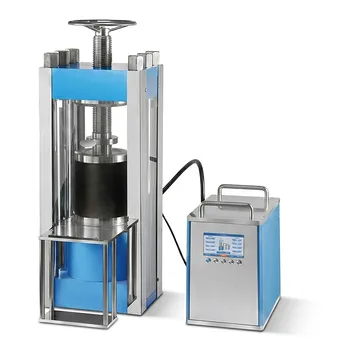
The primary manufacturing advantage of direct hot pressing regarding product finishing is the elimination of mechanical reworking. By sintering materials to their final density with high precision, this technology achieves a "near net-shape" state immediately, removing the need for costly and difficult post-processing steps.
Core Takeaway: Direct hot pressing streamlines production by combining densification and shaping into a single step, effectively bypassing the finishing phase required for materials that are traditionally difficult to machine.
The Mechanics of Near Net-Shape Precision
Achieving Final Density Immediately
Direct hot pressing allows materials to be sintered to their final density within the mold itself. Unlike methods that require multiple stages to achieve structural integrity, this process reaches the target density during the initial heating and pressing phase.
Eliminating Mechanical Reworking
The most critical advantage for finishing is the reduction of downstream labor. Because the output allows for high near net-shape precision, manufacturers can often skip subsequent mechanical reworking.
Processing Difficult Materials
This advantage is particularly valuable when working with advanced materials that are naturally hard or brittle. Since the material is formed to shape while hot and malleable, you avoid the wear and tear associated with grinding or cutting these materials after they have hardened.
Broader Operational Benefits
Consistency Through IT Integration
Modern hot pressing machines can be integrated with IT technology for precise control over the densification process. This ensures that the surface finish and dimensional accuracy are consistent across batches, further reducing the need for corrective finishing.
Uniform Material Properties
The technique provides superior temperature field uniformity within the workpiece. This thermal consistency ensures that the material properties are homogenous throughout the part, preventing surface defects that would otherwise require finishing work to hide or repair.
Understanding the Trade-offs
Equipment Specificity
While direct hot pressing lowers the initial investment compared to isostatic pressing, it remains a specialized process. It is most effective for specific geometries where "near net-shape" is sufficient; extremely complex geometries might still require minor finishing or alternative methods.
Thermal Management Limits
The process is energy efficient because it reduces energy consumption by limiting longitudinal heat flow. However, this specific thermal profile means the process must be carefully managed to ensure the heat stays concentrated where needed without damaging the equipment or the periphery of the part.
Making the Right Choice for Your Project
To determine if direct hot pressing is the right solution for your manufacturing line, consider your specific priorities:
- If your primary focus is Reducing Cycle Time: Direct hot pressing is ideal because it removes the bottleneck of mechanical reworking from your workflow.
- If your primary focus is Cost Efficiency: The combination of lower initial equipment investment (vs. isostatic) and energy efficiency makes this a high-value option.
- If your primary focus is Material Quality: Use this method to ensure consistent density and uniform material properties across large diameter workpieces.
Leveraging direct hot pressing allows you to move from raw material to a finished, high-density product with minimal intervention.
Summary Table:
| Feature | Advantage of Direct Hot Pressing | Impact on Finishing |
|---|---|---|
| Dimensional Accuracy | High near net-shape precision | Eliminates costly mechanical reworking |
| Densification | Reaches final density within the mold | Skips post-processing stages |
| Material Handling | Shapes materials while malleable | Avoids grinding/cutting brittle hardened materials |
| Quality Control | IT-integrated densification control | Ensures consistent surface finish across batches |
| Thermal Uniformity | Homogenous temperature distribution | Prevents surface defects and structural flaws |
Streamline Your Lab Production with KINTEK
Ready to eliminate the bottlenecks of post-processing? KINTEK specializes in comprehensive laboratory pressing solutions designed to enhance your research and manufacturing efficiency. From manual and automatic models to heated, multifunctional, and glovebox-compatible presses, we provide the precision tools needed to achieve perfect near net-shape results.
Whether you are working on advanced battery research or material science, our range of cold and warm isostatic presses ensures you get the exact density and finish you require. Contact our experts today to find the ideal pressing solution for your lab!
Related Products
- Automatic Hydraulic Hot Press with Large Plate and Precision Temperature Control for Advanced Material Sample Preparation and Industrial Research
- Automatic Heated Hydraulic Press Machine with Hot Plates for Laboratory
- Heated Hydraulic Press Machine with Heated Plates for Vacuum Box Laboratory Hot Press
- Automatic High Temperature Heated Hydraulic Press Machine with Heated Plates for Lab
- Automatic Hydraulic Heat Press Machine with Multi Stage Programmable Control and Integrated Water Cooling Plate Size 180x180mm
People Also Ask
- What are the specific features and applications of hydraulic hot press machines? Precision Solutions for Modern Labs
- How does an automatic hydraulic press operate? Achieve Precision and Consistency in Lab Pelleting
- What are the advantages and common applications of an automatic hydraulic press? Elevate Your Lab's Precision
- What is the technical significance of setting a precise dwell time? Achieve Peak Material Density and Stability
- When is an automatic hydraulic press more suitable than a manual press? Scale Your Lab with Precision & Speed