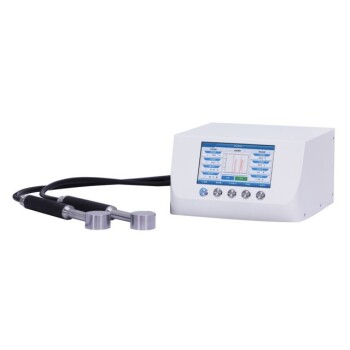
Precision loading plates serve as the primary mechanism for simulating external geological loads. Placed directly on the surface of a gelatin substrate, these plates mimic the physical weight of surface topography or volcanic edifices. Their function is to induce controlled stress perturbations within the medium, which force vertically ascending fluid-filled fractures to deviate from their natural path.
By strategically adjusting the mass and position of these plates, researchers create non-uniform stress fields that deflect magma intrusions. This experimental setup provides a quantitative link between surface weight—such as a growing volcano—and the subsurface trajectory of the plumbing system.
The Mechanics of Stress Induction
Simulating Volcanic Topography
In experimental settings, precision loading plates are not merely weights; they represent geological features.
They act as proxies for mountains, volcanic cones, or other significant surface masses that exert pressure on the crust below.
Generating Stress Perturbations
The presence of a loading plate alters the internal stress state of the gelatin substrate.
Instead of a uniform pressure gradient, the plate introduces specific stress perturbations. These non-uniform fields are the invisible forces that interact with the fluid mechanics of the intrusion.
Controlling Intrusion Trajectories
Deflecting Vertical Ascent
Under normal conditions, fluid-filled fractures (simulating magma) tend to ascend vertically due to buoyancy.
However, the stress fields generated by the loading plates interfere with this ascent. The external load forces the fracture to deflect, changing its angle and direction as it navigates the altered stress environment.
Quantifying Eruption Controls
Researchers use these plates to measure cause and effect systematically.
By varying the mass and position of the plates, scientists can observe exactly how changes in surface load shift the final eruption location. This transforms a theoretical concept into observable, quantitative data.
Understanding the Trade-offs
Idealized vs. Complex Loads
Precision loading plates offer high control, but they represent an idealized load.
While they allow for specific variables to be isolated (e.g., exact mass), they may simplify the messy, irregular distribution of weight found in actual geological topography.
Sensitivity to Placement
The method relies heavily on the precise positioning of the plates.
Because the stress perturbations are localized, small deviations in plate placement can significantly alter the trajectory of the fracture, requiring rigorous experimental consistency to ensure reproducible results.
Implications for Experimental Design
To effectively use precision loading plates in your modeling, consider the following experimental focus areas:
- If your primary focus is trajectory mechanics: Use the plates to map how increasing mass incrementally changes the angle of deflection for ascending fluids.
- If your primary focus is hazard prediction: Adjust the position of the plates to model how shifting volcanic loads moves the potential eruption site away from the central vent.
Success in this experimental approach depends on rigorously correlating the input (plate mass/position) with the output (fracture deflection) to build an accurate model of crustal stress.
Summary Table:
| Feature | Physical Role in Research | Impact on Result |
|---|---|---|
| Topography Proxy | Simulates volcanic cones and surface weight | Creates realistic crustal pressure scenarios |
| Stress Induction | Generates non-uniform stress perturbations | Replaces uniform gradients with complex fields |
| Trajectory Control | Deflects vertical fluid-filled fractures | Directs magma ascent away from natural paths |
| Variable Control | Allows adjustment of mass and position | Provides quantitative data on eruption locations |
Optimize Your Geological Stress Modeling with KINTEK
Precise research requires precise pressure. KINTEK specializes in comprehensive laboratory pressing solutions designed to meet the rigorous demands of material science and geophysical research. Whether you are modeling crustal stress or advancing battery research, our range of manual, automatic, heated, and multifunctional presses, alongside our specialized cold and warm isostatic presses, provides the exact load control needed for your experiments.
Don't let inconsistent loading compromise your data. Contact KINTEK today to discover how our high-precision equipment can enhance your lab's accuracy and help you master complex stress-field simulations.
References
- Séverine Furst, Francesco Maccaferri. Dynamics of magmatic intrusion: what can we learn from the comparison of analog and numerical models?. DOI: 10.30909/vol.07.01.6787
This article is also based on technical information from Kintek Solution Knowledge Base .
Related Products
- Infrared Heating Quantitative Flat Plate Mold for Precise Temperature Control
- Lab Polygon Press Mold
People Also Ask
- How do precision temperature-controlled heating plates function in electrolyte thermal stability storage experiments?
- What is the importance of a precision temperature-controlled heating module? Ensure Aluminum-Cadmium Thermal Stability
- How does heating platen precision affect rubber specimens? Achieve uniform density and reliable testing results.
- How are thin polymer films produced for spectroscopic analysis? Expert Guide to Heat and Low-Pressure Methods
- What accessories and field services can be used to optimize the capabilities of presses? Maximize Your Lab Performance