
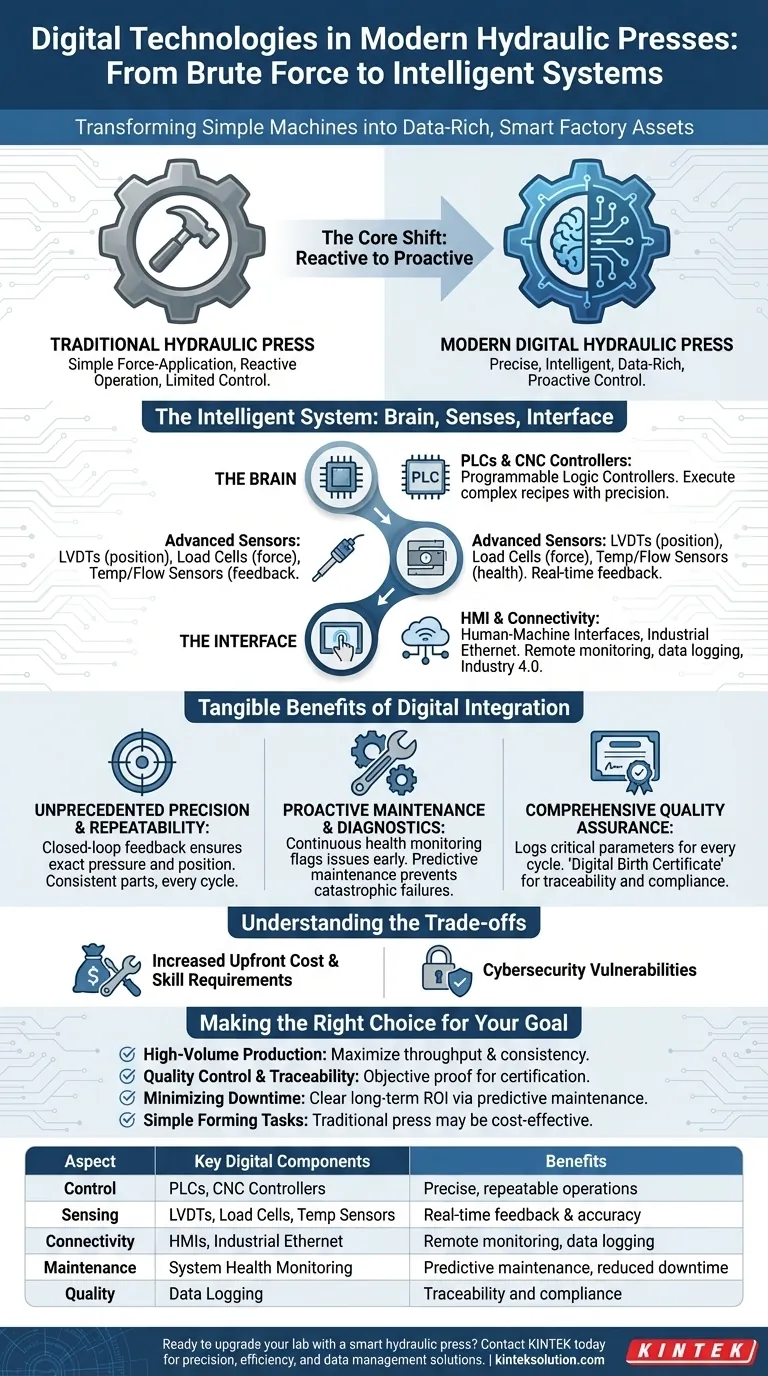
In short, digital technologies fundamentally transform hydraulic presses from simple force-application machines into precise, intelligent, and data-rich manufacturing systems. By integrating programmable logic controllers (PLCs), advanced sensors, and network connectivity, modern presses gain the ability to be programmed remotely, monitor their own health, and collect real-time data on every cycle. This results in a dramatic improvement in accuracy, operational efficiency, and the consistency of finished parts.
The core shift is from reactive operation to proactive control. Instead of just applying force, a digital hydraulic press uses data to ensure every action is precise, repeatable, and documented, turning a traditional tool into a smart factory asset.

From Brute Force to Intelligent Control
The classic hydraulic press is a marvel of power, but it lacks finesse. Digital technologies add a layer of intelligence that allows for precise management of that power, unlocking new capabilities and efficiencies.
The Brain: PLCs and CNC Controllers
At the heart of a modern press is a Programmable Logic Controller (PLC) or a more advanced Computer Numerical Control (CNC) system. These digital controllers are the brain of the operation.
They replace older, less flexible relay logic or manual controls, allowing operators to execute complex, multi-step pressing recipes with near-perfect precision. This ensures that parameters like ram speed, dwell time, and pressure are controlled exactly as programmed.
The Senses: Advanced Sensor Integration
If the PLC is the brain, sensors are the nervous system, providing essential feedback. Modern presses go far beyond simple pressure gauges.
Key sensors include:
- Linear Transducers (LVDTs): These measure the exact position of the ram to within thousandths of an inch, ensuring precise depth control.
- Load Cells: These directly measure the force being applied, offering more accurate feedback than hydraulic pressure readings alone.
- Temperature and Flow Sensors: These monitor the health of the hydraulic fluid and system, providing early warnings of potential issues.
The Interface: Data and Connectivity
This stream of data is made useful through Human-Machine Interfaces (HMIs)—typically ruggedized touch screens. HMIs allow operators to easily load programs, monitor the process in real time, and view diagnostic alarms.
Furthermore, industrial Ethernet connectivity allows the press to communicate with a central factory management system (MES or ERP). This enables remote monitoring, data collection for analysis, and integration into a fully connected "Industry 4.0" environment.
The Tangible Benefits of Digital Integration
Integrating these digital components produces clear, measurable advantages in a production environment.
Unprecedented Precision and Repeatability
The closed-loop feedback between the PLC and sensors allows the press to self-correct during a cycle. If pressure begins to dip, the controller can instantly adjust the hydraulic flow to maintain the setpoint. This active control is what guarantees extreme repeatability from one part to the next.
Proactive Maintenance and Diagnostics
Continuous monitoring of system health is a game-changer for maintenance. A digital press can track oil temperature, pump efficiency, and cycle times.
By setting baseline performance metrics, the system can flag subtle deviations that indicate a developing problem, such as a slow leak or a wearing pump. This allows for predictive maintenance, scheduling repairs before a catastrophic and costly failure occurs.
Comprehensive Quality Assurance
A digital press logs the critical parameters of every single cycle. This creates a "digital birth certificate" for each part produced, including the exact force, depth, and time applied.
This data is invaluable for quality control and traceability, which is a strict requirement in industries like aerospace, medical, and automotive manufacturing.
Understanding the Trade-offs
While the benefits are significant, adopting advanced digital presses involves important considerations.
Increased Upfront Cost
A press equipped with sophisticated controls, sensors, and software carries a higher initial purchase price than a simple, traditional press. Retrofitting an older machine can also be a significant capital investment.
New Skill Requirements
Maintaining a digitally-integrated press requires a different skillset. Technicians must be comfortable with software, networking, and sensor diagnostics in addition to traditional hydraulics and mechanics.
Cybersecurity Vulnerabilities
Any networked machine is a potential target for a cyberattack. Securing a smart press and the factory network it connects to is a critical consideration that should not be overlooked.
Making the Right Choice for Your Goal
The decision to invest in a digitally-enhanced hydraulic press should be driven by your specific operational needs.
- If your primary focus is high-volume, repeatable production: The recipe management and precise process control offered by digital systems are essential for maximizing throughput and consistency.
- If your primary focus is quality control and traceability: The comprehensive data logging from a digital press provides the objective proof required for certification and quality analysis.
- If your primary focus is minimizing downtime: The predictive maintenance and advanced diagnostics enabled by digital monitoring offer a clear long-term return on investment by preventing unplanned outages.
- If your operation involves simple forming or low-tolerance tasks: The added expense and complexity may not be justified, and a traditional hydraulic press could remain the most cost-effective solution.
By aligning the technology with your strategic objectives, you can ensure that the move to a digital hydraulic press delivers transformative value to your operation.
Summary Table:
| Aspect | Key Digital Components | Benefits |
|---|---|---|
| Control | PLCs, CNC Controllers | Precise, repeatable operations |
| Sensing | LVDTs, Load Cells, Temperature Sensors | Real-time feedback and accuracy |
| Connectivity | HMIs, Industrial Ethernet | Remote monitoring, data logging |
| Maintenance | System Health Monitoring | Predictive maintenance, reduced downtime |
| Quality | Data Logging | Traceability and compliance |
Ready to upgrade your lab with a smart hydraulic press? KINTEK specializes in lab press machines, including automatic lab presses, isostatic presses, and heated lab presses, designed to enhance precision, efficiency, and data management for your laboratory needs. Contact us today to learn how our solutions can bring intelligent control and proactive maintenance to your operations!
Visual Guide
Related Products
- Automatic High Temperature Heated Hydraulic Press Machine with Heated Plates for Lab
- Manual Heated Hydraulic Lab Press with Integrated Hot Plates Hydraulic Press Machine
- Heated Hydraulic Press Machine with Heated Plates for Vacuum Box Laboratory Hot Press
- Laboratory Hydraulic Press 2T Lab Pellet Press for KBR FTIR
- Laboratory Hydraulic Press Lab Pellet Press Machine for Glove Box
People Also Ask
- Function of a Laboratory Hydraulic Press with Heated Platens in SSE? Enhance Battery Density & Conductivity
- What are the requirements for electrode pressing with high-viscosity ionic liquids like EMIM TFSI? Optimize Performance
- How does a laboratory heated hydraulic press facilitate PBN sample prep for WAXS? Achieve Precise X-Ray Scattering
- What are the industrial applications of heated hydraulic presses? Master Heat & Force for Precision Manufacturing
- Why is a laboratory hydraulic press with heating plates required for PLA/TEC films? Achieve Precise Sample Integrity



















